Honestly, last month I came across a message on Binance Square saying that Pixels revealed a direction during their AMA in February 2026: $PIXEL in the long run, it might become something solely for staking, with rewards given in USDC. My first reaction was, isn't this basically cutting the utility of the token down a notch? But then I dug into previous interviews and realized Luke Barwikowski actually mentioned something that hit home back at the end of 2025. He said that in 2024, the rewards issued by the team would far exceed what the ecosystem could generate, and it just wouldn’t hold up. They later brought in a crew of seasoned pros from Web2 to adjust the strategy. To be honest, I can hardly recall any blockchain gaming teams that are willing to admit they issued too much, too fast.
Now, this combo of 'pure staking tokens + USDC rewards' is the most pragmatic exit strategy I see at the moment. Just think about it, how did those P2E games collapse? Once the tokens unlock, everyone wants to sell because if you don’t sell, someone else will, and the price just spirals down. After Stacked swapped rewards from PIXEL to USDC, players receive stablecoins, so there’s no rush to dump PIXEL. The role of PIXEL shifts from 'reward currency' to 'proof of stake'; by staking it, you share in the ecosystem’s revenue. This effectively cuts off the most direct selling pressure chain.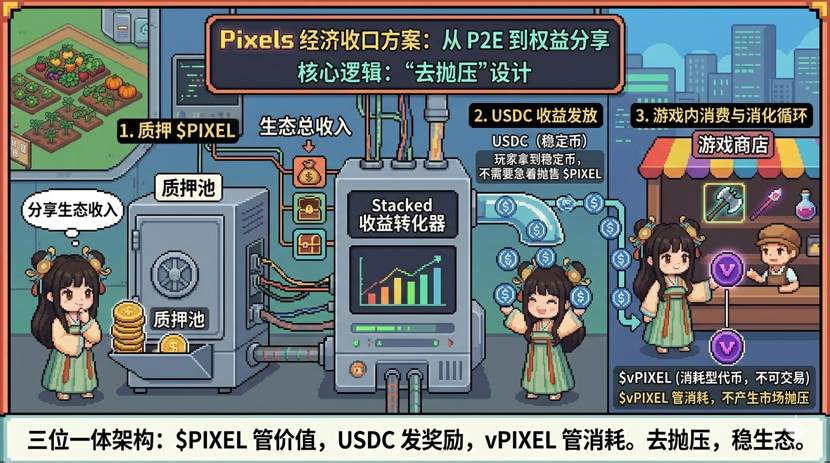
At the core mechanism level, I have to break it down. The total supply of PIXEL is 5 billion, and currently about 771 million have been unlocked, which is just over 15%. In the token distribution, ecosystem incentives account for 34%, treasury for 17%, and the team for 12.5%. This structure is considered normal in the blockchain gaming space, but the unlocking period continues until 2029, so there’s still a long time for supply release.
So what is vPIXEL? It is a non-tradable consumable token that is pegged 1:1 to PIXEL, can only be spent in-game, and cannot be transferred or sold. This might sound a bit convoluted, right? I didn’t initially understand the purpose of such a design either. But I gradually realized it’s essentially a consumption cycle. You stake PIXEL to earn rewards, which are in USDC, but if you want to spend in the game to buy items, you can use vPIXEL. Once you spend vPIXEL, it won’t be swapped back into PIXEL and dumped back into the market; instead, it gets locked within the ecosystem. On a compliance level, it's also more favorable than directly buying tokens on-chain, making it more friendly for Google Play and App Store reviews. So economically, PIXEL manages 'value storage and governance', while vPIXEL manages 'in-game consumption without creating sell pressure'. This dual-track system isn’t a first in blockchain games, but Pixels is currently the most successful example on Ronin.
Multi-game staking is also an interesting element in the PIXEL economic model. PIXEL holders can stake tokens across different sub-games like Pixels, Pixel Dungeons, Sleepagotchi, etc. The more a game is staked, the more the community perceives its value, and the project team will allocate resources accordingly. This mechanism is logically sound at least; by 2025, over 10,000 independent wallets had staked about 185 million PIXEL tokens. However, from a practical experience standpoint, the annualized returns from staking in different games vary significantly, as some games are still in the early development stage and haven’t been commercially monetized yet, leading to lower yields.
From a data perspective, daily active users grew from 45,000 in January 2026 to over 120,000 in March, a 167% increase. By March 2026, it surpassed 1 million, making it the second game on Ronin to break the million daily active users mark after Axie. But to be frank, there were also months in 2025 where activity dipped, and overall activity on the Ronin chain saw about a 70% decline in 2025. So don’t just look at the peaks; there are still structural issues with a single game propping up an entire chain.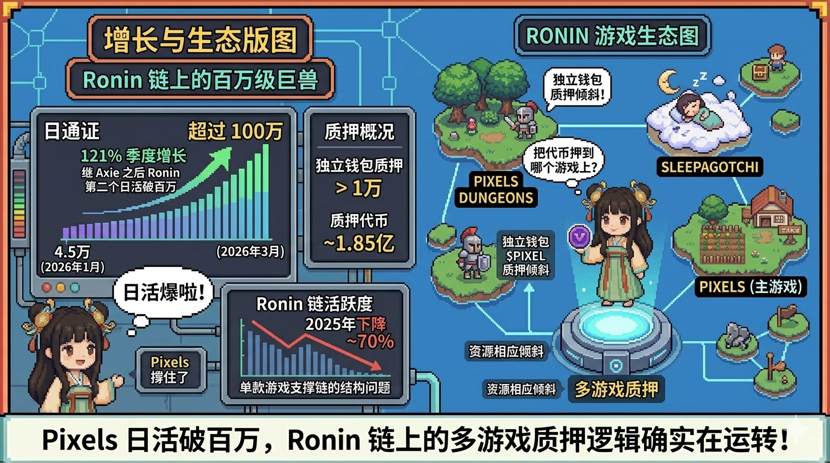
On the flip side of the coin, I have to mention a few things that make me uneasy.
The first point is that the speed of the team’s strategic shift is a bit rapid. When Stacked launched on March 26, 2026, Luke admitted that it was a soft launch, focusing first on first-party games, with other studios not onboarded for now. However, the AMA mentioned that in the future, they might engage Web2 users through Steam and mobile games, where assets are on-chain but the front end can completely hide the complexity of Web3. This shift from on-chain to partially off-chain, from P2E to Stacked, from PIXEL rewards to USDC rewards, and from external studios to initially focusing on internal projects has seen intense adjustments over the past year. While each adjustment makes sense individually, together they indicate that the team’s underlying economic model hasn’t fully solidified and is still in a state of trial and error. This means there are still significant uncertainties for holders.
The second point is that while vPIXEL is stable and designed for long-term patience, the experience for newcomers is still lacking. I brought a friend in, and he was stuck at the mine entrance for nearly half an hour not knowing how to trigger the next task, and these issues were already reported during the early launch. The project team’s improvement plan is to further reduce friction in the experience for newcomers in the first seven days and introduce a smoother onboarding process, but if these things drag on too long, it will significantly impact customer acquisition.
The third point, as mentioned earlier, is that the long tail pressure from the unlocking period is still significant. With a PIXEL supply of 5 billion, the subsequent unlocking period extends to 2029. Additionally, according to on-chain data released in April 2026, the current circulation distribution shows that ecosystem multi-signature addresses hold about 34%, and treasury multi-signature addresses hold about 17%. This is clearly different from projects purely targeting the secondary market, but it’s still difficult to accurately estimate the market absorption capacity during each unlocking event.
Currently, the known daily inflation rate for BERRY is around 2%, and the official team acknowledges this as a problem that needs to be addressed, but a complete dynamic adjustment plan has yet to be fully implemented. There was an early exchange window of 7.6175 PIXEL for 1,000 BERRY, but it hasn’t been explicitly committed to remain unchanged in the official documentation, which is a significant unknown.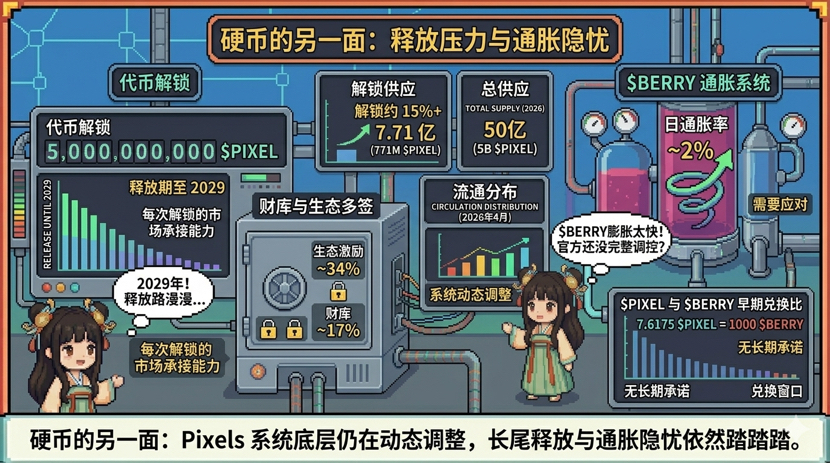
Let me share my stance.
Pixels is currently one of the few blockchain games on Ronin with daily active users reaching the million mark. In this round of adjustments from token economics to reward mechanisms, I personally believe it’s more reliable than those mindless minting P2E models. The design thought behind Stacked, vPIXEL, and USDC rewards has an internal logic.
But the question is, how fast and how far can it run? Right now, no one can say for sure. The mass onboarding of external studios has yet to be validated, and the adoption of vPIXEL will take time. The P2E concept has taken down too many projects over the past three years; whether Pixels can truly become a long-term project that separates 'play' from 'earn' and then combines them again is still up in the air, and we’re not anywhere near confirmation.
I will continue to play and monitor the data, especially focusing on the actual yield levels of additional staking pools in the next six months to a year and whether new user retention really improves. If you ask me for my judgment, I’d say it’s worth following up, especially if you plan to track the fundamental evolution of the project in the long run, but I would be quite conservative with position size and the allocation of research focus.