
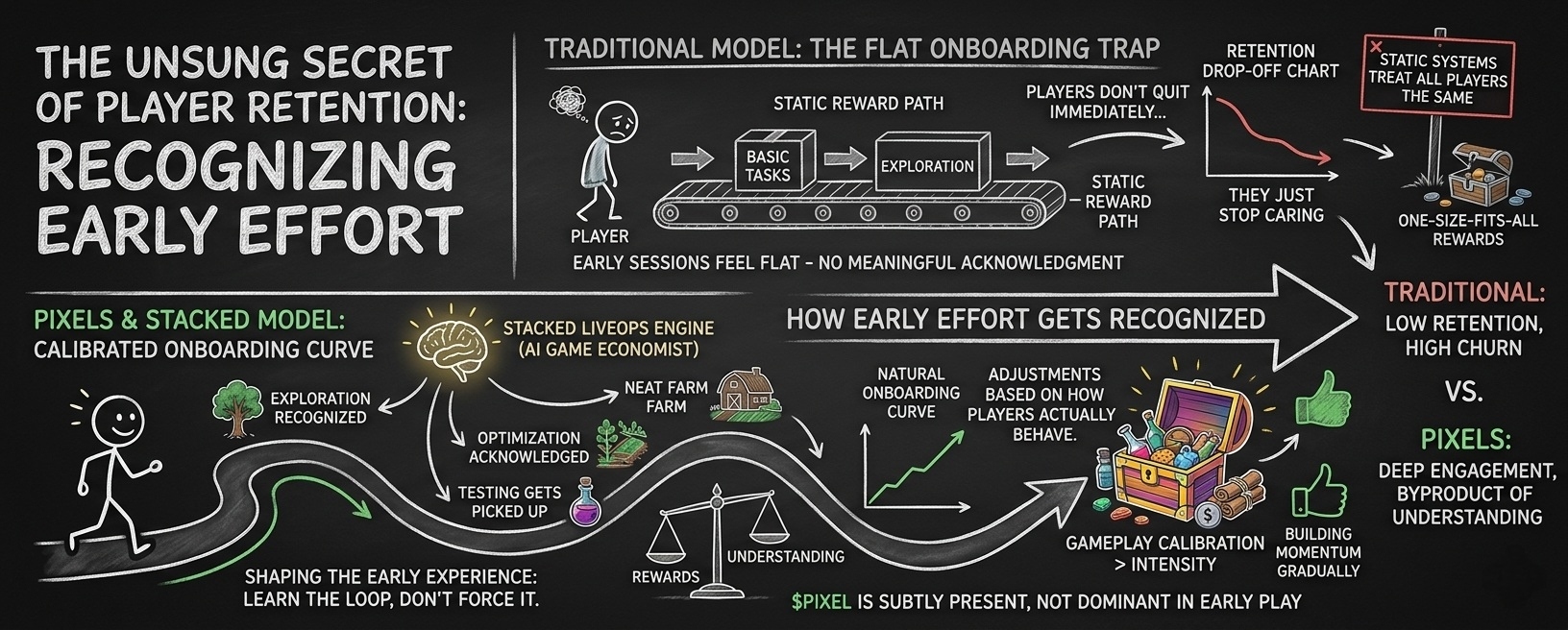
There’s a small detail in game design that most people ignore, but it usually decides whether players stay or quietly drop off: how early effort gets recognized.
In a lot of systems, the first few sessions feel flat. You do tasks, you explore, but nothing really acknowledges that initial effort in a meaningful way. Players don’t always quit immediately,they just stop caring.
Pixels handles this phase differently.
The early progression doesn’t feel overloaded with rewards, but it also doesn’t leave you guessing. There’s a sense that the system is paying attention to what you’re doing, especially in those first interactions. Not everything is rewarded, but the actions that matter seem to get picked up more consistently.
That balance is hard to get right.
If you reward too much early on, players burn through the system and lose interest. If you reward too little, they never build momentum. What Pixels seems to be doing is shaping that early experience so players gradually understand what’s valuable inside the game.
This is where Stacked plays a role in the background.
Instead of locking rewards into fixed paths, it allows adjustments based on how players actually behave during those first sessions. Different players move differently,some explore, some optimize, some just test things out. A static system treats them all the same. This one doesn’t.
Over time, that creates a more natural onboarding curve.
You’re not being forced into a loop, you’re learning it as you go. And because of that, engagement feels less like a requirement and more like a byproduct of understanding the system.
PIXEL fits into this stage in a subtle way. It’s present as part of the reward layer, but it doesn’t dominate the early experience. That probably helps keep the focus on gameplay first, instead of turning everything into a grind from the start.
What stands out here isn’t intensity, it’s calibration.
The system doesn’t rush to prove its value. It builds it gradually, through small signals that most players won’t consciously notice, but will respond to anyway.
And in games, that’s usually what makes the difference.