
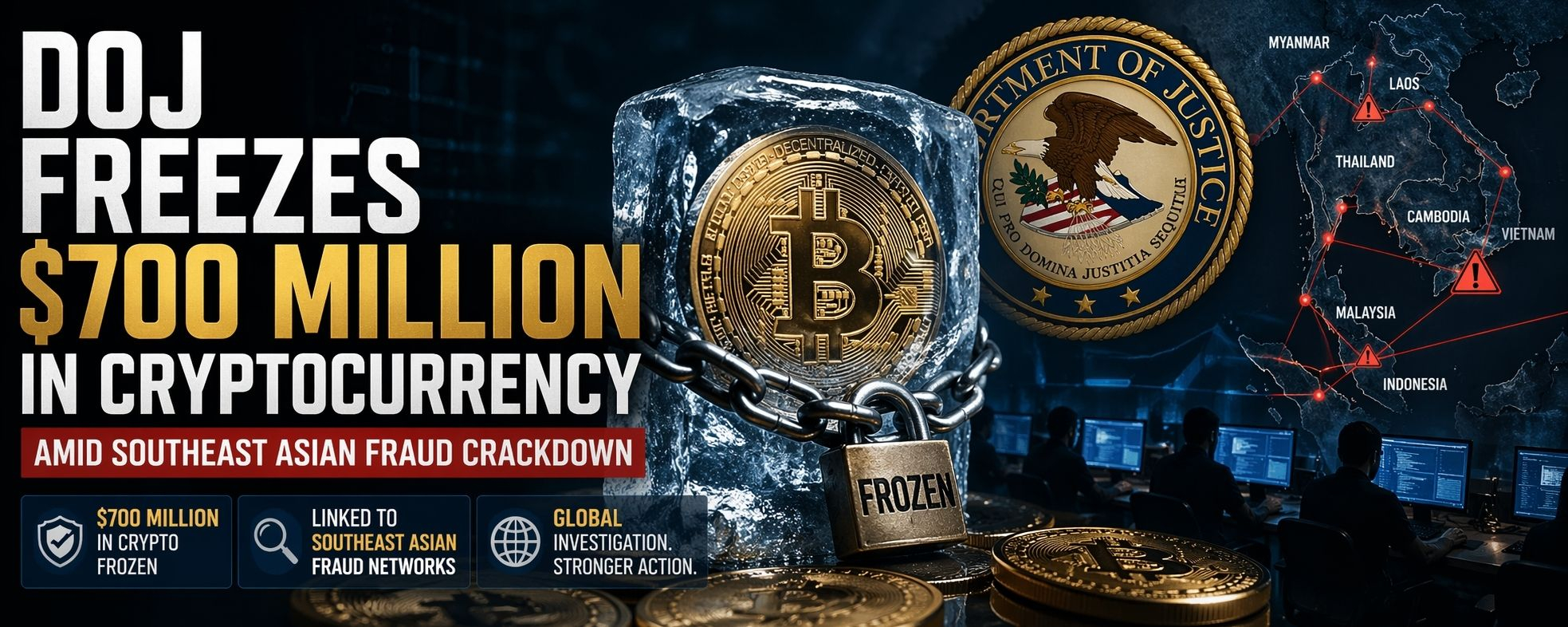

In a sweeping move that reflects the growing seriousness of crypto-related financial crime, the U.S. Department of Justice has frozen roughly $700 million in digital assets linked to a sprawling fraud network rooted in Southeast Asia. Unlike earlier enforcement actions that often focused on isolated wallets or smaller operations, this case reveals the scale at which organized groups are now operating and how deeply crypto has been integrated into their financial pipelines. The frozen funds are believed to be tied to long-running scam ecosystems that blend social engineering, fake investment platforms, and coordinated laundering strategies designed to exploit both technology and human behavior.
What stands out in this case is not just the amount, but the structure behind it. These weren’t random scams operating independently; they functioned more like structured enterprises, with defined roles, scripted victim engagement processes, and financial routing systems optimized for speed and anonymity. Victims were often approached through messaging platforms, where scammers built trust over weeks or even months before introducing crypto investment opportunities. The platforms used appeared polished and credible, often mimicking legitimate exchanges or trading dashboards. Once funds were deposited, however, control shifted entirely to the fraud operators, and withdrawal requests were either blocked or manipulated to extract even more money.
The Southeast Asian connection is significant, as the region has increasingly been identified as a hub for large-scale scam compounds. These operations often rely on a mix of voluntary participants and trafficked individuals forced into scam labor, adding another layer of complexity to enforcement efforts. The funds generated from these activities are rapidly moved through a web of wallets, converted across multiple blockchains, and sometimes funneled into decentralized finance protocols to further obscure their origin. This level of coordination makes traditional financial surveillance methods ineffective, forcing authorities to adapt.
That adaptation is now clearly visible. The DOJ’s action demonstrates how blockchain transparency once seen as a loophole for anonymity is becoming a powerful investigative tool. By analyzing transaction flows, clustering wallet behavior, and identifying repeat patterns, investigators were able to reconstruct the movement of funds across networks. This allowed them to intervene not at the entry or exit points alone, but at critical junctions within the laundering chain. Freezing assets at this scale requires precision, and it suggests a level of technical capability that is rapidly catching up to the complexity of these fraud systems.
Beyond enforcement, the broader implication is a shift in how crypto crime is being treated globally. This is no longer viewed as a niche or emerging issue it is now a central concern in financial regulation and international cooperation. Agencies are increasingly sharing intelligence, aligning legal frameworks, and investing in specialized tools to track digital assets in real time. For the crypto industry, this creates a more defined operating environment. While some may see it as increased pressure, it also reduces systemic risk by targeting the actors that erode trust in the ecosystem.
For users, the takeaway is more grounded. The mechanics of these scams are evolving, but the entry point remains human vulnerability trust, curiosity, and the appeal of easy returns. No level of blockchain innovation can fully protect against that. Awareness, skepticism, and basic verification remain the first line of defense.
In many ways, the $700 million freeze represents more than just a successful operation. It marks a moment where enforcement, technology, and global coordination are beginning to align. Crypto may still be a rapidly evolving space, but it is no longer operating in the shadows and actions like this make that increasingly clear.