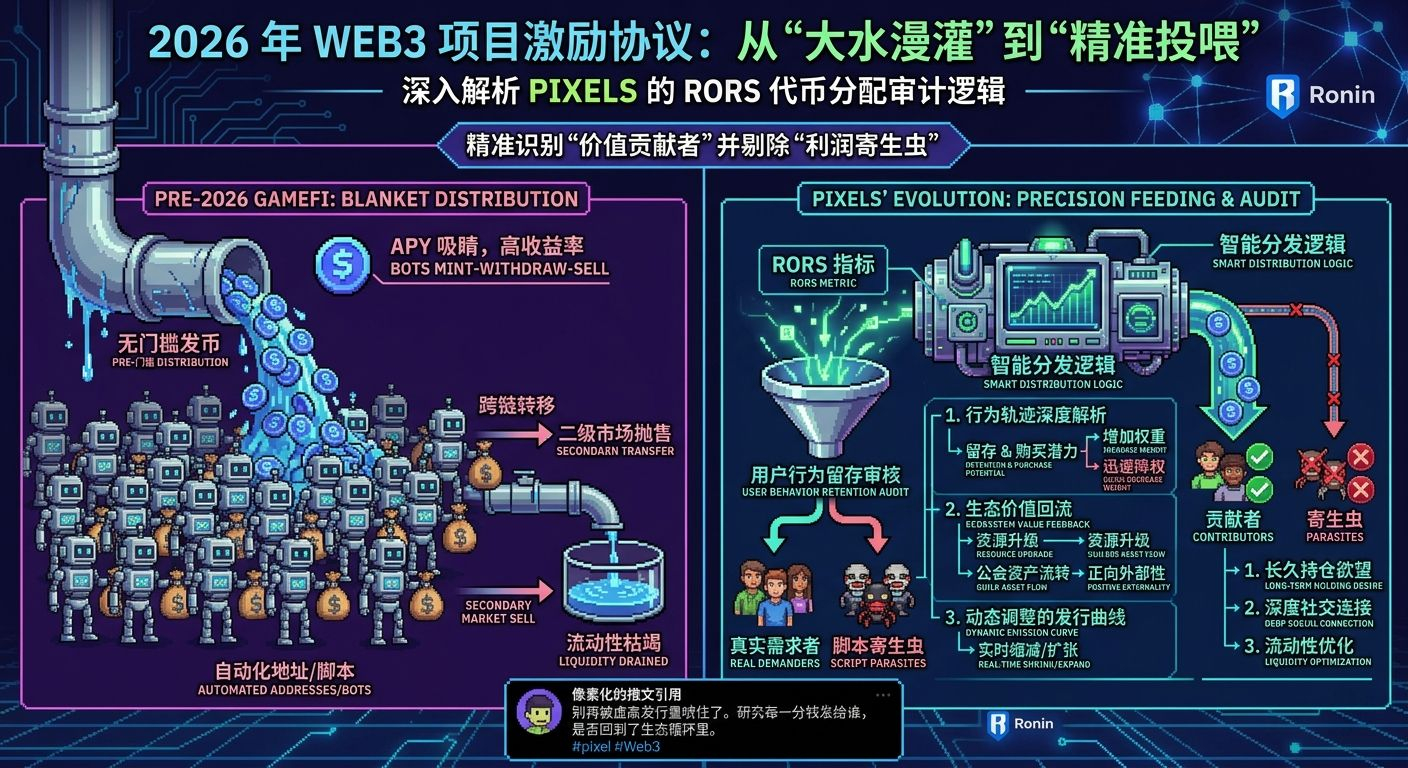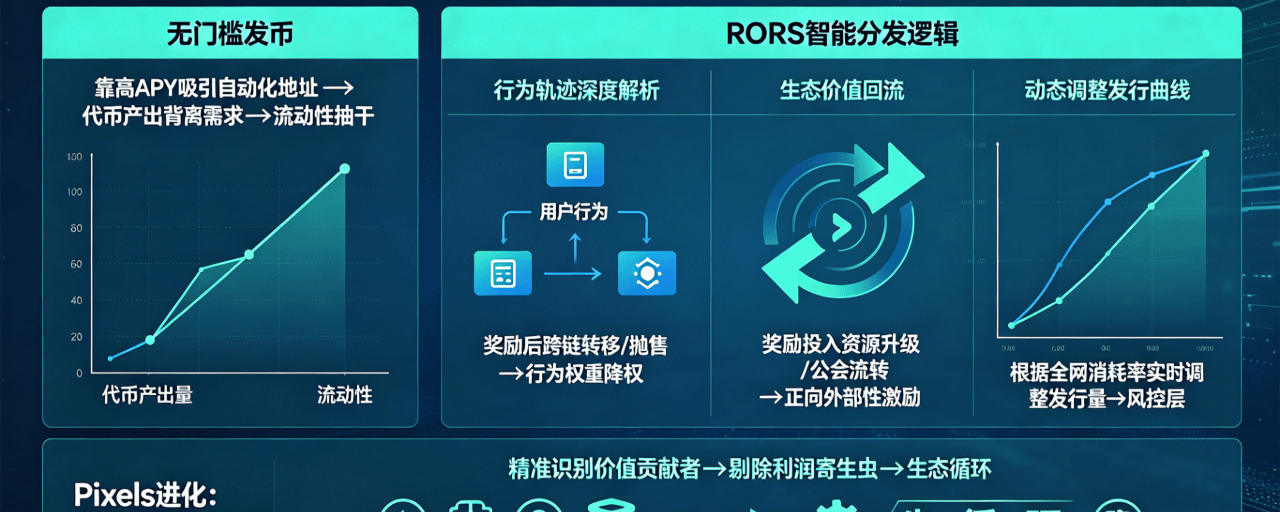

In the year 2026, in this efficiency-driven market, if a Web3 project is still relying on 'no-barrier token issuance' to maintain appearances, its valuation logic in the secondary market has basically hit zero. We've seen too many GameFi disasters: initially attracting attention with high yields (APY), only to end up with a bunch of automated addresses that just 'mine, withdraw, and sell', ultimately causing the token issuance to diverge severely from real system demand, with liquidity being sucked out in an instant.
The root of this collapse lies in the misalignment of distribution logic.
Most projects view token issuance as a 'sunk cost', thinking that as long as the address count goes up, the system is successful. But in Pixels' current operational logic, every token $PIXEL

Outflows are assigned extremely strict audit properties. Here, we need to focus on the RORS metric they proposed.
In traditional crypto incentive models, rewards are given for 'actions'—as long as you clicked on a contract or completed a task, tokens automatically flow into your wallet. The biggest flaw in this model is that it can't distinguish whether the action comes from a genuine user or a script aimed at draining the treasury.
@Pixels The Pixels team, by deploying this smart distribution logic, has transformed rewards from 'marketing expenses' into 'capital allocation':
A deep analysis of behavioral trajectories means the system no longer cares if you completed a task but focuses on your behavioral retention after receiving rewards. If you immediately transfer tokens across chains or sell them on secondary markets, your behavior weight will be rapidly downgraded in the background.
The return of ecological value means that true incentives will be geared towards addresses that generate 'positive externalities'. For instance, are the rewards you received reinvested into system resource upgrades? Are they involved in asset circulation between guilds?
The dynamically adjusted issuance curve, through this feedback mechanism, means the issuance volume is no longer a fixed constant slope written in the white paper, but is adjusted in real-time based on the actual consumption rate across the network.
This approach essentially adds a layer of risk control to the tokens.
It turns $PIXEL into a 'measuring stick' for evaluating user quality. When this system identifies an interaction path with high stickiness and spending potential, it amplifies that path's reward weight through the RORS algorithm. This not only prevents cheating but also conducts a large-scale liquidity optimization.
To put it simply, the reason Pixels can thrive on the Ronin chain is that it has evolved from a simple pixel game into a self-purifying incentive protocol. It proves that in the Web3 world of 2026, protocols that can accurately identify 'value contributors' and weed out 'profit parasites' will have true vitality.
Don't be fooled by those inflated total issuance numbers. Study who exactly receives every cent in this system and whether that money eventually cycles back into the ecosystem. Only when issued rewards can lead to a longer-term holding desire and deeper social connections can this economic model truly escape the shadow of a Ponzi scheme.
At this crossroads, those who can't grasp the logic shift from 'flooding the market' to 'precision feeding' are doomed to hop around in the fog of garbage data. 🙄 #pixel