
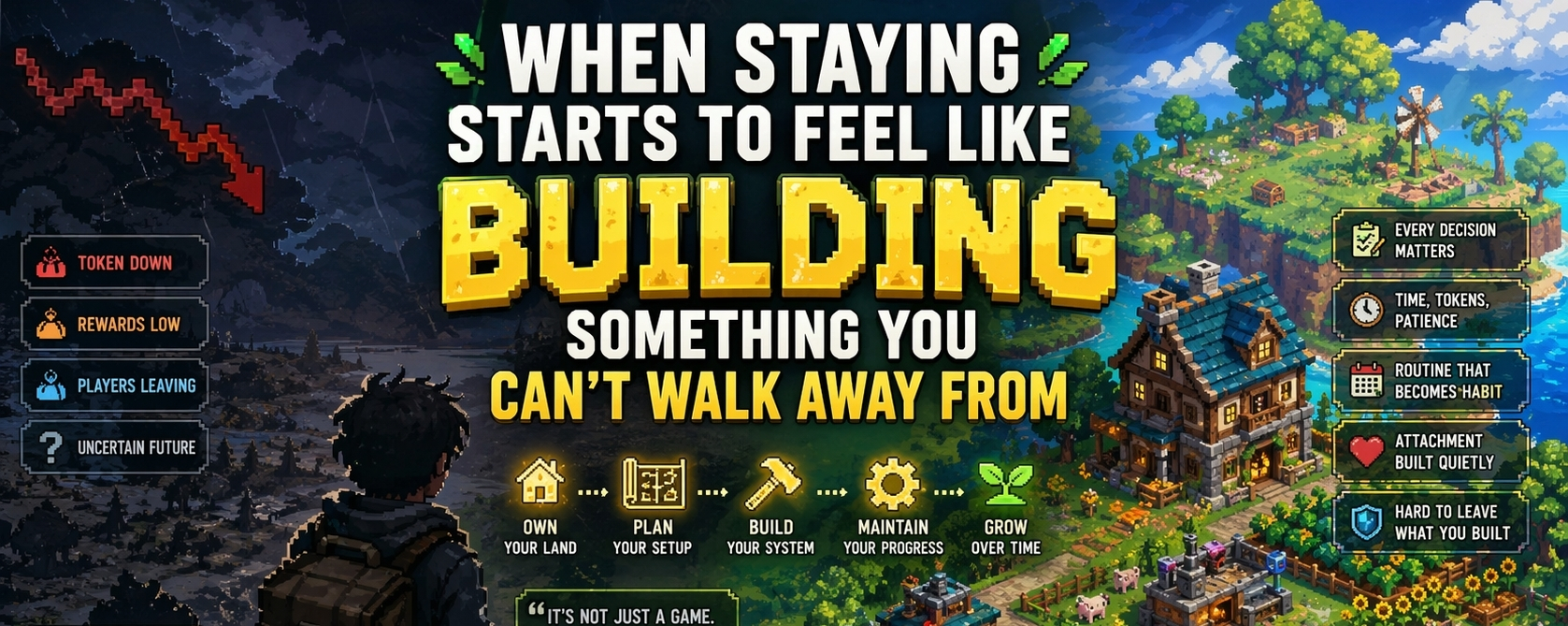
I didn’t step into Pixels at the “right” time, at least not by the usual logic people follow in web3 games. The token was already slipping, rewards from farming were thinning out, and everything I had seen in other ecosystems suggested one simple rule: wait it out or don’t enter at all. But I still went ahead and bought land, almost casually, telling myself it was just to understand how things worked from the inside. I thought it would stay small, something I’d test and maybe leave behind. What I didn’t expect was how quietly that one decision would start reshaping the way I experienced the entire game.
Owning land didn’t feel like unlocking profit, it felt like taking on something that needed attention. The moment it was mine, the game stopped being a repetitive loop and started becoming a system I had to think about. I wasn’t just planting and harvesting anymore, I was arranging space, planning production, deciding what made sense to build and when to upgrade. Every change required time, tokens, and patience, and over time those small decisions began stacking into something that felt structured, almost like a living setup that depended on me to keep it running. It wasn’t perfect, and honestly it still isn’t, but that’s what made it feel real.
As weeks turned into months, I realized the hardest part wasn’t building the land, it was the way it slowly anchored me. I started knowing everything about it without thinking. Where things were placed, when crops would be ready, how long production cycles took, what needed to be adjusted next. That familiarity doesn’t come instantly, it grows with repetition, and once it settles in, leaving feels different. It’s not about losing money at that point, it’s about stepping away from something you’ve spent time understanding and shaping. That’s where Pixels quietly changes its tone, because the attachment doesn’t announce itself, it just builds in the background.
Technically, land is optional in the game. You can participate without ever owning it, and for a while that feels true. But the longer you stay, the more it starts to feel like you’re only seeing part of the experience. There’s this subtle pull, not aggressive, not forced, but always present, suggesting that the deeper layer of the game exists on the other side of ownership. And once you cross into that layer, your role shifts. You’re no longer just a player moving through tasks, you’re someone maintaining progress, holding onto something that doesn’t run the same way without you.
Then came the phase where things got harder. The token dropped further, rewards slowed down even more, and the overall energy of the game shifted. You could feel people questioning whether it was still worth it. New players didn’t stick around as much, casual ones disappeared, and activity started thinning in a way that was hard to ignore. But strangely, many of the players who had built something didn’t leave. They stayed, even if they were quieter about it. And I think the reason is simple, even if it doesn’t feel obvious at first. When you haven’t invested much, walking away is easy. But when you’ve spent months building, adjusting, learning, and creating a routine, leaving starts to feel like giving something up that isn’t easy to replace. #pixel
So you stay, not always because it’s profitable, but because it feels incomplete to stop. You log in, take care of what needs to be done, make small improvements, and tell yourself you’ll decide later what it all means. That’s where the line starts to blur. Is it enjoyment that keeps you here, or is it the weight of what you’ve already put in? Pixels doesn’t really force an answer. It just creates a space where both feelings exist together, where building something over time naturally makes it harder to step away, even when conditions aren’t ideal. $PIXEL
Right now, I’m still part of it. My land is running, slowly evolving, still far from perfect but steady in its own way. I still check in, still think about what could be better, still make small changes that probably don’t matter to anyone else but feel important to me. And I can’t say with complete certainty why I’m still here. Maybe I genuinely enjoy the process, or maybe I’ve crossed a point where leaving feels heavier than staying. At some stage, those two reasons stop feeling separate, and that’s where the experience becomes something more than just a game. @Pixels