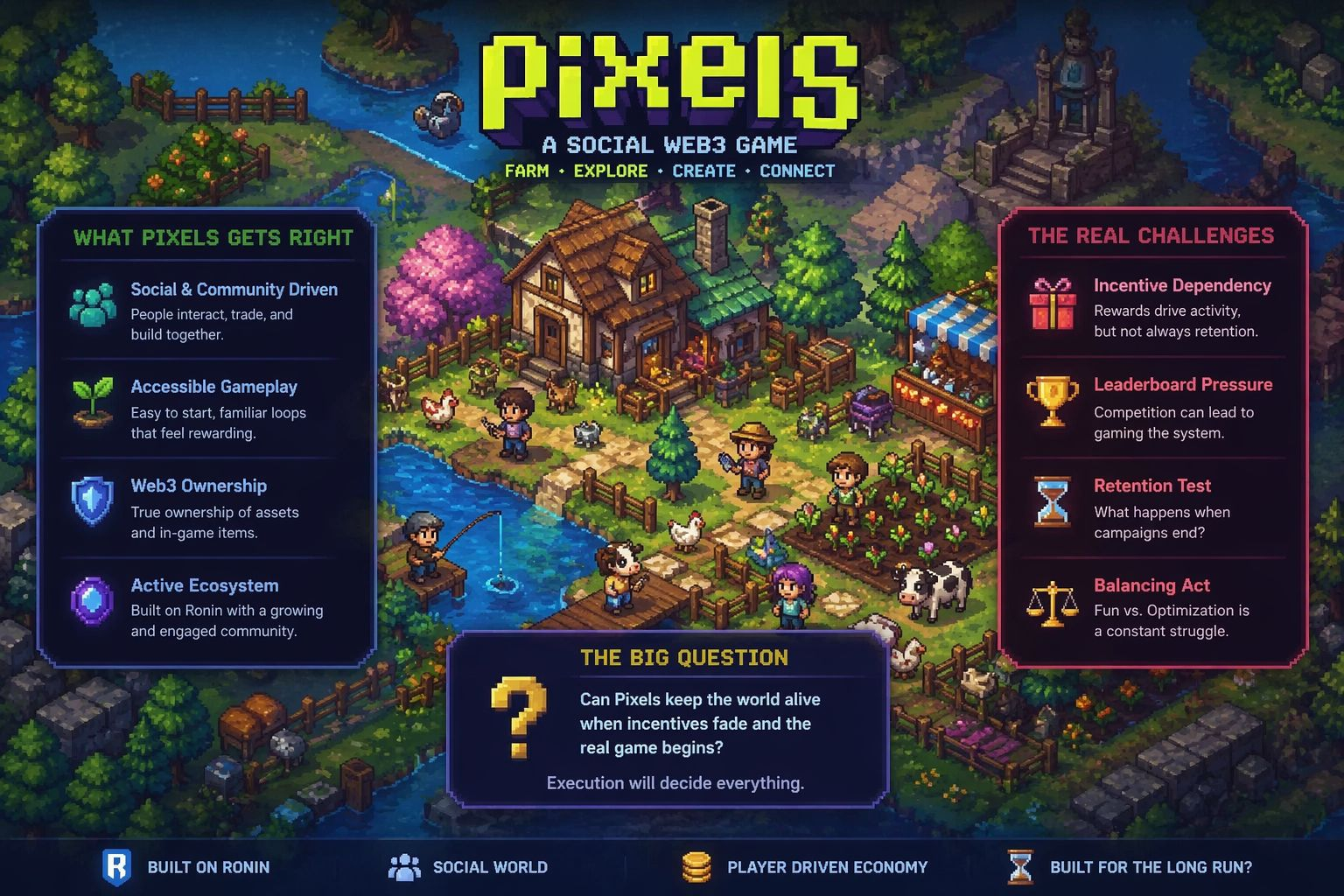
I’ve been noticing Pixels more often than I expected, and not in the loud, overpromising way that usually comes with crypto games. It keeps showing up in conversations that sound half curious and half cautious, which is usually the more interesting signal anyway. A social casual Web3 game on Ronin, built around farming, exploration, and creation, sounds easy to understand at first. But reality is different, especially in a space where “easy to understand” often hides the hardest problems.
What catches my attention is not the theme itself. Farming games are familiar. Open worlds are familiar. Social layers are familiar. What matters is whether the project can make all of that feel alive without turning into a grind loop dressed up as community. That’s where things get interesting. In crypto, a lot of games can explain themselves in one clean sentence, and then fall apart the moment you ask what keeps people around after the novelty wears off. Pixels has been living in that tension for a while now. It sits right in the middle of a problem the whole industry still refuses to solve cleanly: how do you make a game that is actually a game, while also carrying the weight of token incentives, ownership, social retention, and infrastructure?
I keep coming back to this idea because it shows up everywhere in Web3. The pitch is almost always elegant. The execution is almost always messy. A leaderboard campaign sounds simple on paper. People compete, activity rises, attention concentrates, and the ecosystem gets a fresh wave of energy. But reality is different. Leaderboards in crypto rarely measure pure engagement. They measure strategy, optimization, budget discipline, timing, and sometimes the ability to exploit the shape of the system better than everyone else. That does not make them useless. It just means they reveal a project’s design more honestly than the marketing does.And 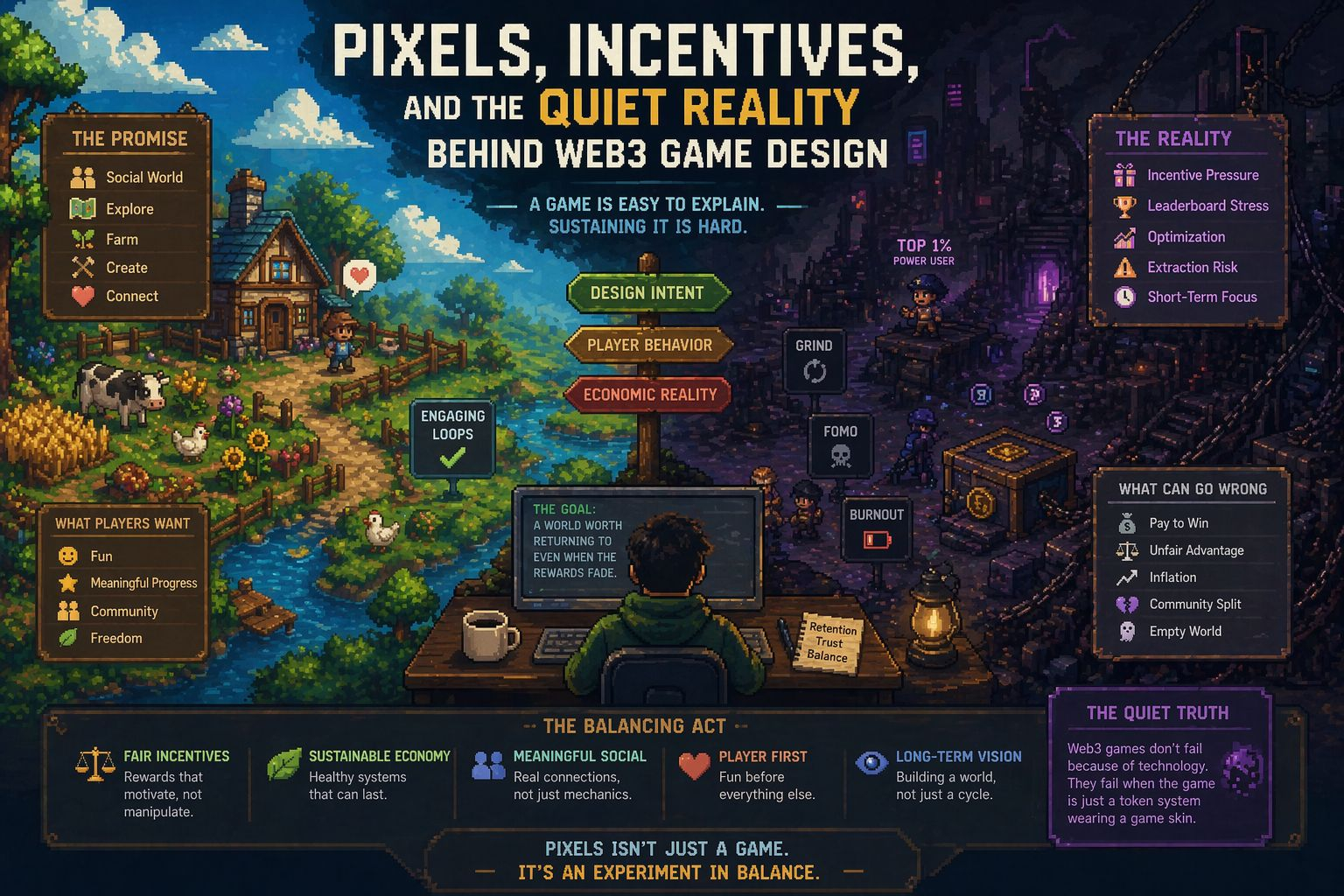 with Pixels, I think that honesty is the point. The project is not pretending to be something abstract or overly technical. It is leaning into a world where users do things, not just hold things. That matters because the industry has spent years trying to convince itself that ownership alone is enough to create a durable ecosystem. It is not. People still need reasons to log in, return, build habits, and feel that their time has some meaning inside the system. In a game like this, the user experience becomes the real chain, the real protocol, the real product. If the loop is weak, the token story will not save it. If the loop is strong, the token becomes a detail instead of the whole argument.
I’m not fully convinced yet by the broader category of Web3 games, and I say that as someone who still watches them closely. Too many of them start with token design and end with entertainment as an afterthought. Too many confuse activity with loyalty. Too many believe that a leaderboard can substitute for a world. Pixels at least feels like it understands the difference between surface-level participation and deeper retention. Still, understanding the difference is not the same as solving it. Execution will decide everything. That line applies more here than anywhere else.
There is also the matter of Ronin, which matters more than people outside the space sometimes admit. Infrastructure is never just background noise in crypto. It shapes who arrives, how they move, what they can afford to do, and how much friction they tolerate before leaving. Ronin has its own reputation and its own audience, and that brings both advantages and constraints. On one hand, there is already a kind of native familiarity. On the other hand, every chain-associated ecosystem inherits the burden of proving that it is not just internally coherent, but externally relevant. A game can be loved by a core community and still struggle to break out. That is not a failure of passion. It is a limitation of distribution, design, and timing.
This is where it gets complicated. The industry likes to talk about interoperability, composability, and user ownership as if those words automatically improve retention. They do not. Most people do not wake up wanting a composable gaming economy. They want something that feels worth their time. They want a reason to care about their progress without feeling trapped by a system that is constantly extracting attention. The best projects in this space are not the ones shouting the loudest about decentralization. They are the ones that quietly absorb the complexity and make the experience feel lighter on the surface. That is a much harder job.
When I look at Pixels, I think about the trade-offs in every layer. If the game is too generous, the economy becomes unstable and the incentives get distorted. If it is too strict, users feel boxed in and the world becomes sterile. If social mechanics are too shallow, the game becomes a checklist. If they are too deep, onboarding suffers and the whole thing gets smaller than it should be. Real systems don’t work in extremes. They survive in compromise. That is not as exciting as the hype cycle likes to pretend, but it is usually more accurate.
There is also the privacy angle, which people in gaming and crypto both like to underthink. Any social system that tracks behavior, reward flows, progression, and wallet-linked activity is sitting on a lot of sensitive structure, even if it does not feel sensitive at first glance. The moment a project starts tying reputation, access, or scarcity to onchain behavior, it has to think carefully about what is exposed, what is inferred, and what persists. In traditional games, users already accept a lot of telemetry without reading the fine print. In Web3, the difference is that more of the system is visible, permanent, and socially legible. That changes the stakes. It also changes the design problem.
I keep seeing people describe projects like Pixels in terms of “adoption,” but that word gets flattened so quickly it almost stops meaning anything. Adoption by whom? For what kind of behavior? For how long? A leaderboard campaign can bring volume, but volume is not always depth. It can tell you the system is capable of attracting attention, but not always capable of earning trust. And trust is the real currency here, even if the market keeps pretending otherwise. Once users believe a project’s incentives are fair, readable, and not entirely manipulated by insiders or power users, they behave differently. They linger longer. They complain less. They tolerate rough edges. That kind of trust is rare, and hard to rebuild once lost.
That is why I am watching this kind of campaign with a mixed feeling. Part of me likes the clarity of it. A leaderboard is brutally honest. It says who showed up, who stayed active, and who understood the game of participation. But another part of me knows how easily these systems become self-referential. The people already inside the ecosystem learn how to optimize, outsiders see a wall of jargon and competition, and the gap between core users and everyone else gets wider. In crypto, that gap often becomes a moat. In gaming, it can become a ceiling.
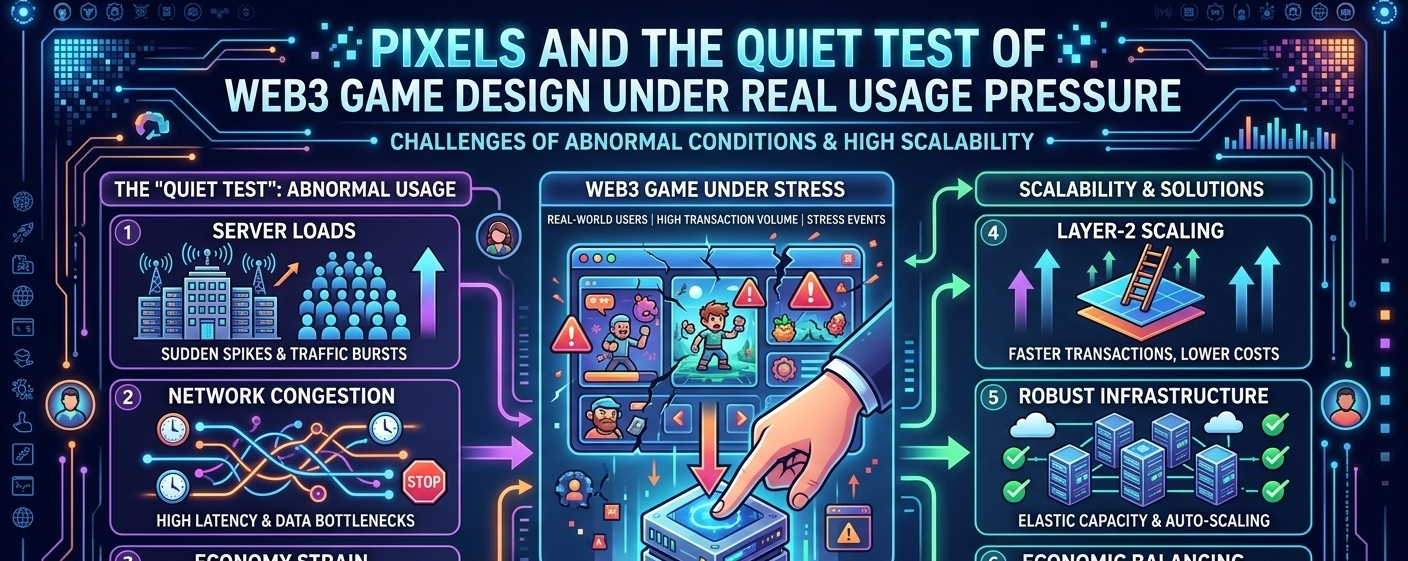
Still, I would rather watch a project like Pixels wrestle with real usage than a thousand polished slides about the future of digital ownership. At least here there is something concrete to inspect: how the game behaves under pressure, how the community responds when incentives shift, how quickly the experience turns from novelty into routine. Those are the questions that matter. Not whether the branding sounds futuristic. Not whether the pitch fits neatly into a thread. Whether people return tomorrow, and then the next day, and whether they still feel that the system gave them something worth the time.
At the end of the day, I think that is the real test for any project in this category. Not whether it can make a splash, but whether it can hold a rhythm. Not whether it can attract attention once, but whether it can survive the moment when attention becomes familiar and the easy excitement fades. Pixels feels like one of those projects that knows the space well enough to avoid the most obvious mistakes, but not so much that I would call the outcome settled. I’m not fully convinced yet, and maybe that is the right position to hold. The best projects in crypto rarely announce themselves as finished. They reveal themselves through repetition, friction, and the small decisions that only become visible when the crowd stops looking at the headline and starts using the thing.