
Let’s be real for a second most people coming into Web3 still think like it’s 2019. Stake your tokens, earn some yield, sit back, watch numbers go up. Easy, right?
Yeah… not anymore.
Something’s shifting, and a lot of people haven’t caught up yet. Games like Pixels are quietly flipping the script. Tokens aren’t just something you park and farm rewards from. They’re turning into access passes, power tools, social badges all rolled into one. And if you’re still treating them like a savings account, you’re probably missing the whole point.
Here’s the thing: this isn’t just about gaming. It’s about how digital economies are evolving. Who gets access. Who gets influence. Who even gets to play the real game behind the game.
And honestly? Most people are still playing the old one.
If you rewind a bit, the early Web3 gaming scene was pretty straightforward. Play-to-earn exploded, and yeah, it was exciting. People were making real money just by playing games. That wasn’t nothing.
I’ve seen this up close. Entire communities jumped in because the income actually mattered. For some people, it beat their day job.
But the model had cracks. Big ones.
Most of those systems worked like a funnel. New players came in, money flowed through, early players cashed out. Tokens kept getting printed, but there wasn’t much reason to spend them inside the game. So what did people do? They sold. Of course they did.
And once the inflow slowed down… everything started falling apart.
Prices dropped. Incentives disappeared. Players left.
You’ve seen this story before.
So developers tried to fix it. They added “utility.” Token sinks. Crafting, upgrades, little in-game purchases. Spend tokens here, burn some there.
It helped. Kind of.
But let’s be honest it still felt forced. Like the game was nudging you: “Hey, please spend your tokens so this economy doesn’t collapse.”
That’s not exactly inspiring gameplay.
Now fast forward to what’s happening in ecosystems like Pixels.
This is where things get interesting.
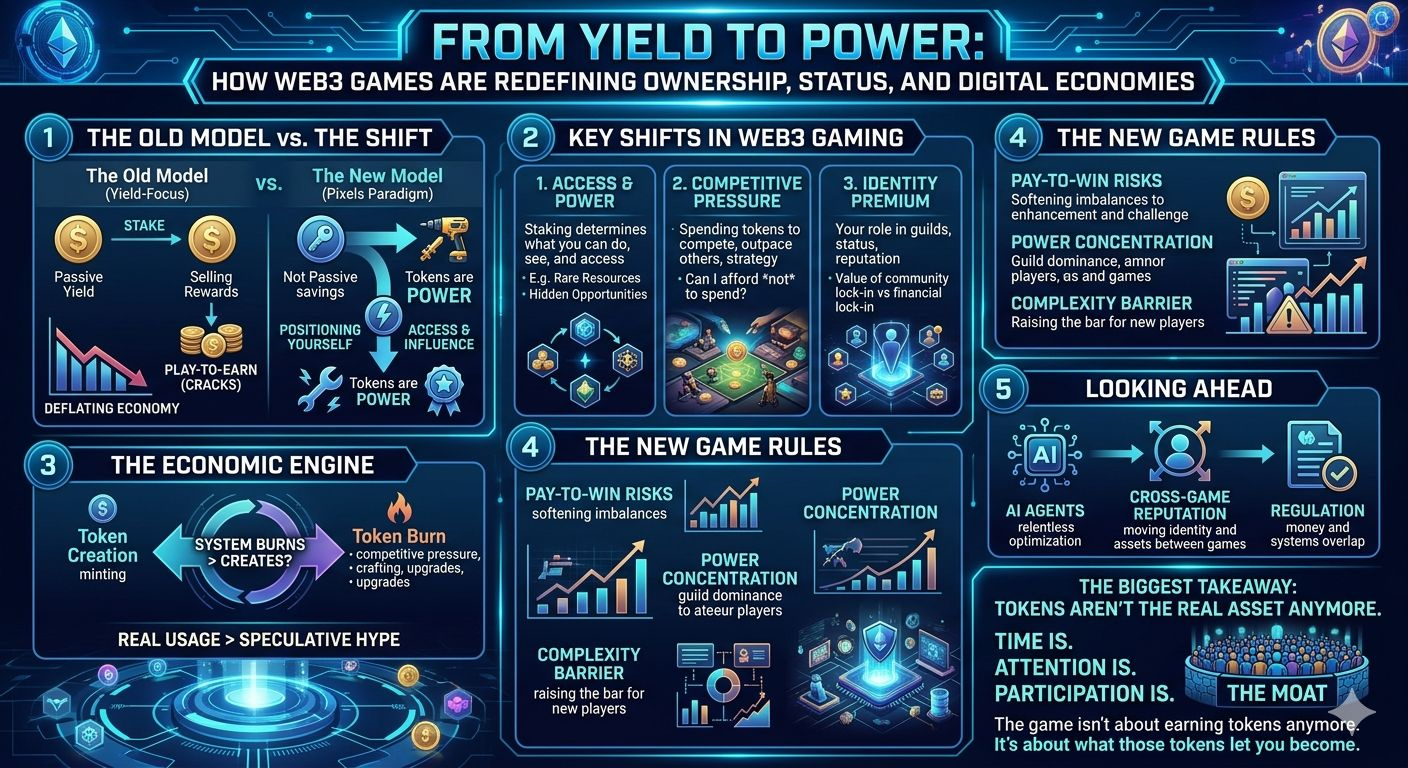
They didn’t just tweak the system they changed the role of the token entirely. Staking $PIXEL isn’t about yield in the traditional sense. It’s not “lock this, earn that.” That mindset doesn’t really apply anymore.
It’s more like… positioning yourself.
Your stake determines what you can actually do in the game. Not just how much you earn, but what you can access. What you can see. Who you can compete with.
That’s a big shift.
Because now staking affects things like:
Whether you can access rare resources
Whether you even see certain opportunities
How much influence you have in your guild
Whether you’re relevant in competitive play
Read that again. It’s not passive anymore.
You’re either in the system… or you’re on the edge of it.
And yeah, this part makes some people uncomfortable.
Because it means holding tokens isn’t enough. Not even close.
If you’re not actively staking, engaging, competing you start fading into the background. You get less access. Fewer opportunities. Lower visibility.
It’s subtle at first. Then it’s not.
That’s where a lot of people get caught off guard. They think they’re “early” because they hold tokens, but the system doesn’t really reward that anymore.
It rewards participation.
Now let’s talk about spending, because this is another piece people misunderstand.
Old model: spend tokens because the game tells you to.
New model: spend tokens because other players are forcing your hand.
That’s a completely different dynamic.
In Pixels, you burn tokens to move faster, recover energy, upgrade assets, win conflicts. Not because the game says “you must,” but because if you don’t, someone else will outpace you.
It’s competitive pressure.
And that changes everything.
Spending becomes strategy.
You’re not asking, “Do I need to spend?”
You’re asking, “Can I afford not to?”
Quick tangent but it matters.
This is why token burn suddenly becomes a big deal again. Not in theory, but in practice. If players are constantly burning tokens to stay competitive, you get real demand. Not fake demand. Not speculative hype.
Actual usage.
So now the key question shifts. It’s not “what’s the APY?” honestly, that’s almost irrelevant now.
The real question is:
Is the system burning more tokens than it’s creating?
If yes, you’ve got something sustainable.
If not… well, we’ve seen how that ends.
Alright, let’s zoom out a bit.
Because the social layer? People don’t talk about this enough.
Guilds in these systems aren’t just for chatting or casual teamwork. They’re economic machines. Coordinated groups that control resources, share strategies, and push each other forward.
And once you’re in one really in one you start to feel it.
You’re not just playing a game anymore. You’re part of a network. You’ve got roles, responsibilities, inside jokes, rivalries.
Sounds small, but it’s not.
Because now leaving the game isn’t just “sell tokens and move on.” You’re walking away from relationships, status, maybe even a reputation you spent months building.
That’s a different kind of lock-in.
Way stronger than any financial incentive.
This is where the idea of “identity premium” comes in, even if people don’t call it that.
Your stake, your activity, your role in a guild it all builds your identity inside the ecosystem. And that identity has value. Real value.
Some players aren’t just rich in tokens. They’re influential. Recognized. Trusted.
You can’t just buy that overnight.
Now, let’s not pretend this model is perfect. It’s not.
There are some real issues here.
First one? Yeah pay-to-win vibes.
If staking determines access and influence, then bigger players can dominate. That’s just reality. You can design around it, soften it, but you can’t fully remove it.
Second problem power concentration.
Big guilds get bigger. Strong players get stronger. Sometimes the gap becomes hard to close.
And then there’s complexity.
New players come in and go, “Wait… I have to stake, join a guild, manage resources, compete for access?” It’s a lot. Not everyone sticks around long enough to figure it out.
So yeah, this model raises the bar.
Still, the upside is hard to ignore.
You get stronger economies. Real demand. Deeper engagement. Systems where players actually care about what happens next.
Not because of hype but because they’re involved.
That’s rare.
Looking ahead, things are only getting more intense.
AI agents are starting to show up. And they don’t sleep. They optimize strategies, farm efficiently, react faster than humans. That’s going to push competition even further.
Then you’ve got cross-game ecosystems on the horizon. Imagine your assets, your reputation, your identity moving between games. Suddenly staking isn’t just about one world it’s about your position across multiple ones.
And yeah, regulation will eventually step in. It always does when money and systems start overlapping like this.
So… will “staking for privileges” become the standard?
Honestly? It’s heading that way.
It makes sense. It aligns incentives. It rewards commitment. It filters out passive noise.
But it has to be designed carefully. Too much imbalance, and people quit. Too much complexity, and people never start.
There’s a sweet spot. Not everyone will find it.
If you strip everything down, the biggest takeaway is pretty simple.
Tokens aren’t the real asset anymore.
Time is.
Attention is.
Participation is.
You can mint tokens. You can burn tokens. You can fork code.
But you can’t fake a community that actually shows up every day, coordinates, competes, argues, wins, loses… and keeps going.
That’s the moat.
So yeah, if you’re still looking at $PIXEL or any similar system and thinking in terms of “yield”…
You might want to rethink that.
Because the game isn’t about earning tokens anymore.
It’s about what those tokens let you become.