
The first time I checked my wallet after playing Pixels for a few weeks, I wasn’t looking for anything special. I just wanted to see what was there. A pet. A small piece of land. A couple of items I had almost forgotten about. And I remember pausing for a second.
They weren’t sitting inside the game interface. They were sitting in my wallet.
That felt different.
At the beginning, Pixels felt like any other online game. You log in, plant, harvest, maybe trade a little. It’s light. Social. Nothing too serious. If I got bored, I could always close the tab and come back later. That’s how most games work. They live on a server somewhere, and when you leave, they stay there. You don’t really “own” anything. You just borrow access.
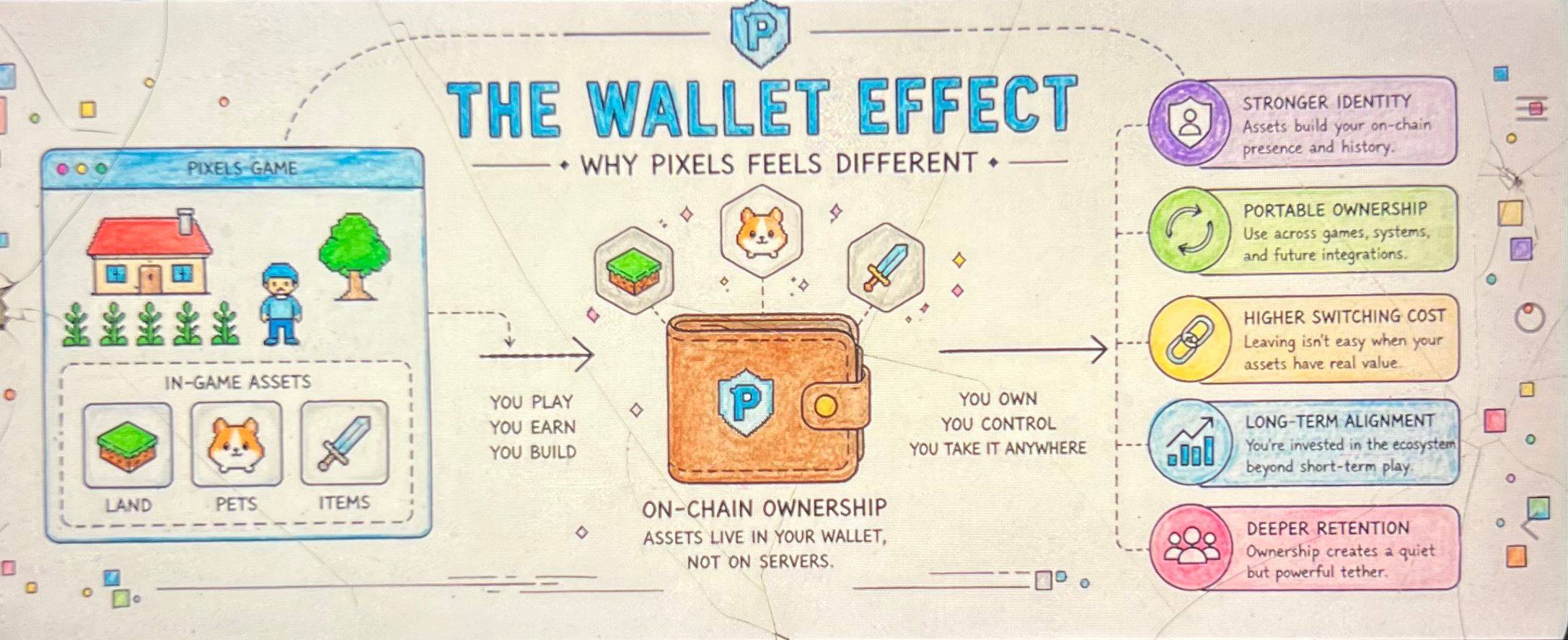
But with Pixels, I started noticing something subtle. The land I bought wasn’t just an in-game unlock. The pet I minted wasn’t just a character model. Technically, they lived in my wallet. That means they existed independently from the game client. If the interface changed tomorrow, or even if the servers went offline, the NFT would still be there.
That idea sat with me longer than I expected.
On paper, on-chain ownership sounds simple. You own the asset. You can trade it. You can move it. It’s portable. But when you actually experience it, it shifts your relationship with the game. It started feeling less like I was just spending time, and more like I was placing pieces somewhere semi-permanent.
Not permanent in value. That’s a different question. But permanent in existence.
I noticed something else too. It quietly changed my behavior. When assets live only inside a game, walking away is easy. You uninstall, and that’s it. But when they live in your wallet, there’s a lingering presence. Even if you stop playing, you still see them when you open your wallet. They become part of your broader digital footprint.
That creates a kind of psychological weight.
It’s not dramatic. It’s subtle. But it’s there.
I started thinking about switching costs. In traditional games, the cost of leaving is mostly emotional. You lose progress, maybe some skins, but they vanish with the account. Here, the cost isn’t just emotional. It’s economic. Even if the asset value fluctuates, it represents something tangible. Something you chose to acquire.
That changes retention in a quiet way.
It’s not that Pixels forces you to stay. It doesn’t. But ownership creates a tether. A soft one. The more assets you accumulate, the more connected you feel to the system. And because those assets are on-chain, they aren’t locked to one specific version of the game. In theory, they could be integrated into other experiences within the same ecosystem.
That’s where it gets interesting.
If ownership is portable, then identity becomes portable too. Your land, your pets, your history — they’re tied to your wallet address, not just your username. That creates continuity across expansions. Across new modes. Across whatever they build next.
I didn’t fully appreciate that at first.
Most Web2 games rely on engagement loops to keep you inside. Daily rewards. Limited-time events. Fear of missing out. Pixels has those too. But underneath, there’s another layer: asset anchoring. When you own a piece of the world, even digitally, it alters your sense of participation.
I’ve also been cautious about it.
Because ownership cuts both ways. If the ecosystem thrives, the assets may gain utility and maybe value. If it weakens, you still hold them. An NFT in a quiet ecosystem is still just an NFT. The market doesn’t owe it relevance.
That’s the part people don’t always sit with long enough.
I found myself asking: am I staying because I enjoy the game, or because I now feel economically tied to it? And maybe the answer is both. Which is probably the point.
On-chain ownership isn’t just a technical feature. It’s a structural retention mechanism. It blends play with property. Time with assets. Fun with exposure. And over time, that blend becomes hard to separate.
What began as simple farming slowly turns into participation in a system. You’re not just harvesting crops. You’re holding positions. Small ones. But positions nonetheless.
It’s not loud. It doesn’t announce itself as some big shift. It just sits underneath everything, shaping behavior in ways that aren’t immediately visible.
Sometimes I open my wallet and scroll past those Pixels assets. I don’t always log in afterward. But I think about it.
And I’m still not entirely sure whether that quiet tether is a feature of ownership… or the beginning of something more structural than it first appears.@Pixels $PIXEL $BULLA $RIVER
