
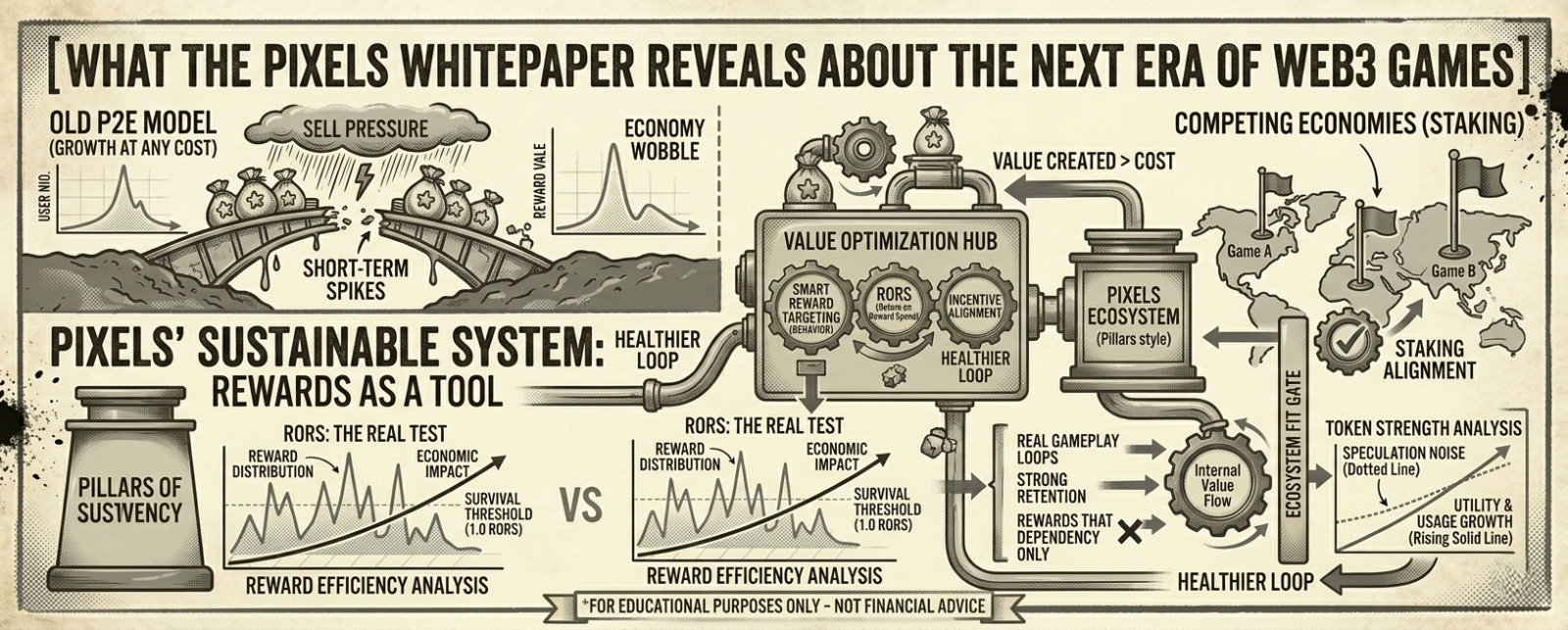

I have stopped trusting game whitepapers that only talk about rewards. Most of them sound clever until the pressure hits. What makes the Pixels whitepaper different to me is that it does not treat rewards as the product. It treats rewards as part of a larger system that has to survive on its own. Pixels says it started as a farming game with strong traction but its broader goal was always to solve play to earn with targeted rewards and better incentive alignment.
The first thing I notice is the three pillar structure. Fun First. Smart Reward Targeting. Publishing Flywheel. That is a better order than most Web3 games use. It starts with the game actually being worth playing. Then it moves to using data to reward the actions that create long term value. Then it tries to turn growth into a loop where better games create richer data and lower acquisition costs. That feels more like a business model than a token campaign.
RORS is the part that really tells me how Pixels thinks. The whitepaper defines it as Return on Reward Spend. It compares rewards given out with the revenue that comes back through fees. Pixels says RORS is currently around 0.8 and wants to move above 1.0 so every reward token spent creates net positive revenue for the ecosystem. That is a serious way to measure game economics because it asks whether rewards are actually efficient. not just whether they are popular.
The staking model pushes that idea even further. Pixels says games themselves become the main validators of the ecosystem. Players stake PIXEL into the games they want to support. That staking pool becomes an on chain UA budget. Games then compete for support by improving retention and net in game spend. I think that is one of the more interesting shifts in Web3 gaming because it turns games into competing economies instead of isolated apps.
vPIXEL is another detail that matters. Pixels describes it as a spend only token backed 1 to 1 by PIXEL. The point is to reduce selling pressure and keep more value inside the ecosystem. That is not a full solution by itself. But it does show that the team understands one of the oldest problems in play to earn. value leaves too fast when utility is weak.
The data loop is probably the strongest sign that Pixels is thinking beyond one game. The whitepaper says every purchase. quest. trade. or withdrawal is logged through the Pixels Events API. Those signals feed models that retrain nightly and shift reward budgets toward the moments and cohorts that improve retention and RORS. That is a very different mindset from handing out emissions and hoping the best users stay.
Ronin matters here too because it gives Pixels a gaming focused base layer. Ronin announced the migration and later said Pixels was live on Ronin with Ronin wallet login and Katana support for BERRY liquidity. To me that makes the story cleaner. Pixels is the economy layer. Ronin is the rail layer. Together they look less like a single game story and more like an experiment in how Web3 gaming infrastructure should actually work.
My honest view is simple. The Pixels whitepaper points to a future where Web3 games are judged less by hype and more by reward efficiency. retention. data quality. and how well the whole system can hold up under pressure. That feels like the right direction. But the real test is still execution. The model is smarter than old GameFi. It still has to prove it can last. What do you think matters more for the next era of Web3 games. better rewards or better systems?
This is for educational purposes only, not financial advice.