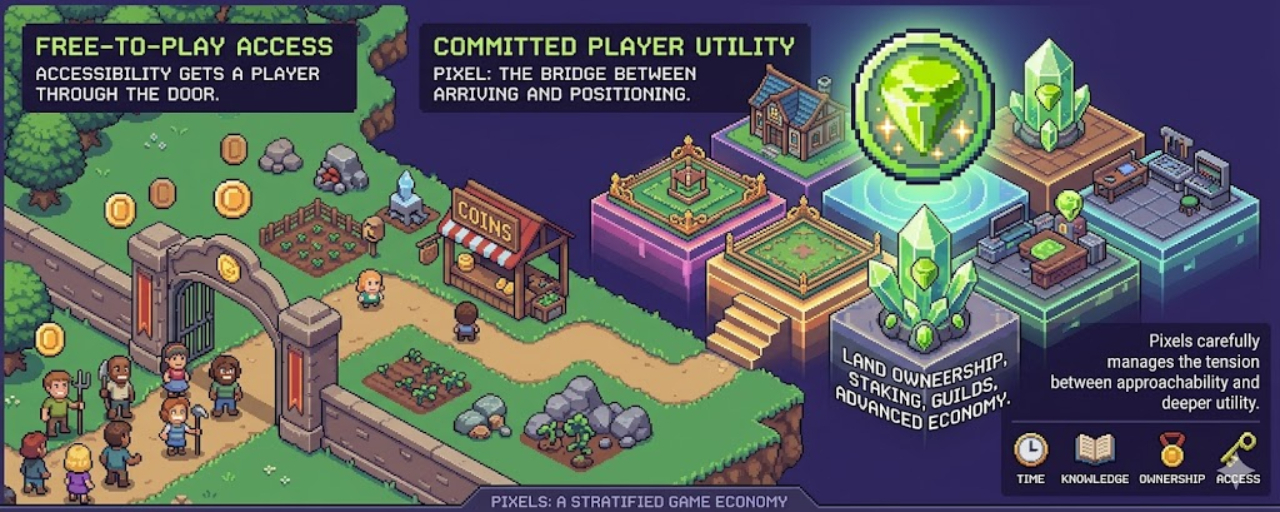
The first time I looked at Pixels as a free-to-play economy, I almost read accessibility as the main story.
No large upfront cost.
Anyone can enter.
The game does not force every player to touch the blockchain immediately.
That matters.
but it is not the whole story.
because accessibility gets a player through the door. it does not guarantee that the player enters the same economy as everyone else.
and Pixels makes that distinction very visible.
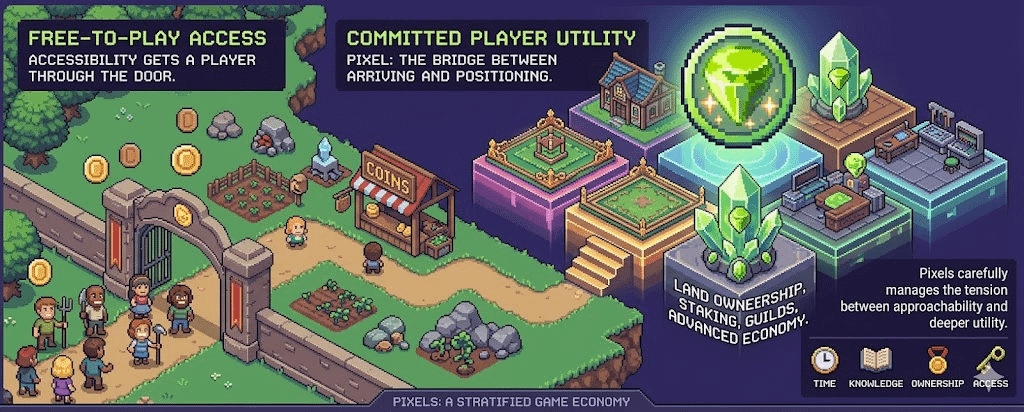
a new player can start with basic gameplay, earn through activity, interact with Coins, complete tasks, and slowly understand the world without needing to behave like an investor on day one. that is important because most Web3 games lost normal users the moment the onboarding process started feeling like a wallet tutorial with gameplay attached.
Pixels avoids part of that problem by letting the lower layer function like an actual game economy.
but then comes the harder question.
what happens when the player looks upward?
because above the basic loop sits land, staking, boosts, guilds, PIXEL utility, and years of accumulated advantage from older players who understood the system earlier. that does not make the economy broken. it makes it real.
real economies compound.
time compounds.
knowledge compounds.
ownership compounds.
access compounds.
and this is where PIXEL becomes both opportunity and pressure.
for a new player, PIXEL can represent a path deeper into the game. a way to access stronger utility, participate in higher-value systems, and move beyond the surface layer. but it can also represent the moment the player realizes that free entry and equal positioning are not the same thing.
that tension is not unique to Pixels.
but Pixels has to manage it carefully because the game is trying to serve two audiences at once. casual players who need the economy to feel approachable, and committed players who need PIXEL to matter enough to justify deeper participation.
too little separation, and the premium layer loses meaning.
too much separation, and the bottom layer starts to feel like a waiting room for people who arrived late.
that is the difficult design space.
and honestly, it is more interesting than the usual Web3 gaming question of whether a token can pump.
the better question is whether a game can let new players enter easily while still rewarding the players who committed earlier without turning the whole economy into a closed club.
Pixels is clearly trying to walk that line.
not perfectly. not effortlessly.
but deliberately.
and that is the part I keep coming back to.
PIXEL is not just a premium token inside the game.
it is the bridge between arriving in Pixels and actually becoming positioned inside it.