

I used to think Pixels was just a simple grind game: the more you’re online, the more you earn.
But after I started diving into the docs for Pixels, especially the part about the economy loop, crafting dependency, and how T5 extends the production chain, I began to realize it’s less like an ordinary game and more like a real operating economy.
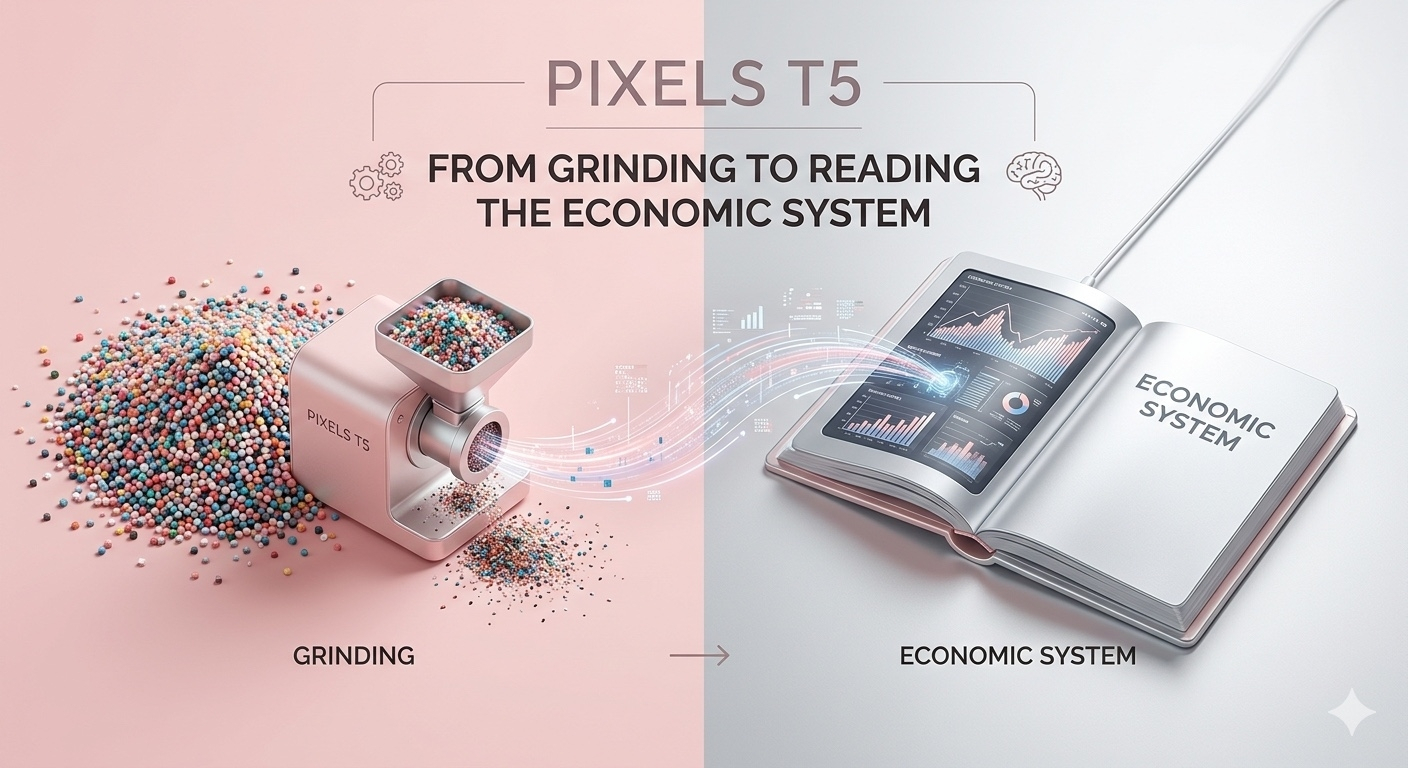
T5 of Pixels isn't just about content updates; it’s a game-changing shift in the economic architecture. Previously, the model was pretty linear: farm → craft → sell, but with T5, everything's pulled into a longer dependency chain, meaning the value of each resource isn't just in itself but in its position within the entire chain behind it. The key point is that T5 creates economic lag: a change in supply doesn’t react instantly but spreads gradually through multiple crafting layers. So players can’t just look at the current price; they need to gauge the bottlenecks in the system to know where shortages or surpluses are coming.
In my view, this is where the game becomes 'challenging yet worth playing' because it forces you to think several steps ahead rather than reacting to immediate prices.
The turning point for me was when I spent quite a bit of time in the marketplace. There were days I didn’t farm much, just observed the prices of a few resource groups over several cycles (about 1–2 hours). I noticed the price fluctuation margins were no longer small like before; there were times when prices surged/dropped by about 10–30% in a short supply-demand cycle, especially when a type of resource was oversupplied by many players farming in the same direction.
At that moment, I realized that Pixels is no longer about 'farming' but about how well you can read the flow of the system.
I noticed an important detail: T5 makes the crafting chain longer and more multi-layered, instead of the simple input → output like before. This means a resource no longer has a fixed value; its price is pulled by multiple layers of demand behind it. I compared this with traditional economic games, where you just farm item A and sell it directly; Pixels differs in that it requires players to look at the '2nd and 3rd layers' of demand, not stopping at surface transactions.
From there, two types of players began to clearly separate:
One group still farms out of habit, selling based on feelings, almost disregarding supply fluctuations. The other group reads supply, measures bottlenecks, and tries to predict when a resource will be scarce in the crafting chain. I once tried switching to the second type, and the feeling was very different: instead of just looking at the current price, I started thinking about 'what does this price reflect in the underlying system?'.
Compared to traditional economic games, which usually have a simple loop of farm → sell → upgrade, Pixels after T5 resembles a more layered system. There are times I farm less but earn more because I'm positioned correctly in the dependency chain, whereas before, farming more almost always equated to higher profits. The documentation clearly states that resources are designed to create interdependency, and my direct experience confirms this: if just one link is oversupplied, the entire chain can pull the price down.
But I also have to admit that I don't always read the system correctly.
There were several times I saw a hot resource and joined late, but just after a short cycle, it became oversaturated with supply, and prices dropped quite quickly (I estimate around 15–25% in a few days of peak trading). Those times made it clear that Pixels does not reward 'trend guessing' but rewards understanding the structure before the trend occurs.
And interestingly, the more I experienced, the clearer it became: this system is not optimized for the diligent player, but for the player who understands structure.
It's like a small economy where information about the supply chain is more important than the number of hours you put in.
In summary...
Essentially, T5 transforms Pixels from an 'action optimization' game into a 'structural reading' system. Those who understand dependency chains have an edge, as the market no longer reacts to farming effort but rather to how the entire supply chain is shifting. I've clearly noticed that since changing my perspective, my decisions are no longer based on gut feelings but on where the system is lacking or oversupplied.
So if a game starts to create behaviors similar to a real market, where value comes from the ability to read the system rather than direct labor, am I then 'gaming' or participating in a real economy in miniature?