
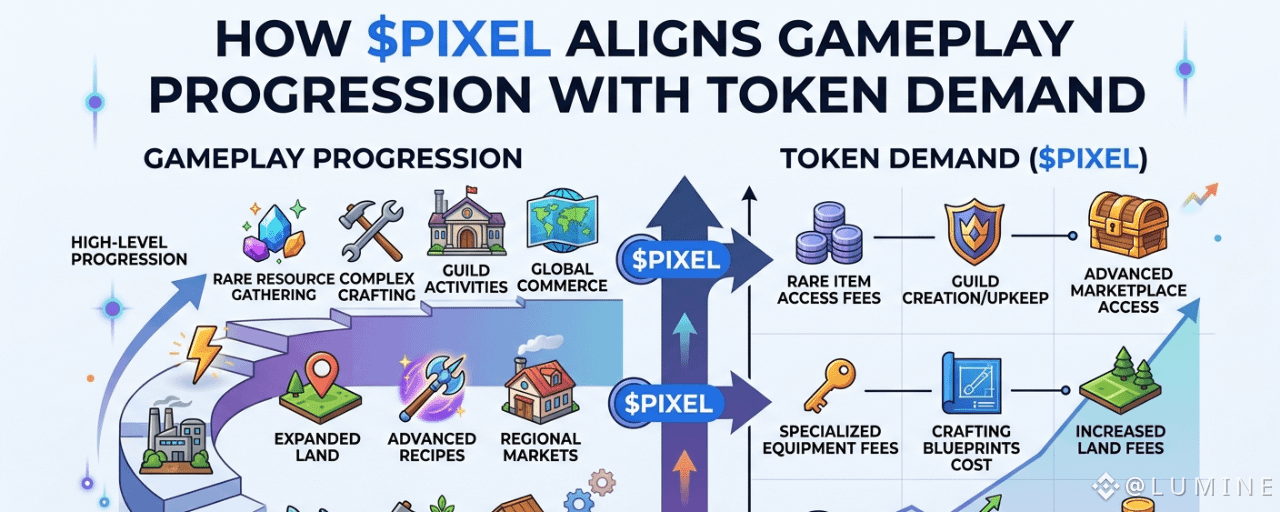

I was thinking about this late at night while going through $PIXEL again, and it started to feel less like a simple play-to-earn game and more like a system trying to fix the usual problems we see in Web3 games.
Most Web3 games fail for the same reason: rewards are too easy, inflation grows too fast, and players leave once the earning slows down. $P$PIXEL ems to be trying something different. Instead of just handing out tokens, it is slowly building a full economy where gameplay, time, and progression actually matter.
This is not just about earning anymore. It’s about balancing how value is created, spent, and sustained inside the game world.
Core Economy Fixes in Gameplay
One of the biggest changes in $PIXEL is how the game controls inflation and resource flow. Instead of letting rewards stack endlessly, the system introduces different “sinks” and limits that make players constantly interact with the economy.
1. Progressive Speck Upgrades (Coin Sinks)
In simple terms, Speck upgrades are designed to scale over time. The more you progress, the more expensive and meaningful upgrades become.
This creates a natural coin sink. Instead of just earning and holding tokens, players are pushed to reinvest into their progression. It prevents the economy from becoming too “lazy” where everyone just farms and holds without using anything.
It also makes long-term play more important than short-term grinding.
2. Crafting Durability (Renewed Demand)
Crafting systems usually suffer from one problem: once you craft something, it stays forever and never needs replacement.
@Pixels this by adding durability. That means items wear out over time and need to be repaired or recreated.
This is important because it keeps demand alive. Resources don’t become useless after one cycle. Instead, players must keep gathering and crafting again, which keeps the economy active.
3. High-Tier Recipes (Resource Absorption)
Another important mechanic is high-tier crafting recipes.
These are designed to absorb surplus resources from the economy. When too many low-level materials exist, high-tier recipes act like a “drain” that consumes them.
This helps avoid inflation of in game resources and keeps rare materials valuable. It also gives advanced players something meaningful to work toward.
4. Inventory Caps (Anti-Hoarding System)
Inventory caps are simple but powerful. They prevent players from hoarding unlimited resources.
In many games, hoarding becomes a problem because players store everything and never spend. That slows down the economy.
With caps in place, players are encouraged to make decisions: use resources, upgrade, or lose efficiency. It keeps the game flowing instead of freezing assets in storage.
5. VIP-Gated Earning Paths
This is where things get more structured.
Certain earning paths, daily tasks, and even withdrawals are gated behind VIP levels.
This is not just about exclusivity. It’s also a way to control distribution and reduce abuse from bots or low-effort farming accounts.
VIP systems also create progression outside of gameplay, meaning players are rewarded for long-term commitment rather than short bursts of activity.
Reward Distribution: How It Is Changing
The reward system is one of the most important parts of $PIXEL, and it has gone through clear stages.
Phase 1: Fixed Rewards
In the early stage, rewards were fixed and tied to curated games.
This means the team selected which games could distribute $PIXEL, and rewards were predictable.
This system is simple, but it does not scale well because it does not adapt to player behavior or market conditions.
Phase 2: Dynamic Reward Pools
In the second phase, things become more flexible.
Now rewards are placed into dynamic pools, and these pools are split based on how much #pixel ked by users.
There is also a monthly cap of around 28 million $PIXEL, which prevents unlimited inflation.
This is important because it ties rewards directly to participation and staking. The more you commit to the ecosystem, the more influence you have on reward distribution.
It also creates balance: not everyone can extract unlimited value without contributing.
Phase 3: Open Game Qualification
The third phase is even more interesting.
Now, any game can qualify for rewards as long as it meets a condition: RORS ≥ 1.
In simple terms, this means the game must generate enough return and sustainability to justify reward distribution.
This opens the system beyond curated content and allows the ecosystem to grow organically. But it also ensures that only healthy games remain part of the reward loop.