
There are times when I do not need to look for very long to know a project has only put on a fresh coat of paint, and there are also times when just a few tables of numbers are enough to tell me the frame underneath is being taken apart and rebuilt. This time my feeling leans entirely toward the latter, because Pixel does not make an impression through the noise of a major update, but through the way the three most important parts of its gameplay rhythm all shift in a very deliberate direction.
After many years of moving through the cycles of hype and exhaustion in economic games, I think the thing most often misunderstood is the difference between new content and a new gameplay rhythm. New content only gives players more things to do. A new rhythm changes how they think about priority, about waiting time, and about how much effort should go into a single login session. Pixel is standing exactly on that line. When XP is adjusted, players do not just see the progress bar move faster or slower, they are also being redirected toward what should be done first and what can rise to become the center of an entire day of play.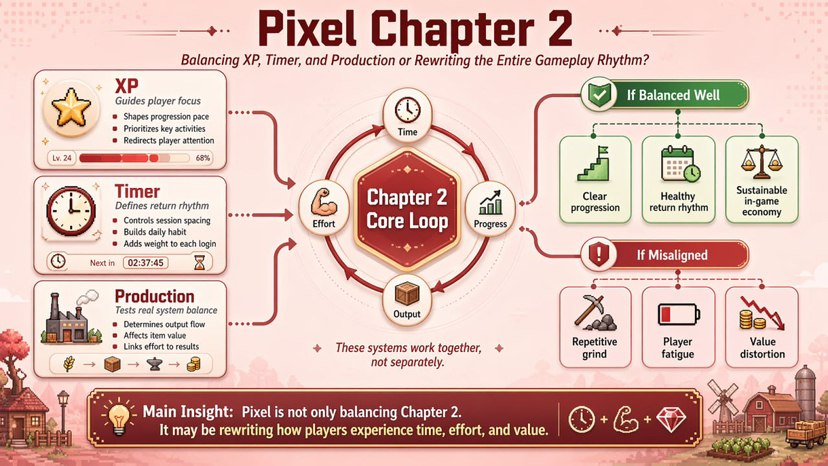
I have always believed XP is the most underrated tool for directing attention in game design. Players often think they are deciding for themselves, but in truth XP density is almost always the invisible hand guiding the flow of behavior. An activity that receives more XP immediately becomes more rational in the eyes of the crowd. An activity that loses XP does not die at once, but it gradually loses its place in the chain of decisions. To be honest, this is where I find Pixel fairly clear headed. The team is using XP to clearly choose which activities truly deserve to stand at the core of Chapter 2.
But XP alone is not enough to rewrite gameplay rhythm. Timer is the layer that shows how deeply the project understands player habit. A short waiting cycle always creates the feeling that many things are running, but it also easily pulls players into constantly returning just to check, then wearing out very quickly. A longer waiting cycle may look slower, yet it gives each login more weight because players have to arrange the order of their actions. Pixel is touching something not everyone notices, that the distance between two returns is the structural frame of the experience itself.
The thing I pay the most attention to lies in production, because production is where every adjustment is forced to answer with real consequences. If production moves too fast, items come out in thick volume, storage swells, labor becomes lighter, and the loop loses its weight. If production moves too slowly, players no longer feel that a day of effort leads to any meaningful result, and Chapter 2 starts to resemble an extended waiting schedule. At this point Pixel does not have much room to be wrong. A system that wants to endure cannot allow progression speed, return speed, and output speed to run in three different directions.
What is more notable is that these three variables create a chain reaction in how players feel ownership over their process. Players only truly stay for the long term when they feel they are maintaining a machine marked by their own hands, not merely dropping in to collect rewards and leave. Pixel is fixing exactly that point. If XP leads players toward work that carries more meaning, if timer makes each return more intentional, and if production binds output more tightly to the effort already invested, then the project is making a habit take on a clearer shape inside the player’s mind.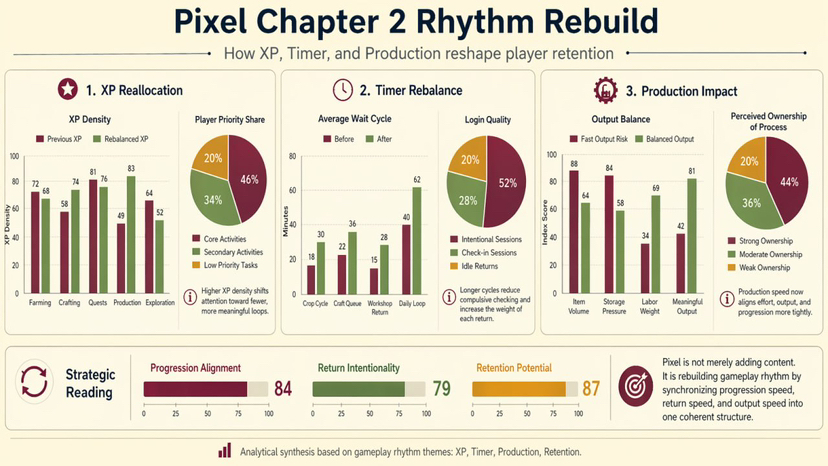
Ironically, the market often reacts most strongly to big rewards or big unlocks, while the thing that decides longevity lies in matters far less glamorous. I see this round of changes from Pixel as a fairly hard handed decision. It does not try to indulge the desire for faster, more, immediate gain. It forces players to accept that progress only has meaning when it is placed inside a chain with order, with delay, and with consequence. I think that is the major difference between a project that wants to create a burst of excitement and a project that wants to build a way of life.
What remains with me is not the excitement that usually follows an update, but the feeling of watching a system tighten itself so it can live longer with its own choices. Pixel seems to have moved past the stage where it only needed to make everything larger, faster, denser, and has stepped into a much harder stage, forcing every link to answer to the rest. When a project dares to touch XP, timer, and production at the same time, what it is really putting to the test is no longer short term appeal, but the true endurance of the whole structure. Perhaps that is why I do not see this adjustment as an ordinary balancing move, but as the moment Pixel begins to redefine how time is absorbed, how effort is valued, and how habit is built into retention. And the remaining question is whether the community is calm enough to realize that Pixel is not only fixing a single chapter, but rewriting the rhythm of the entire project itself.