
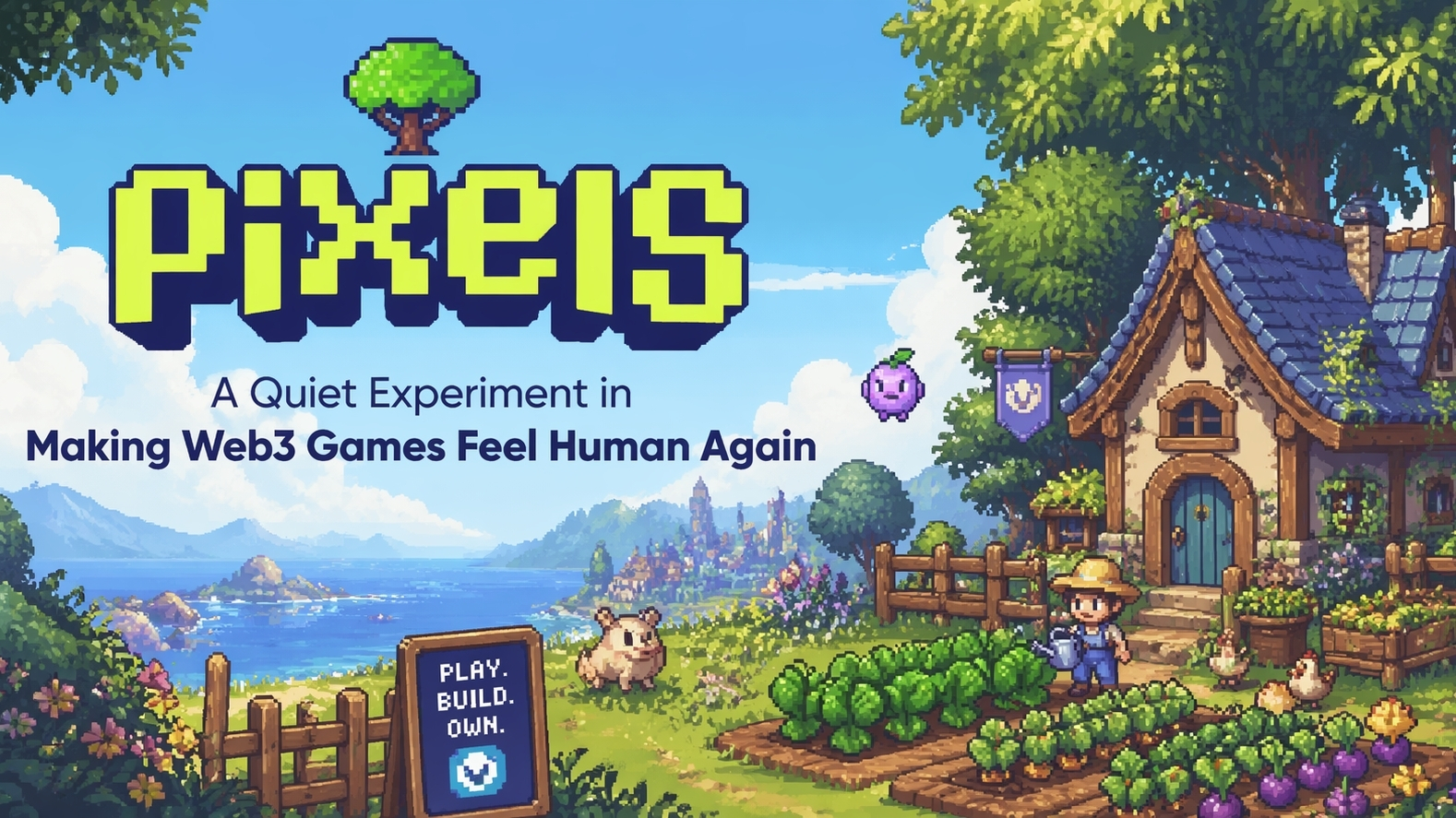

Pixels is one of those projects I keep coming back to, not because it’s loud or everywhere, but because it’s trying something a bit more grounded. I’ve been watching this space long enough to see how quickly things fall apart when a game forgets it’s supposed to be a game first. So when I look at Pixels, I’m not thinking about trends or hype—I’m just asking a simple question: would anyone still play this if the crypto part disappeared?
What makes Pixels interesting to me is how familiar it feels. Farming, exploring, slowly building something over time—it’s not trying to reinvent the idea of a game. And that’s actually refreshing. I’ve seen too many projects pile on complicated systems and token mechanics before proving that the core experience is even enjoyable. Pixels seems to start from a quieter place. It focuses on routine, on small progress, on giving players a reason to log in again tomorrow without needing a big promise attached.
I find myself paying close attention to how time works inside the game. In most Web3 projects, time quickly turns into pressure—players feel like they need to optimize, extract, earn. That usually kills the experience. Pixels feels like it’s trying to slow that down. The value of what you do isn’t pushed aggressively in your face. It’s there, but it doesn’t dominate every decision. That balance is fragile, though. I’ve seen how easily a system can tip from “engaging” into “transactional.”
There’s also something to be said about the environment it’s built on. Choosing a network that prioritizes speed and low cost might sound like a technical detail, but it changes how the whole game feels. If every action is smooth and almost invisible from a blockchain perspective, players can stay immersed. I’ve seen projects fail not because their ideas were bad, but because the experience felt clunky. That kind of friction pushes people away faster than anything else.
I keep thinking about the role of the token in all of this. In Pixels, it doesn’t seem to sit at the center, and that might be intentional. When money becomes the main focus, people start behaving differently. They stop playing and start calculating. By keeping it more in the background, Pixels at least gives itself a chance to build something that feels natural. But that also raises a challenge—can the system stay alive without constantly pulling in new demand?
The social side is where things get even more uncertain. Games live or die based on whether people form habits and connections. You can design mechanics, but you can’t force real interaction. Pixels leans into a shared world where players cross paths and build alongside each other, but I’ve learned that community isn’t something you can guarantee. It either forms on its own, or it doesn’t.
And then there’s the bigger question I always come back to: does the blockchain actually add something meaningful here? It’s easy to talk about ownership and open systems, but I’ve seen how often those ideas don’t change how people behave day to day. For Pixels to really matter, that layer has to enhance the experience, not just exist alongside it.
The more I watch it, the more Pixels feels like an experiment in restraint. It’s not trying to be everything at once. It’s just trying to see if a simple, social game can exist in a Web3 environment without breaking under its own incentives. That’s a harder problem than it sounds.
So I keep observing, quietly. Because sometimes the projects that don’t try to impress you right away are the ones worth understanding over time.