
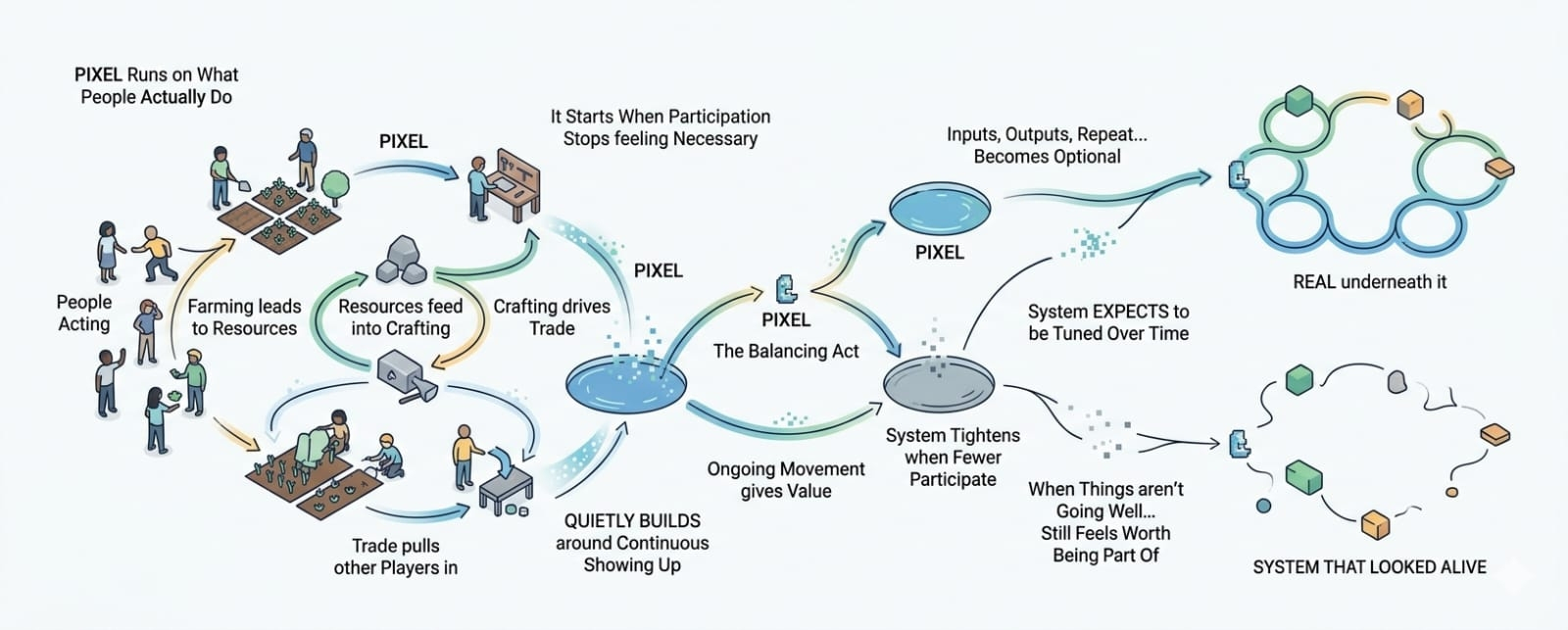
I’ve seen how these systems fade. Not collapse overnight just slowly lose their pulse. Fewer players log in. Trades become less frequent. Conversations dry up. On the surface, everything still looks intact, but underneath, the energy is gone.It usually starts when participation stops feeling necessary.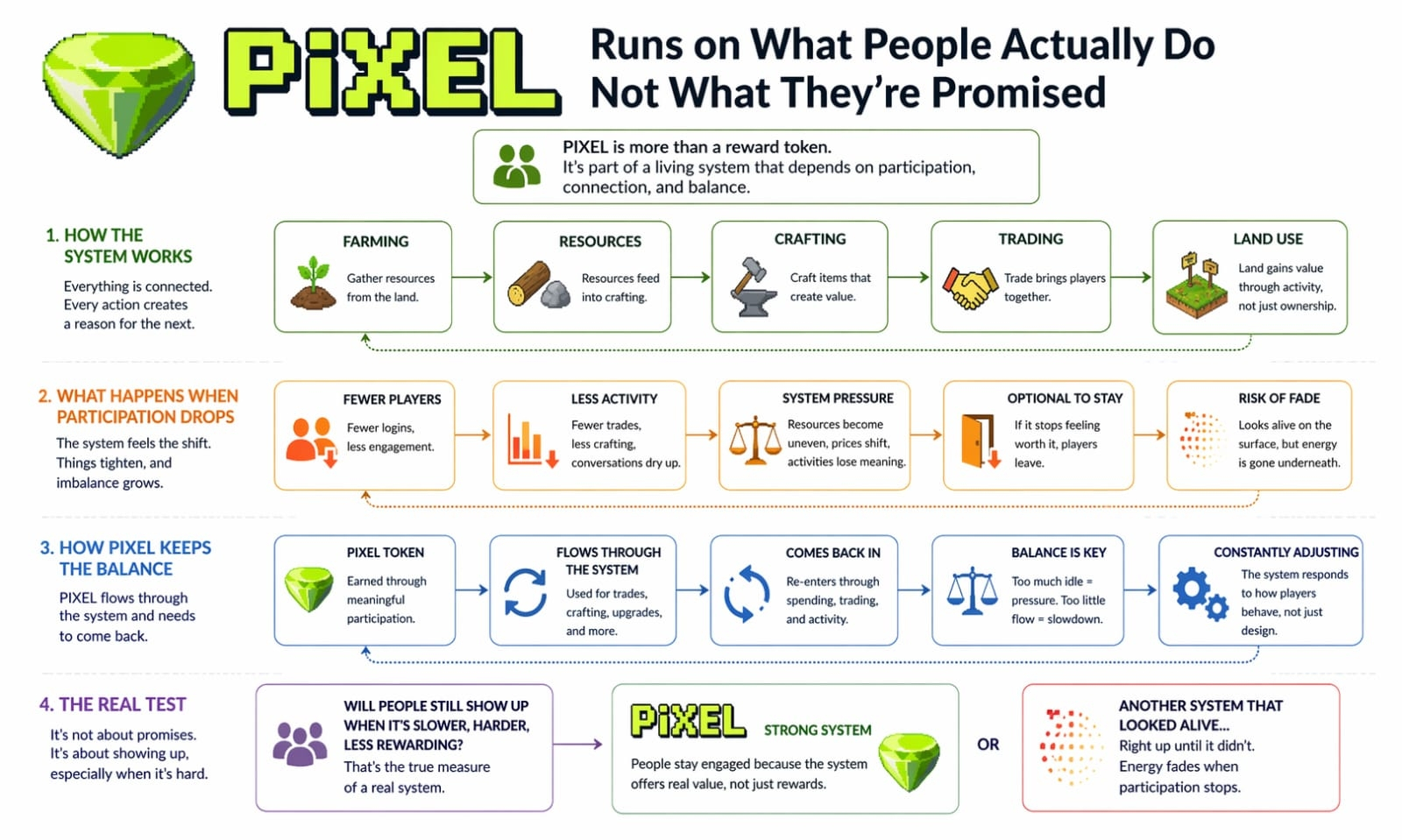
I remember playing a few blockchain games where the rewards looked good at first. You log in, complete tasks, earn tokens it all feels structured. But after a while, you realize something: you’re not really playing anymore. You’re just moving through a system. Inputs, outputs, repeat. And once you see it that way, it becomes optional. Easy to step away from.
That’s where things begin to thin out.
What made Pixels feel different to me wasn’t that it solved this completely, but that it approached it differently. It doesn’t lean too heavily on promises of return. Instead, it quietly builds around the idea that the system only works if people keep showing up and doing things that matter inside it.When I spent time in it, the loops felt connected. Farming led to resources. Resources fed into crafting. Crafting created reasons to trade. And trading pulled other players into the picture. Even land didn’t feel like something you just hold it felt like something you use, something that only has value if it’s part of that ongoing movement.
ItPIXEL Runs on What People Actually Do Not What They’re Promised sounds simple when you say it out loud. But in practice, it’s fragile.Because the moment fewer people participate, you can feel it. Resources become uneven. Prices shift. Certain activities stop making sense. The system tightens in ways that aren’t always comfortable. I’ve seen that happen before, and it’s usually where things start to break.But maybe that’s not entirely a flaw.It actually feels closer to how real systems behave. When participation drops, things adjust. Not always smoothly, but honestly. The difference is that in games, people don’t have to stay. If it stops feeling worth it, they just leave.That’s where PIXEL sits in all of this.It’s not just a reward it’s part of the balancing act. It flows through the system based on what people do, but it also needs to come back into it. If too much of it sits idle, pressure builds. If too little moves, activity slows. Keeping that balance isn’t something you solve once it’s something you keep adjusting.@Pixels And to its credit, Pixels doesn’t really hide that.It doesn’t pretend to be perfectly stable. If anything, it feels like a system that expects to be tuned over time responding to how players behave, not just how it was designed on paper. That makes it harder to judge quickly, but maybe more honest in the long run.
Because at some point, every system gets tested. Not when things are going well, but when they aren’t.
That’s when you find out if people still show up.
And that’s really what this comes down to. Not the token price, not the player count on a good day but whether the system still feels worth being part of when it’s quieter, slower, less rewarding.#pixel
If Pixels can hold that if it can keep people engaged even then there’s something real underneath it.
If not, it becomes another system that looked alive, right up until it didn’t.$PIXEL