


Most reward systems look perfect until real players touch them.
I’ve seen too many of them on paper. Clean loops, balanced emissions, sustainable incentives. Everything works until real players show up and start pulling the system in directions it wasn’t designed for.
So when I read the Stacked announcement, I wasn’t looking for features.
I was looking for one thing: did this system survive contact with reality?
That’s where the profitability claim changes everything.
Not because profitability means it’s solved. It doesn’t. But because it proves something harder—that the system didn’t collapse under its own incentives.
And that’s rare.
Most GameFi systems don’t fail immediately.
They look fine in the beginning. Activity grows, rewards feel meaningful, users come in. The problem shows up later.
Rewards get farmed. Bots optimize faster than humans. Players extract value without feeding the system back.
And eventually, the economy starts paying out more than it can justify.
That’s where things break.
Not at the feature level. At the incentive layer.
Which is exactly where Stacked is positioned.
The mistake most people make is reading Stacked from the player side.
Missions, streaks, rewards, cross-game progression. That’s what’s visible.
But that’s not where the credibility comes from.
The real system sits underneath.
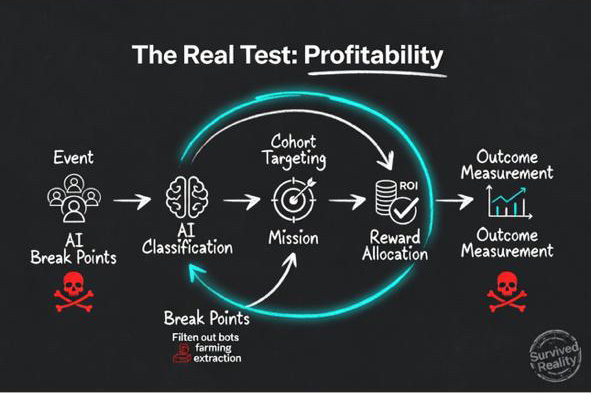
Every action inside the game becomes an event. That event doesn’t just get logged—it gets evaluated.
Who performed it? What kind of player are they? What is the system trying to optimize right now?
From there, the system decides what to do next.
Some behaviors get turned into missions. Some get rewarded immediately. Some get ignored.
That decision follows a loop that keeps adjusting:
event → classification → cohort → mission → reward → outcome → feedback
Stacked isn’t rewarding activity. It’s auditing whether activity deserves to be paid.
And the important part is not the loop itself.
It’s that the loop is tied to actual outcomes.
That’s where profitability enters the picture.
If a system like this is running and the game is still profitable, it means something very specific happened.
Rewards didn’t just create activity. They created activity that justified their own cost.
That’s a different standard.
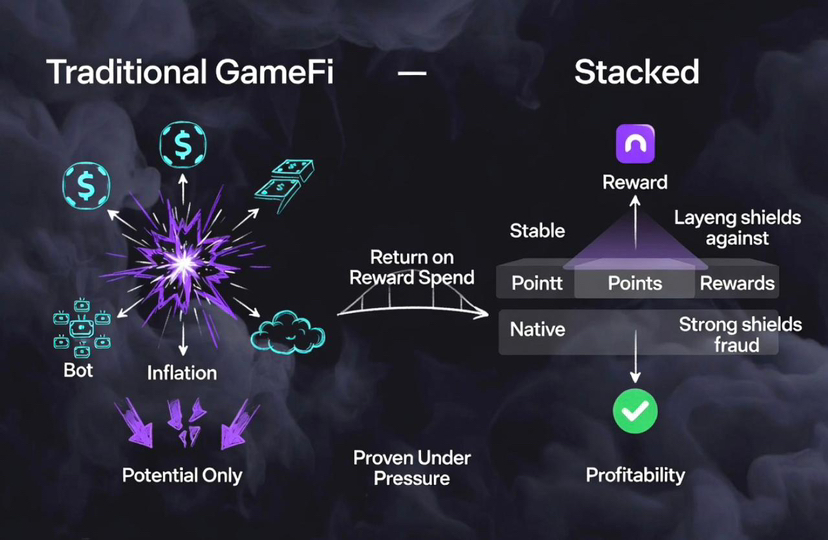
Because in most systems, rewards are disconnected from outcomes.
You can see how many players completed a mission. But you don’t know if that mission created anything that lasts.
Did it improve retention? Did it lead to real spending? Did it deepen engagement?
Or did it just generate temporary activity that disappears the moment rewards stop?
Stacked forces that connection.
Every payout has to prove itself.
If it doesn’t create something durable, it gets adjusted or removed.
That’s what “return on reward spend” actually means in practice.
This is also why the rollout looks the way it does.
If your system depends on measuring outcomes accurately, you can’t scale it blindly.
Because scale hides mistakes.
You get more data, but less clarity on what’s actually working.
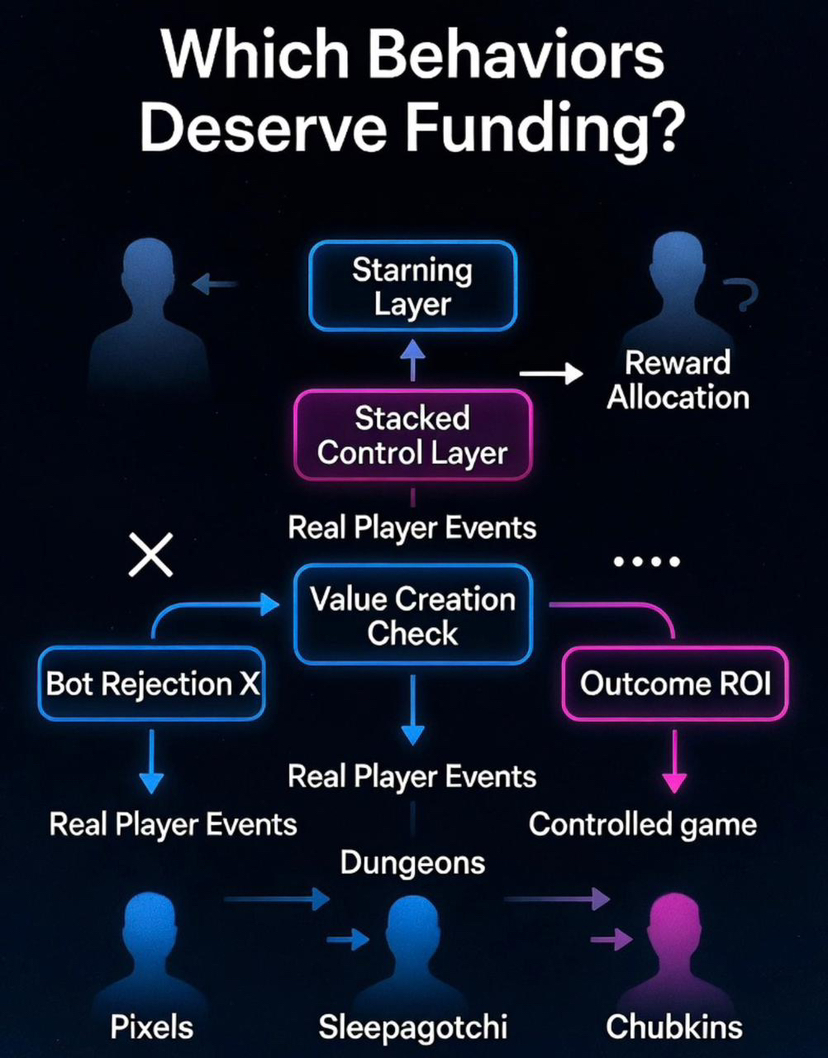
Starting with Pixels, Pixel Dungeons, Sleepagotchi, and Chubkins isn’t about being cautious.
It’s about maintaining control.
These are environments where the team already understands the loops.
They know where players drop off. They know how rewards get exploited. They know what real engagement looks like.
So when Stacked runs inside these games, every adjustment produces a clear signal.
Not just that something worked.
But why it worked and where it breaks next.
That kind of feedback is what turns a reward system into something that can actually learn.
The multi-reward design supports this in a way that’s easy to overlook.
Most systems rely on a single token to do everything.
Reward players. Attract attention. Provide liquidity. Signal long-term value.
That creates a constant conflict.
Increase rewards, and you create sell pressure. Reduce rewards, and engagement drops.
You end up balancing one asset against itself.
Stacked removes that constraint.
Different reward types serve different roles.
Stable assets can represent immediate value. Native tokens can tie into the ecosystem. Points can be used to test behavior without creating external pressure.
This separation gives the system more control.
It can reward behavior without automatically turning every payout into the same economic consequence.
That’s critical if you want rewards to stay sustainable.
When you put all of this together, the profitability claim starts to mean something more concrete.
It’s not just a signal that the game made money.
It’s evidence that the incentive system didn’t spiral out of control while running at scale.
That rewards didn’t outpace value creation.
That the system was able to filter behavior, allocate incentives, and adjust fast enough to stay balanced.
And that’s the part that changes the credibility of the pitch.
Because most GameFi projects are still speaking in potential.
If this works, it will be sustainable. If adoption grows, the economy will stabilize.
Stacked is saying something different.
This system already ran inside a live environment, with real players, real incentives, and real pressure—and it didn’t break.
That doesn’t make it perfect.
But it makes it real.
If you step back, the shift becomes clearer.
The conversation is no longer about how to design rewards.
It’s about how to control them.
Which behaviors deserve to be funded. Which ones look active but don’t create value. Which incentives actually lead to something that lasts.
That’s a harder problem than it sounds.
Because once rewards are treated as capital, not giveaways, every decision becomes more constrained.
You can’t reward everything.
You have to choose.
That’s why profitability matters here.
Not as an endpoint.
But as proof that the system made those choices and survived them.
That it didn’t try to pay for everything.
That it filtered, adjusted, and allocated incentives in a way the economy could sustain.
So when I read Stacked now, I don’t see a reward system being introduced.
I see a system that already proved it can operate under pressure—and is now being packaged for broader use.
And that’s a very different kind of pitch.
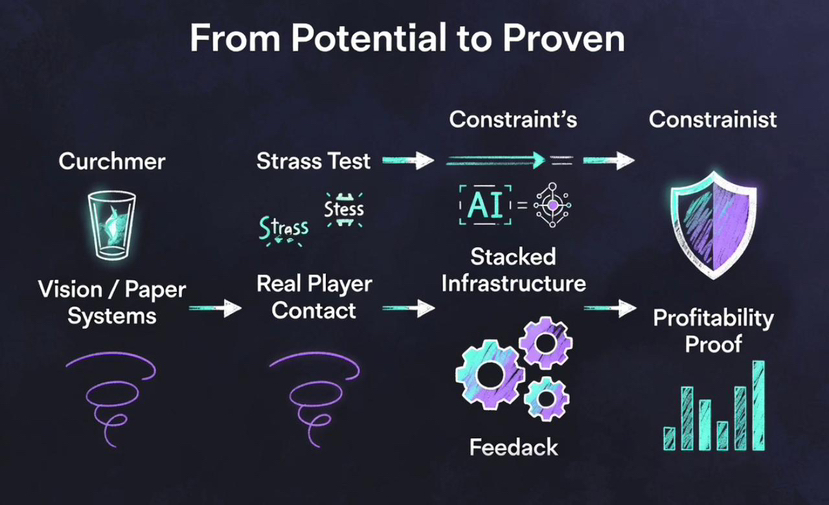
Not “this might work.”
But “this has already been forced to work.”
In GameFi, profitability isn’t success. It’s proof the system didn’t break.