
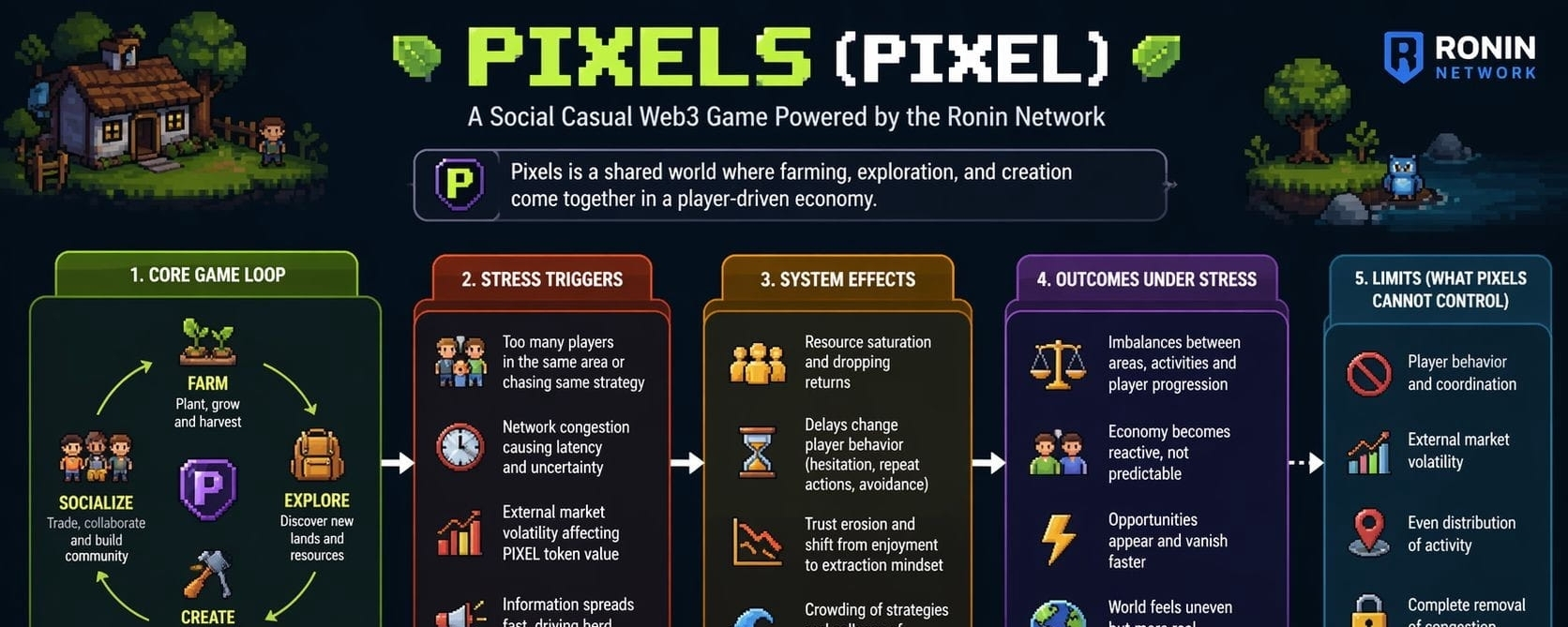
. The loop is familiar: log in, perform routine actions, observe outcomes, repeat. It doesn’t demand much deliberate thought; it simply absorbs your time in a quiet, structured way. Initially, it feels like repetition.
But over time, that sense of repetition begins to shift.
I started noticing that the system doesn’t respond the same way twice even when I do. Identical actions don’t consistently lead to identical outcomes. Not in an obvious success-or-failure sense, but in whether those actions seem to carry forward into something larger, or quietly fade out of relevance. The distinction isn’t clearly defined, yet it’s perceptible.
Some behavioral patterns seem to gain momentum over time, as if the system subtly reinforces them. Others equally reasonable on the surface never quite connect to anything beyond the moment they occur. This doesn’t feel like inconsistency; it feels like adaptation.
The longer I engaged with Pixels, the more it seemed less like a fixed system reacting to players, and more like something gradually reshaping itself around player behavior. It doesn’t just process activity it appears to absorb it, influencing how future activity is recognized and sustained.
That realization changes how you interact with it.
Without consciously deciding to, I found myself gravitating toward behaviors that “fit” more naturally within the system. Not necessarily because they offered better rewards, but because they seemed to integrate more seamlessly into whatever came next. Other actions began to feel disconnected, as though they existed outside the system’s evolving structure.
It becomes a feedback loop: player behavior influences the system, and the system, in turn, reshapes player behavior. Over time, this loop narrows what feels intuitive or worthwhile, not by force, but through subtle reinforcement.
What stands out most is the system’s quiet filtering mechanism.
Certain actions seem to pass through this filter and become part of a persistent, evolving structure. Others remain isolated, never linking into anything larger. The system never explicitly signals which is which, but the difference is felt in how continuity forms around some patterns and not others.
And that continuity becomes a guide.
Once something feels like it will persist, you naturally lean toward it. Not through conscious strategy, but through an intuitive pull toward stability toward what appears to “matter” within the system’s current state.
This is where the idea of a traditional “game economy” starts to feel insufficient.
Rather than a fixed framework distributing outcomes, Pixels begins to resemble a dynamic, evolving structure one that continuously adjusts based on the behaviors flowing through it. Value, attention, and persistence are not static; they are reshaped in real time by the very actions they go on to reinforce.
The longer you stay within the system, the harder it becomes to separate your behavior from the system itself. Repeated actions seem to add weight to certain pathways, increasing their likelihood of persistence, while others gradually lose relevance without ever being explicitly removed.
It doesn’t feel like control.
It feels more like gradual alignment where user and system begin to reflect each other so closely that it’s difficult to tell which one is leading.
And that’s the unresolved tension.
If the system is constantly adapting to behavior, and behavior is constantly adapting to the system, then what appears to be a simple gameplay loop may actually be something far more fluid an environment continuously shaped by the patterns its participants reinforce.
I’m still inside that loop. Still engaging, still repeating certain actions without always knowing whether I’m following the system, or quietly contributing to what it will become next.
It doesn’t feel finished.
If anything, it feels like an ongoing process where the boundary between playing the system and shaping it gradually disappears.