
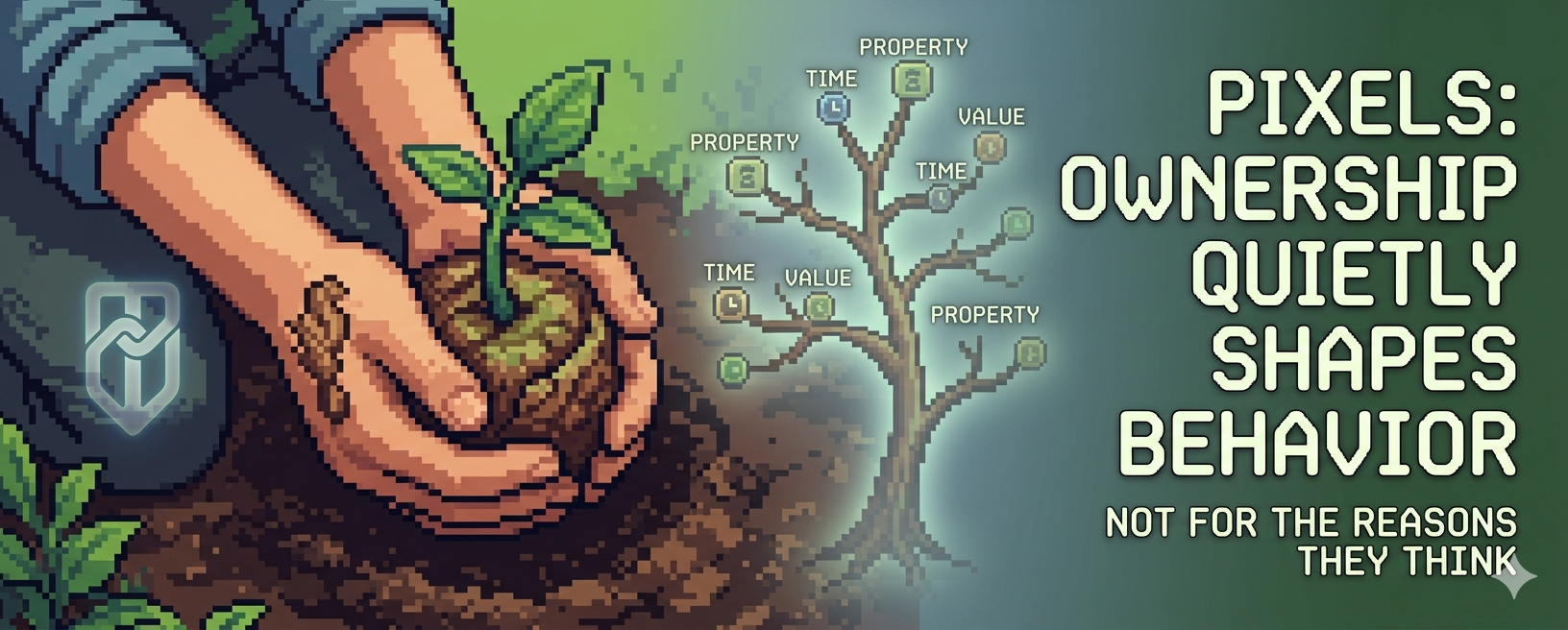

I keep coming back to Pixels, and honestly, not for the reasons most people expect. It doesn’t try too hard. It doesn’t scream for attention. And maybe that’s exactly why it holds mine.
At first, it just feels like a simple farming game. Move around. Collect things. Plant, harvest, repeat. Nothing groundbreaking on the surface. But the longer I sit with it, the more I start noticing what’s happening underneath that simplicity.
Something feels different.
I notice how the pace isn’t aggressive. There’s no constant push telling me to hurry up or maximize every second. It almost feels like the game is okay with me taking my time. That alone changes how I behave. I’m not rushing decisions. I’m not reacting. I’m just… moving with it.
And that shift is subtle, but it matters.
What stands out to me is how ownership is handled. Not as a feature. Not as something the game keeps reminding you about. It’s just there, quietly shaping everything. Land, items, resources—they don’t feel temporary. They feel like they belong somewhere. Like they carry weight.
I pay attention to how that changes my mindset. I’m not just using things anymore. I’m thinking about them. Holding them longer. Making slower decisions. There’s a kind of responsibility that creeps in without being forced.
That’s where it starts to feel different from typical games.
Because usually, everything feels disposable. Here, it doesn’t.
Running on Ronin Network, the whole idea of ownership isn’t loud, but it’s deeply embedded. And over time, it stops feeling like some “Web3 concept” and just becomes part of how the world works.
That’s something most people overlook.
They talk about ownership like it’s the headline. But I don’t think that’s the point. The real shift is in behavior. I notice players becoming more patient. More intentional. Less like consumers, more like participants.
It feels like people are slowly settling into the world instead of just passing through it.
Then there’s the social side. And this part is interesting in a quiet way.
No one is forcing collaboration. There’s no heavy system pushing interaction. But it still happens. Players gather. Share space. Build around each other. It feels natural, almost like the environment encourages it without saying anything directly.
That’s rare.
Because usually, games try too hard to create social moments. Here, they just… emerge.
I notice how progress doesn’t feel like a checklist. There’s no overwhelming pressure to “complete” something. It unfolds slowly. And somehow, that makes it feel more personal. Like I’m deciding what matters instead of being told.
Some days it feels like I’m progressing. Other days, I’m just existing in the world.
And both feel valid.
Time behaves differently here too. It stretches. Farming, waiting, coming back—it creates a rhythm. Not fast. Not slow. Just steady. And that rhythm builds a kind of connection I didn’t expect.
Not excitement. Not intensity.
Something calmer.
It feels like I’m building something, even when I’m doing very little.
And that’s the part I keep thinking about.
Player-driven progress sounds like a buzzword, but here it actually feels real. Not because the system says so, but because small actions start to stack up over time. Quietly. Without pressure. Without noise.
And because ownership exists, those small actions don’t disappear. They stay. They matter.
I notice that this changes how I value time inside the game. It doesn’t feel wasted. Even slow progress feels meaningful. That’s not something most systems get right.
What stands out to me the most is that Pixels isn’t trying to impress anyone. It’s not built around hype. It’s built around behavior. Around how people move, interact, and slowly attach themselves to a space.
It feels like a quiet shift.
The kind you don’t notice immediately.
But once you do, it’s hard to unsee.
And I keep watching it, not because it’s loud or flashy, but because it’s consistent in a way that feels intentional. Like it understands something deeper about how people engage over time.
That’s what I notice.
Not the surface.
But the way it changes how I think while I’m inside it.
