
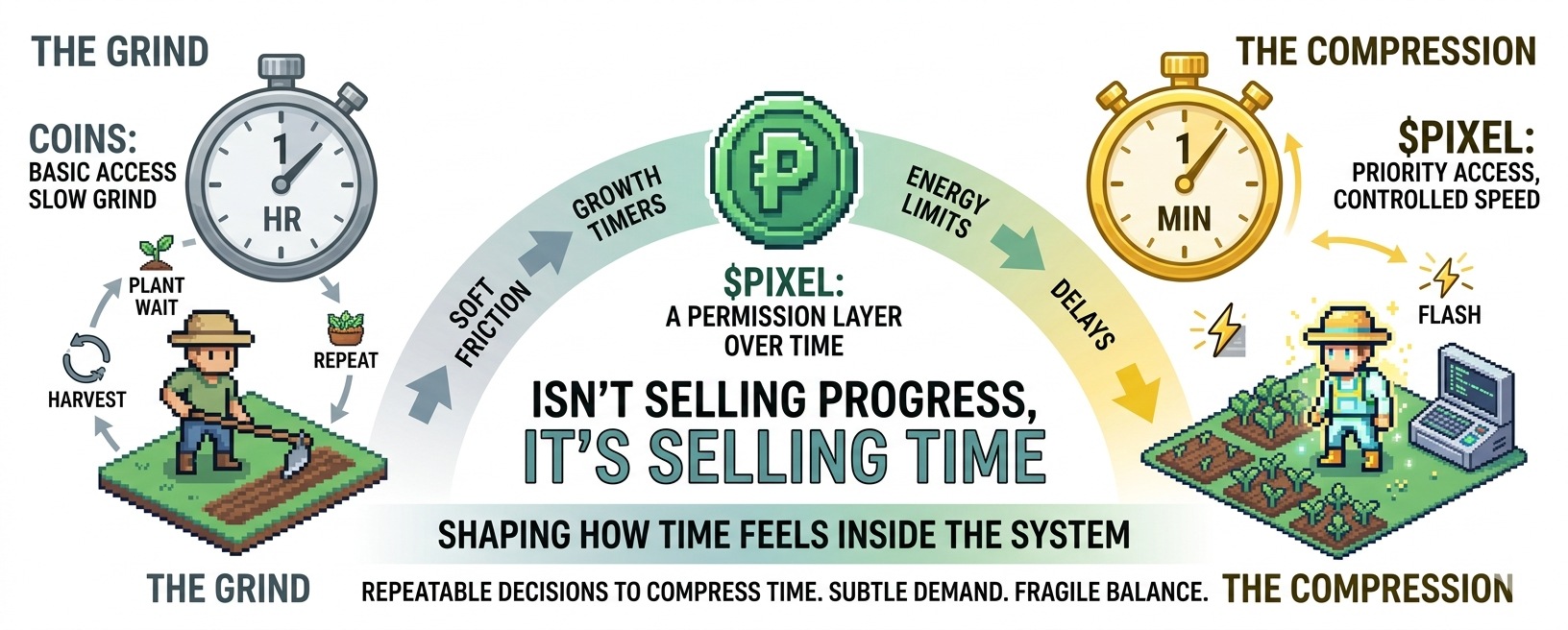
I didn’t notice anything unusual in the beginning. Pixels felt like a familiar farming loop layered on top of a token the kind of structure we’ve seen many times before. Plant, wait, harvest, repeat. It looked predictable, almost too easy to categorize.
But after spending more time observing how people actually play, a subtle misalignment started to emerge. Nothing broken. Nothing obvious. Just a quiet deviation from the typical “progress economy” most GameFi systems rely on.
What stood out wasn’t what players were getting it was how long everything took.
That sounds simple, but it shifts the entire perspective. Most GameFi tokens are built around selling progress: better tools, faster output, higher returns. Pixels technically does that too. But the real pressure point isn’t the reward it’s the delay wrapped around it.
Growth timers, energy limits, small pauses on their own, they feel harmless. But together, they create a kind of soft friction. Not enough to frustrate immediately, but enough to be felt over time.
And that’s where $PIXEL quietly finds its role.
It doesn’t behave like a traditional currency. It feels more like a permission layer over time. When players use it, they’re not really buying items they’re making a decision. That waiting is no longer worth it. That repeating the same loop again isn’t worth the effort.
Those decisions happen more often than you’d expect.
I’ve seen players who don’t care much about optimizing output, yet still reach for pixel just to smooth things out. Not to win just to reduce friction. That kind of demand is subtle. It’s hard to measure, but it repeats consistently.
There’s also a structural split inside the system that often goes unnoticed.
Coins handle the basic layer. They keep the world running. You can stay there indefinitely, just participating. But the moment you start wanting control not just progress you begin to drift toward pixel.
That boundary feels intentional.
It resembles systems where free access and priority access coexist. Same environment, but a different experience depending on how much control you want over time. Pixels doesn’t explicitly say this, but it behaves like it does.
This is where the usual “adoption” conversation starts to feel incomplete.
People tend to focus on user growth, new inflows, expansion curves. But the more I look at it, the more it feels like repetition matters more than growth.
If players repeatedly encounter small delays that feel worth skipping, demand can exist without massive user inflow. Not explosive demand just steady, recurring decisions to compress time.
That kind of behavior doesn’t show up clearly on charts.
But it’s fragile.
If the system becomes too efficient if waiting stops being noticeable then PIXEL loses its function. There’s nothing left to compress. On the other hand, if delays start feeling artificial, like they’re only there to push spending, players will notice. And when they do, they don’t usually stay quiet.
So the system walks a very thin line.
Friction has to feel natural. Almost invisible. Like part of the environment, not something imposed. That’s much harder to maintain than it sounds, especially at scale.
I also think the market is still reading this the wrong way.
Most analysis focuses on supply, unlock schedules, user numbers clean, trackable metrics. But they miss the behavioral layer. The quiet, repeated decisions players make without thinking:
Skip this.
Speed that up.
Don’t run that loop again.
That’s where the token actually lives.
And it’s not guaranteed that players will keep choosing that path. Sometimes people prefer the grind. Sometimes they just leave instead of paying to make things smoother. I’ve done that myself closed the app instead of speeding things up.
That option is always there.
So I’m not fully convinced this model holds long term. But I also don’t think it’s being priced correctly right now.
Pixels doesn’t really sell progress.
It shapes how time feels inside the system slower in some places, faster in others, optional in between.
And PIXEL sits right at the point where that feeling can be changed.
Whether that turns into durable demand or fades as a temporary habit probably depends on how subtle they can keep the system.
Because subtle systems are the easiest to underestimate.
