

I’m gonna be honest with you, when I first heard about Pixels, I rolled my eyes. Hard. It sounded like the same recycled Web3 hype we’ve been drowning in since 2021. Farming game, tokens, “community,” blah blah. You know the script. But then I actually spent time in it. Not just poking around, I mean really sitting there, grinding crops, talking to random players, watching the market shift in real time. And yeah… it got under my skin in a way I didn’t expect.
It’s weird. Like, the game looks simple. Almost too simple. Pixel art, basic farming loop, nothing flashy. But that’s the trick. It lowers your guard. You think it’s just chill gameplay, something you can casually click through while watching YouTube. And then suddenly you’re thinking about crop timing, price fluctuations, whether it’s smarter to sell raw goods or craft them first. It sneaks up on you. Quietly.
Actually, wait… let me rewind a bit. You remember Axie Infinity, right? That whole boom and crash. People were treating it like a job, not a game. Wake up, grind, cash out, repeat. It worked for a while, especially in places where even small earnings mattered. But the system was kinda doomed. Too many people extracting value, not enough real demand. Inflation kicked in, rewards tanked, and suddenly everyone realized they weren’t playing a game anymore—they were stuck in a spreadsheet with cute creatures.
Pixels feels like it learned from that mess. Or at least tried to. It doesn’t scream “earn money” in your face. It’s quieter. Slower. You farm because it’s satisfying, not because you’re chasing some daily quota. And yeah, there’s a token, PIXEL, but it’s not shoved down your throat every second. It’s just… there. Part of the system.
And honestly, that’s what makes it dangerous in a good way. You start playing for fun. Then you realize, oh, this thing I just crafted actually has value. Someone out there needs it. There’s a real player on the other side of that transaction, not just an NPC sink. That changes how you think. It’s subtle, but it shifts your mindset from “I’m playing a game” to “I’m participating in something.”
Let’s be honest here, though. The economy part? It’s messy. Like, really messy sometimes. Prices swing, people hoard, whales exist (yeah, still a thing), and occasionally you’ll see weird market behavior that makes no sense unless you remember this is crypto-adjacent and people love to speculate. But at the same time, that chaos is kinda the point. It’s not perfectly balanced, and it probably never will be. Real economies aren’t either.
I almost forgot to mention the social side, which is actually the part that surprised me the most. Most Web3 games talk about community, but it ends up feeling forced. Discord spam, fake hype, “gm” culture. Pixels is different. You’ll just… run into people. Chat while farming. Trade directly. Share tips. It feels more like those old MMO moments where you’d randomly meet someone and end up talking for an hour about nonsense.
And yeah, some of it is chaotic. You’ll get scammers trying dumb stuff, or people arguing about prices like it’s Wall Street. But that’s real interaction. Not polished, not scripted. Just people being people.
Now, the Ronin network part. This is actually important, even if it sounds boring at first. If Pixels was on Ethereum mainnet, it’d be dead. Straight up. No one wants to pay high fees just to plant virtual carrots. Ronin makes it smooth. Cheap transactions, fast confirmations, you barely notice the blockchain layer most of the time. And that’s how it should be. If the tech gets in the way, you’ve already lost.
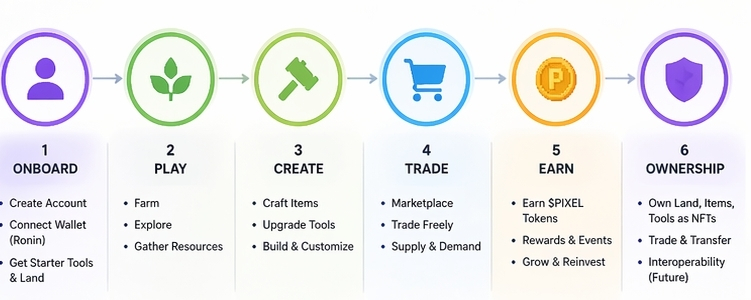
But here’s the thing that keeps bugging me, and I don’t think enough people talk about it. The whole Web3 promise of “ownership” sounds amazing, right? You own your assets, your progress, your time. Cool. But ownership only matters if there’s demand. If nobody wants what you have, it’s just data sitting in a wallet. Pixels tries to solve this by making everything part of a loop—resources feed into crafting, crafting feeds into trade, trade feeds back into farming—but it’s still fragile. If player interest drops, the whole thing can wobble.
And yeah, January 2026, we’ve seen enough projects come and go to know that hype cycles are brutal. One month everyone’s talking about a game, next month it’s a ghost town. Pixels has held on better than most, but it’s not immune. Nothing in this space is.
Also, let’s not pretend everyone is here for the same reason. Some people genuinely enjoy the gameplay. Others are min-maxing profits. And then there’s a middle group just vibing, doing a bit of both. That mix creates tension. You’ll see it in the markets, in chat, everywhere. The “fun players” get annoyed when things feel too grindy, the “profit players” get annoyed when rewards aren’t optimized. It’s a constant push and pull.
Actually, wait… this part is important. The grind. Pixels isn’t free from it. You will grind. You’ll plant, harvest, repeat. Over and over. The difference is whether it feels like work or not. Some days, it’s relaxing. Other days, it feels like you’re clocking in for a shift. That line is thin, and if the game crosses it too often, people bounce.And then there’s the token itself. PIXEL. It’s not just a currency, it’s a pressure point. If the price goes up, everyone gets excited, more players join, activity spikes. If it drops, you can feel the mood shift almost instantly. People get quieter. Less trading. Less energy. It’s kind of wild how much a number on a chart can affect behavior inside a game.
But you know what? That’s also what makes it fascinating. You’re not just playing, you’re observing human behavior in real time. Incentives, reactions, decisions. It’s like a tiny economic experiment wrapped in a farming sim.I keep thinking about why this works, or at least why it works better than most Web3 games. And I think it comes down to one thing. It doesn’t try too hard. It’s not screaming “this will change everything.” It’s just doing its thing. Farming, crafting, trading. Letting players figure it out.
Anyway, there’s also this weird psychological hook. Once you’ve invested time, built up your land, figured out the systems, you don’t want to leave. Not because you’re forced to, but because you’ve created something. Even if it’s just a digital farm, it feels like yours. That sense of ownership—real or perceived—matters more than any token reward.
But yeah, I wouldn’t call it perfect. Far from it. There are clunky systems, occasional bugs, balancing issues that make you question what the devs were thinking. And sometimes the economy does things that feel straight-up irrational. But maybe that’s part of the charm. It’s not polished to death. It’s alive, in a messy way.
Let’s be real, though. The biggest question is sustainability. Can this thing last? Can it keep players engaged without relying on constant token incentives? That’s the test every Web3 game faces. Pixels is doing better than most, but the pressure’s always there.
And I guess that’s why I keep coming back to it. Not because it’s perfect, or because I think it’s the future of gaming or whatever people like to say. It’s just… interesting. It feels like we’re in the middle of something experimental, something that could either stabilize into a genuinely fun, player-driven world or slowly drift into irrelevance if the balance tips the wrong way.
And honestly, watching that play out in real time is half the appeal.
