
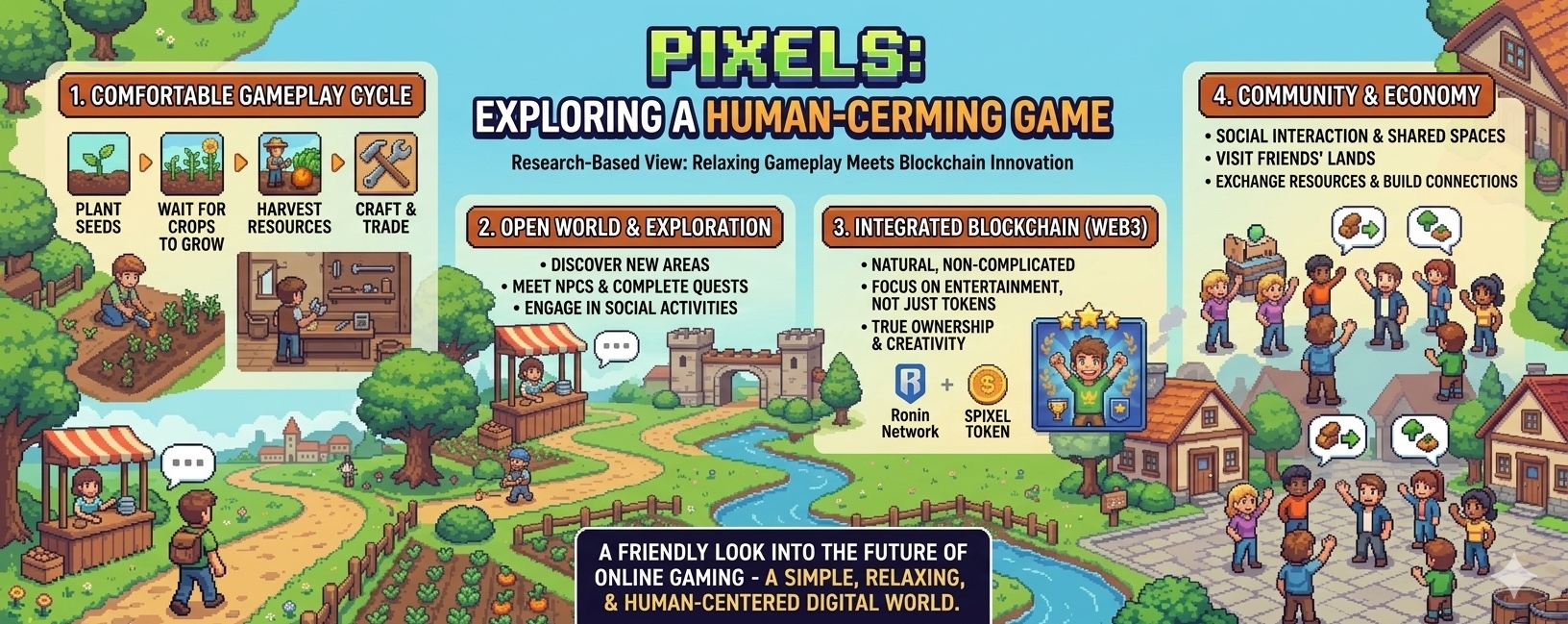
When I look at Pixels, I do not see it as just another casual farming game. I see it as an interesting example of how Web3 gaming is trying to become more natural, social, and easy for everyday players. Pixels, also known as PIXEL, is a social open-world game powered by the Ronin Network. It brings together farming, exploration, crafting, land development, and online community interaction in one simple but engaging environment.
What makes Pixels important is its ability to mix familiar gameplay with blockchain-based features. Many people feel that Web3 games are difficult to understand because they often focus too much on tokens, wallets, and trading. Pixels takes a softer approach. It first gives players a calm and enjoyable world where they can plant crops, collect resources, complete tasks, and build their own progress. The blockchain part supports the experience, but it does not completely control the fun of the game.
From my point of view, farming is the foundation of Pixels. A player plants seeds, waits for crops to grow, harvests them, and then uses those items for crafting, missions, or trading. This simple activity creates a steady gameplay cycle. It also teaches players about planning and resource management. For example, I may choose to grow a certain crop because it is needed for a quest, while another player may focus on producing items that are useful in the game economy.
The open-world structure also adds depth. Players are not locked into one repeated task. They can explore different areas, meet characters, discover opportunities, and take part in social activities. This makes the game feel more alive. I believe this is one reason Pixels has gained attention. It does not only reward activity; it encourages participation.
Another strong part of Pixels is its community-based design. Players can interact, visit spaces, exchange resources, and become part of a shared digital world. This social layer is important because games become more meaningful when people are connected through them. In Pixels, personal progress and community engagement work together.
The PIXEL token adds another layer to the game’s economy. It can support rewards, transactions, and different in-game uses. However, the real value of Pixels is not only in its token. Its value comes from how well it combines entertainment, ownership, creativity, and social interaction.
In my research-based opinion, Pixels represents a more practical direction for Web3 gaming. It shows that blockchain games do not need to feel complicated or purely financial. They can be simple, relaxing, and human-centered. Pixels is a digital farming world where players can create, explore, trade, and connect while experiencing the future of online gaming in a friendly way.