
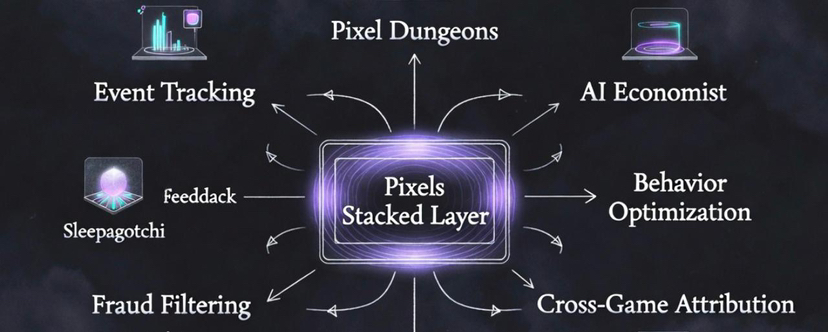
If Stacked was just a feature, Pixels wouldn’t be building a business around it.
That’s the part that changed how I read the whole announcement.
At first glance, it looks like a better reward layer. Cleaner missions, smoother flow, more control. But the deeper you go, the less it looks like something built only for one game.
Because the system underneath is too heavy for that.
You don’t build something with this many moving parts unless you expect it to operate beyond a single environment.
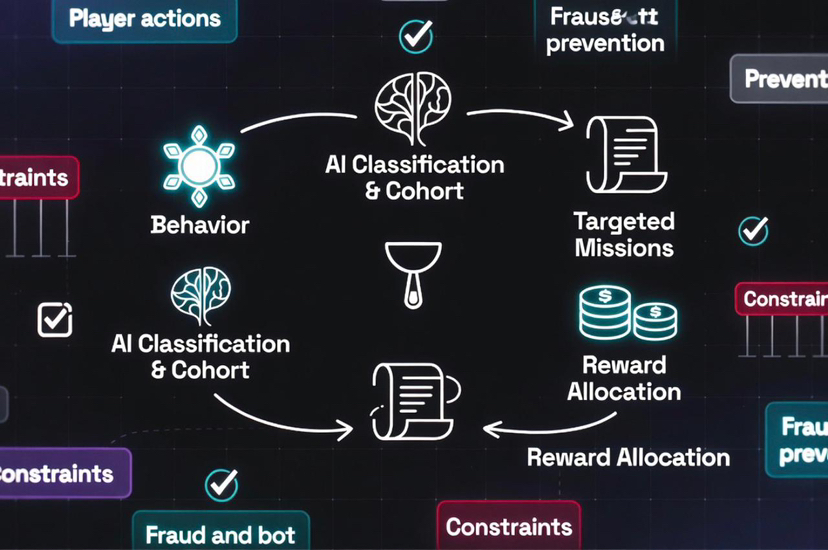
Event tracking, behavior classification, targeting, reward logic, fraud filtering, attribution, an AI economist layer that’s not a feature stack. That’s infrastructure.
Not the kind you design manually either. Most of this only works if parts of it are model-driven. Classification isn’t static. Cohorts shift as behavior shifts. Reward sizing likely adjusts against marginal outcomes, not fixed rules. That’s closer to continuous optimization than game design.
More specifically, it’s automated LiveOps logic. The part most studios still run manually, or guess through dashboards, is being abstracted into a system that executes decisions continuously.
And infrastructure doesn’t stay inside one product for long.
The easiest mistake is to focus on the player side.
Open the app, complete missions, earn rewards, move across games. That’s what people see.
But that’s not where the value is being built.
The real system sits underneath that surface.
Every action inside a game becomes an event. That event is processed, grouped, and evaluated against something the system is trying to optimize.
Some players get missions that pull them deeper into loops.
Some get pushed toward spending.
Some get filtered out entirely.
That decision is not content.
It’s allocation.
And allocation implies measurement. Attribution isn’t just did the player act, it’s which action actually moved the outcome. If a reward doesn’t improve retention, depth, or spend within a defined window, it loses priority. That turns rewards into something closer to budgeted experiments than fixed incentives.
And it follows a loop that keeps tightening over time:
behavior → classification → cohort → mission → reward → outcome → feedback
The important part is that this loop doesn’t reset. It compounds. Each cycle reduces uncertainty around what a specific player type responds to, which means future rewards become more precise and harder to exploit.
Once that loop works reliably, it stops being tied to a single game.
It becomes something you can plug into other systems.
Which is exactly how ad networks and recommendation systems scaled. Once decision making outperforms human tuning, it stops being a feature and starts being a dependency.
That’s where the business model starts shifting.
Pixels isn’t just monetizing its own players anymore.
It’s building the layer that decides how other games spend their reward budgets.
And that’s a very different position.
Because most studios don’t actually know if their rewards are working.
They see activity spikes, but not whether that activity turns into retention, revenue, or anything that lasts. So they increase rewards, hoping to fix the problem, and usually make it worse.
The issue isn’t lack of incentives.
It’s lack of control.
Stacked closes that gap by forcing every reward to justify itself.
Not in theory, but in outcomes.
Did this payout bring the player back?
Did it move them into a deeper loop?
Did it create real spend?
If not, it gets adjusted or removed.
That’s where return on reward spend becomes real.
Rewards stop being something you give away.
They become capital you allocate.
And once you see them that way, every payout has to justify its existence like an investment, not an incentive.
This is also why the soft launch matters more than it looks.
If you’re building a system that controls incentives at this level, you don’t scale it blindly.
Because scale hides mistakes.
And in systems like this, hidden mistakes don’t stay small. They get amplified through reward distribution.
You get more data, but less clarity.
Starting inside Pixels, Pixel Dungeons, Sleepagotchi, and Chubkins gives the team something most platforms don’t have: controlled environments where behavior is already understood.
They know where players break.
They know how bots farm.
They know what real engagement looks like.
So every adjustment teaches them something precise.
Not just what worked but where it fails next.
That’s the kind of learning you can’t shortcut.
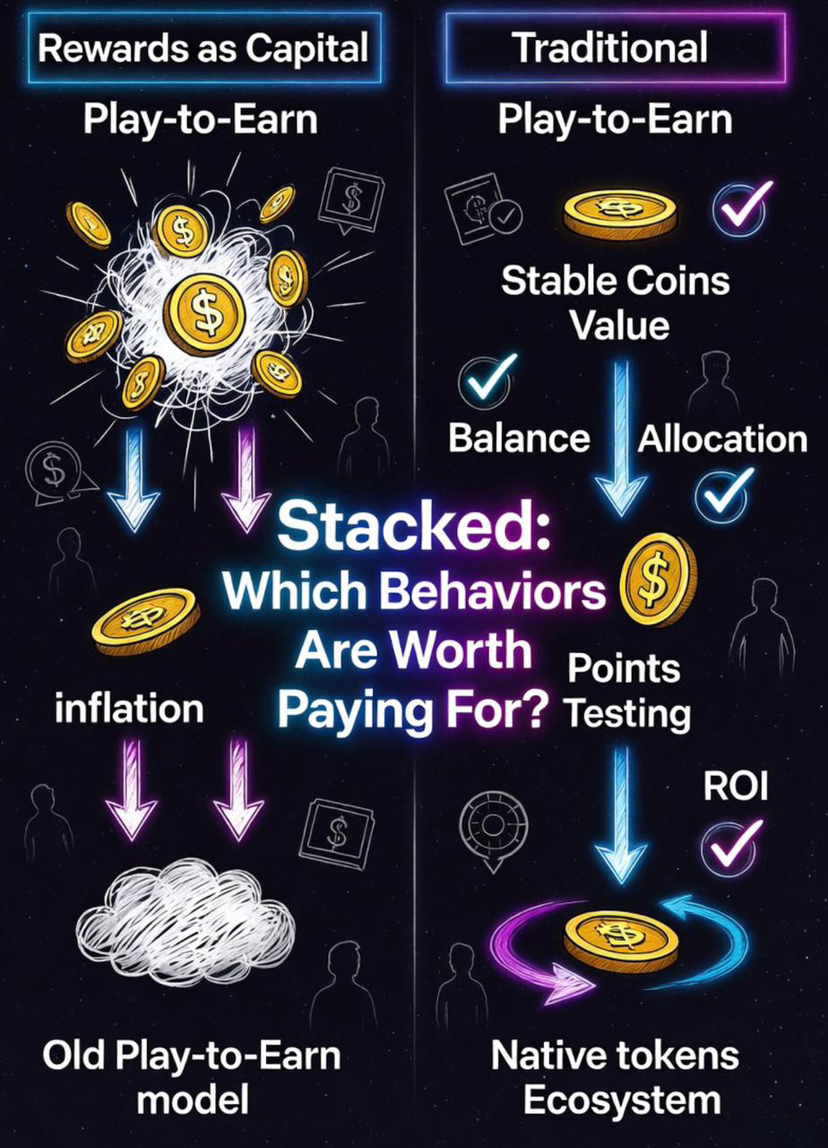
The multi reward direction quietly supports this shift.
Most systems force one token to do everything. Reward, liquidity, speculation, alignment.
That creates pressure from every direction.
Increase rewards, and you create sell pressure.
Reduce them, and engagement drops.
You end up balancing one asset against itself.
Stacked removes that constraint.
Different reward types can do different jobs.
Stable assets can represent immediate value.
Native tokens can tie into the ecosystem.
Points can test behavior without external pressure.
That separation gives the system control over how value flows.
And it makes the system usable for other studios who don’t want to rebuild their entire economy from scratch.
If you step back, the shift becomes clear.
Pixels isn’t just building a better game economy.
It’s building the system that decides which player behaviors across games are worth paying for.
And once that system proves itself, it doesn’t stay internal.
It becomes something other studios plug into to:
optimize retention
reduce wasted reward spend
limit bot extraction
improve LiveOps decisions
At that point, reward design stops being design.
It becomes capital allocation under uncertainty.
The closest comparison isn’t another game. It’s ad-tech. Real-time bidding systems decide where marketing dollars go based on expected return. Stacked is doing something similar, but with player behavior instead of impressions.
At that point, Pixels stops being just a game.
It becomes the layer that controls how games pay for growth.
There’s also a difference in how this is being positioned.
Earlier play-to-earn models were built on promises.
If enough players come, the system will sustain itself.
Stacked doesn’t rely on that.
It points to what already happened.
Millions of players.
Hundreds of millions in rewards.
Thousands of iterations.
And then it says: this system already helped stabilize our own economy.
That’s not a vision.
That’s productization.
The question has changed.
GameFi used to ask:
how do we pay players?
Stacked asks something harder:
which behaviors are actually worth paying for?
That sounds less exciting.
But it’s the only question that keeps a system alive.
Because once rewards become capital, not giveaways, everything tightens.
You don’t reward activity because it exists.
You reward it because it produces something that lasts.
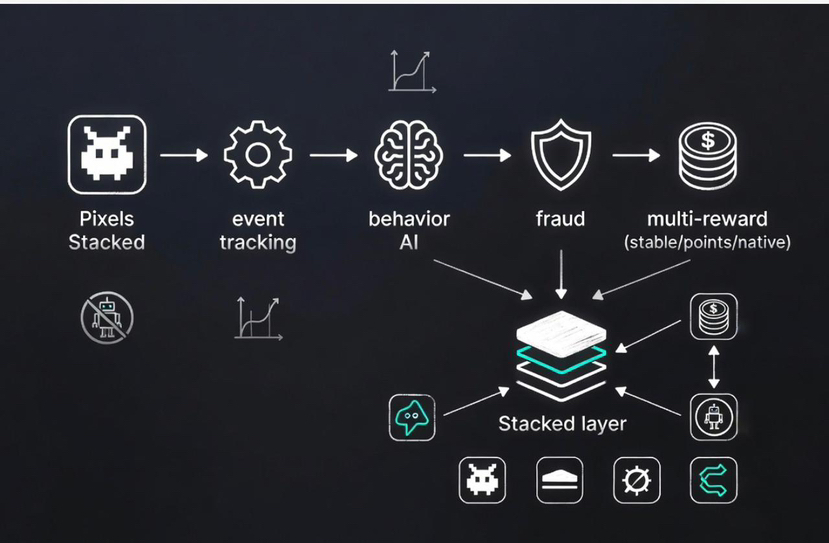
That’s why Stacked doesn’t feel like a feature.
It feels like the layer Pixels had to build after realizing that reward design was the real bottleneck.
And once you solve that problem well enough, it stops being something you keep inside your own game.
It becomes something other systems depend on.
Pixels isn’t trying to make rewards better.
It’s deciding where rewards are allowed to exist.
The difference is simple.
Games used to distribute rewards.
Now they’re starting to allocate capital.
