
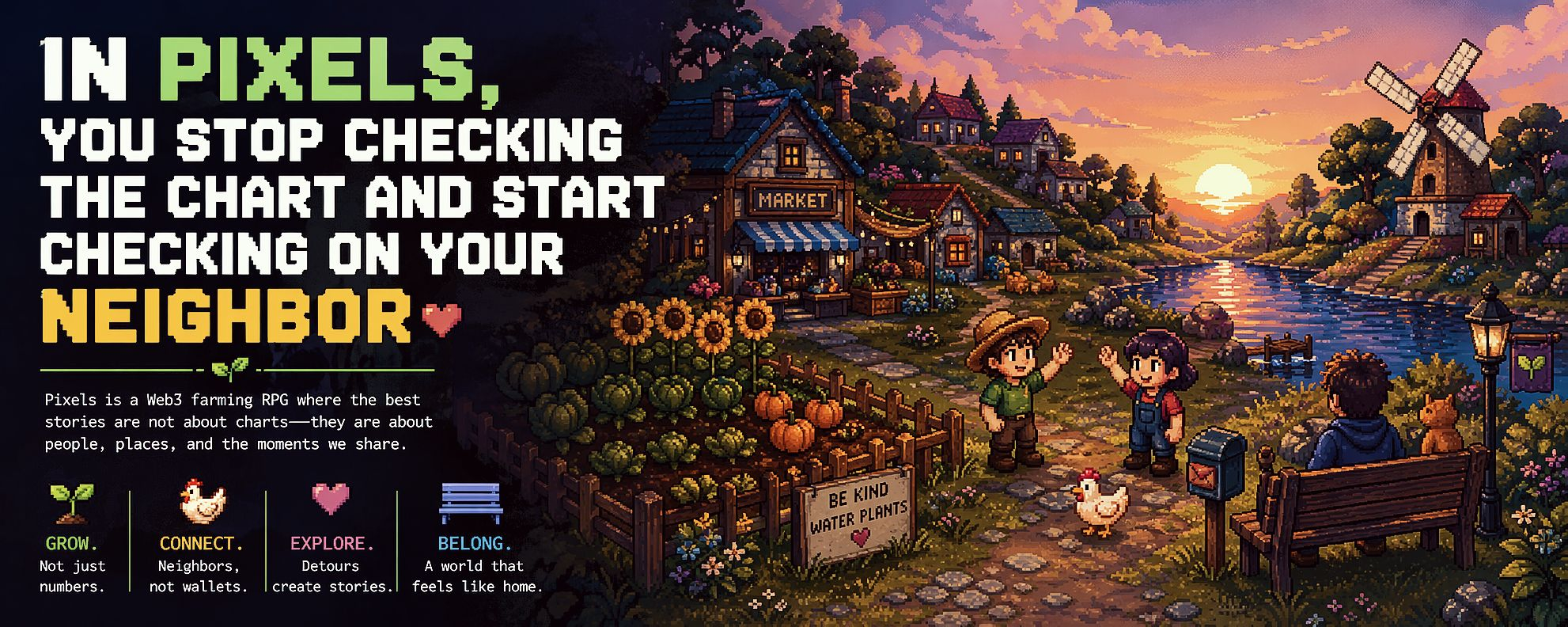
It happens in every Web3 game. You join the Discord, and within an hour, someone is posting a chart. Price predictions. Yield calculations. Break-even timelInes. Suddenly nobody is talking about the game anymore. They are talking about the numbers behind it. And before you know it, even the people who just wanted to relax are checkIng token prices instead of checking on their crops. The game becomes a chart story. And chart storIes are exhausting.
Pixels is not innocent here. There are tokens, there are markets, there are people watching prices. That is just reality. But something strange happens when you actually spend time in Pixels. The chart fades. Not because you stop caring about value. But because the game gives you something else to care about first. It gives you a player story. 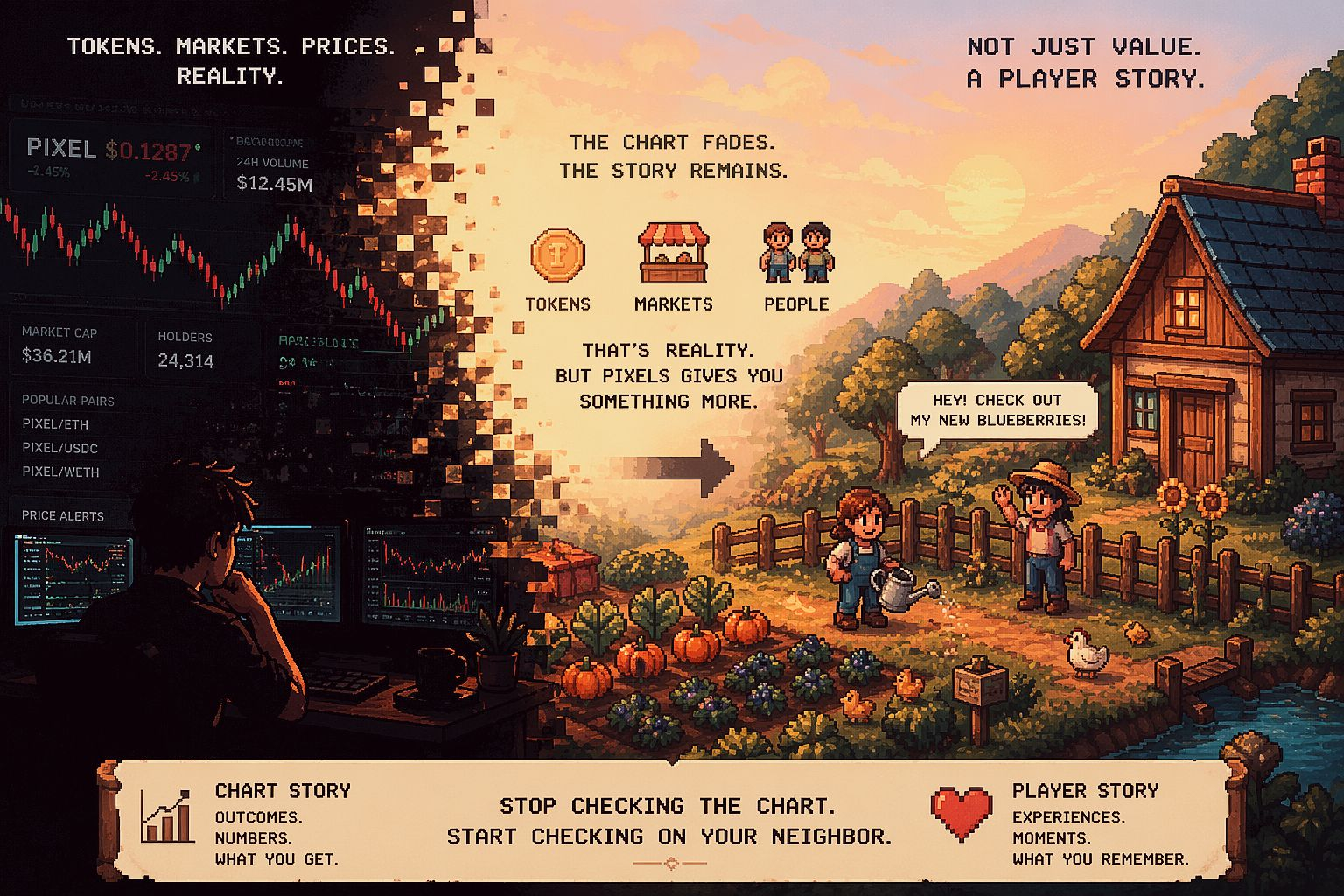
Talk tO someone who has been playIng for a few months. Ask them what they did yesterday in PiXels. They are not going to tell you about their ROI. They will tell you about the new fence they buIlt. The pumpkin they accidentally watered twice. The neighbor who showed them a hidden fishing spot behind the windmill. Those are not economIc updates. Those are small, goofy, human narratives. They have characters and mistakes and little victories that nobody else would care about except that they happened to this specific person in this specific place.
That shift, from chart to player, does not happen by magic. Pixels designs for it. The game never forces a dashboard in your face. There is no flashing price ticker in the corner. When you lOg In, you see your farm. Your crops need water. Your chickens are hungry. The sun is settIng over the hill where your friend planted those sunflowers last week. The game presents itself as a place first and an economy second. That orientatIon changes what you pay attention to. You start looking at the world, not your wallet.
Think about most Web3 games. They ask you to track so much. Liquidity pools. StakIng rewards. Floor prices. Volume. That list just keeps going. Those are not game mechanics. They are financial instruments dressed up as gameplay. And sure, they produce a certain kind of player story. But it is a thin one. I bought low and sold high. I minted early and flIpped it. Swap the names and the numbers, and you have the same arc repeated a thousand times.
Pixels produces thicker stories. They sound different. There is the player who spent twenty minutes chasing a runaway chicken. The one who accidentally planted carrots in a perfect straight line and then decided to leave them because the symmetRy looked nice. The one who logs in every evening just to siT on a specific bench near the marketplace because that is where they first met someone who became a friend. Those stories have no financial value. And that is exactly why they matter. They are not about extraction. They are about experience.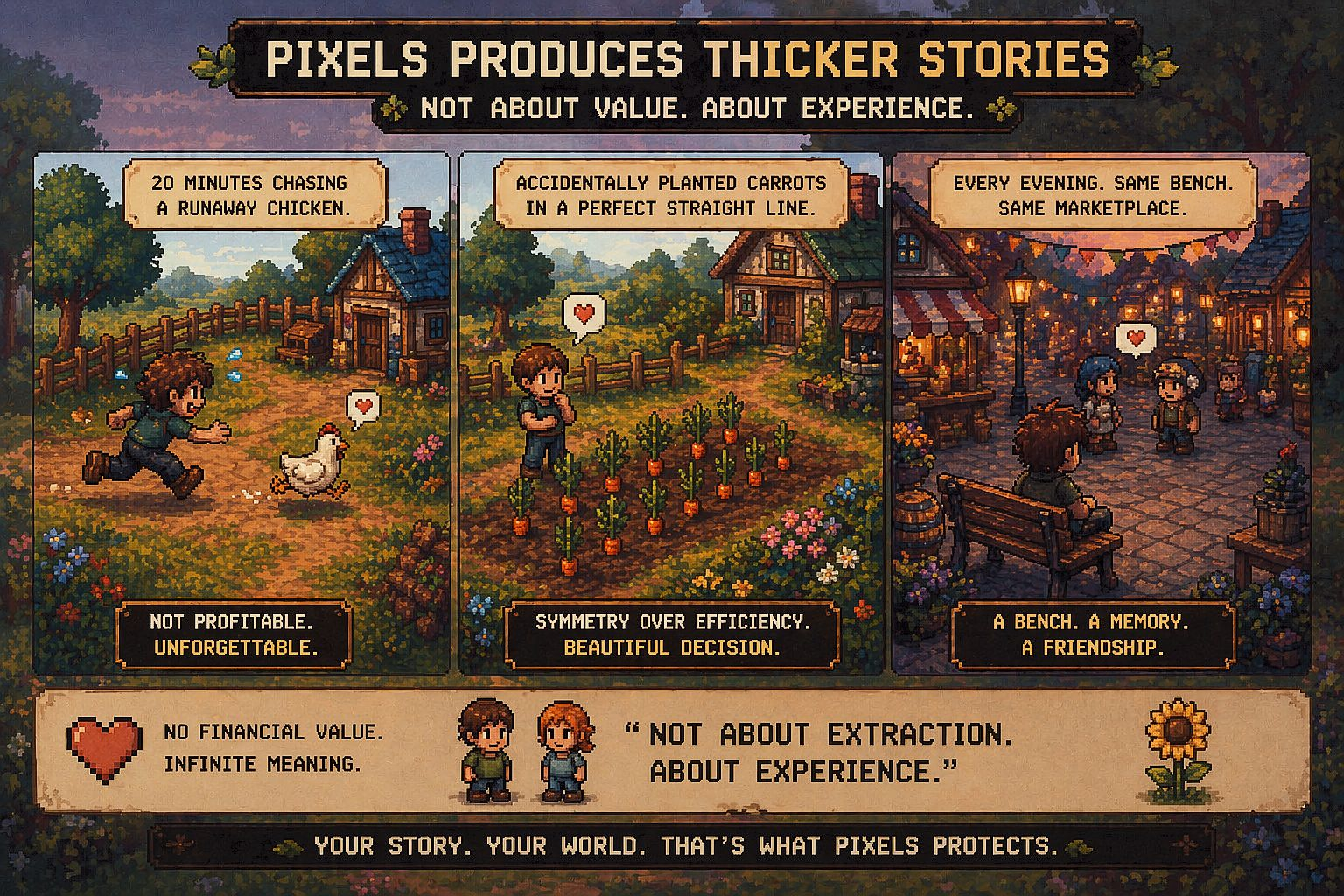
The game feeds these stories through its design. Progression in Pixels is slow. Crops take real hours. Animals need daily attention. You cannot rush everything. That slowness creates gaps, and gaps leave room for the unexpected. You wander while waiting for your pumpkins to grow. You notice a neighbor's gate is left open. You walk in, see their farm, maybe leave a little note. None Of that was scripted. The game did not give you a quest to explore. It just left the door open and trusted your curiosity. That is how player stories start. Not with a reward. With an invitation.
Here is another thing. Player stories in Pixels tend to Include other people, but not in that cold, transactional way most Web3 games do. You are not trading with a stranger to optimize your yield. You are trading because you need clay and they have extra, and while you are there, you notice they grow blueberries in a pattern you have never seen. The social thing happens because it is not required. You can play Pixels entirely alone. The fact that you choose to talk to someone, to help them, to remember their name that choice is the seed of a story.
The chart story, honestly, leaves little room for choice. It optimizes everything. It tells you the most efficient path, the best crop, the highest yield. Efficiency is the enemy of narrative. Stories live in detours, mistakes, preferences that cannot be justified by numbers. You plant sunflowers instead of blueberries because you like the way they look. You build a fence that costs more than it earns because it makes your farm feel like home. Those deciSions are economically dumb and narratively essential. Pixels does not punish you for them. It quietly rewards you with a world that feels like yours.
Maybe that is the real difference. Chart stories are about outcomes. Player stories are about presence. A chart tells you where you ended up. A player story tells you what it felt like to be there. Pixels chooses presence. It says, do not worry about the prIce of your pumpkins right now. Just water them. Look at how the light hits the leaves. Over there, someone is waving at you. Go see what they want. The tokens will still be there later. But the moment when you fIrst helped a neighbor harvest their field, when you found that hidden pond, when you sat on that bench and watched the sun set over a world you helped build? That moment is yours. No chart can grab it. And no chart can take it away.