
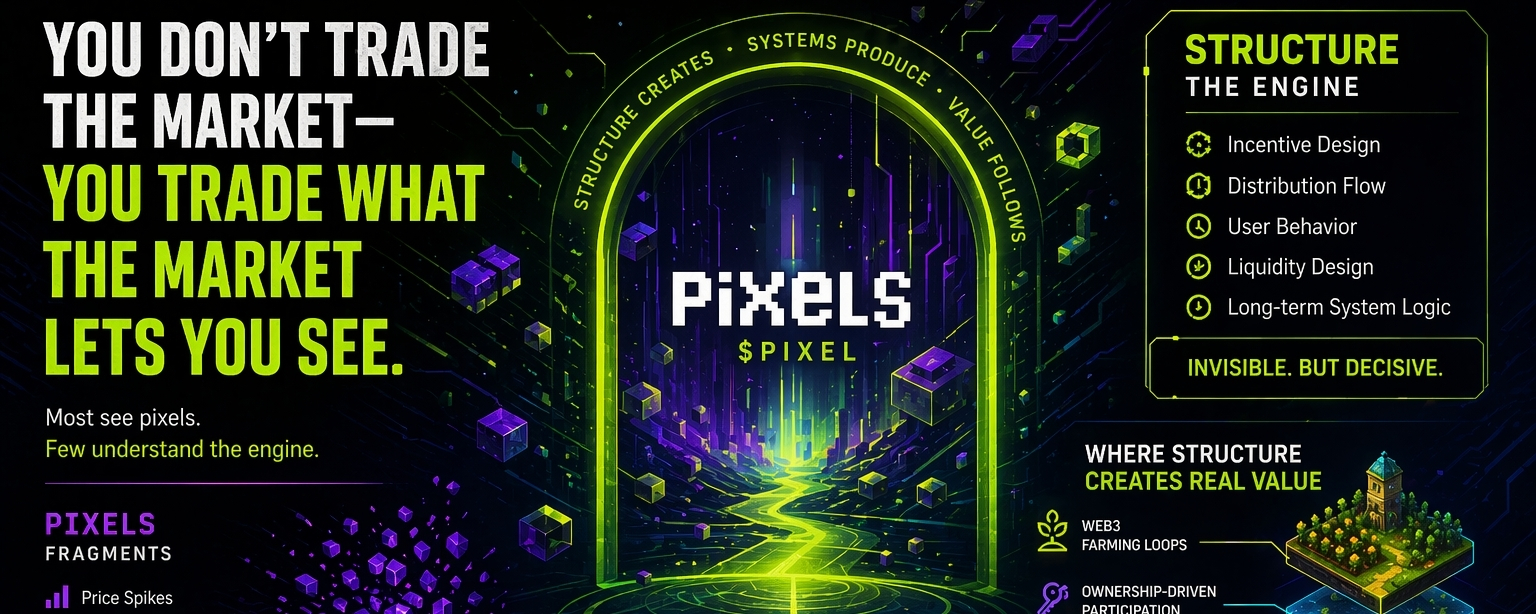
Most traders react to pixels — isolated fragments like price spikes, trending tokens, sudden social attention. These look like signals, but they are incomplete inputs. They trigger emotion, not understanding.
Structure is different. It’s the full mechanism behind those fragments — incentives, distribution flow, user behavior, liquidity design, and long-term system logic. While pixels move attention, structure is what actually produces those movements.
This is where most participants misread digital markets. They assume visibility equals opportunity. So they chase narratives, hype cycles, and short-lived momentum, believing they are early—when in reality, they are late to something already visible.
In ecosystems like @Pixels and $PIXEL the real shift is structural: Web3 farming loops, ownership-driven participation, and in-game economies where value is created through engagement, not just speculation. The system rewards those who interact with the structure itself, not those who only react to outcomes it produces.
Smart money behavior is not about reacting faster—it’s about understanding deeper. It doesn’t compete for pixels; it studies how pixels are generated. It tracks incentive design, user flow, and the silent mechanics that decide where attention and liquidity eventually concentrate.
Most will only see the outcome.
A few will understand the engine.
So the final question is—are you still interpreting fragments as signals, or are you learning to position yourself inside the structure that decides what becomes visible next?



#pixel #MarketRebound #StrategyBTCPurchase #meme板块关注热点 #TrendingTopic