

Pixels is one of those Web3 gaming projects that looks simple on the surface, which is probably why it is more interesting than the louder projects around it. It does not begin with a dense financial interface or some over-polished pitch about changing gaming forever. It starts with a small pixel-art world, a few basic tasks, some crops, some resource gathering, and a social space where players can move around and interact
That matters
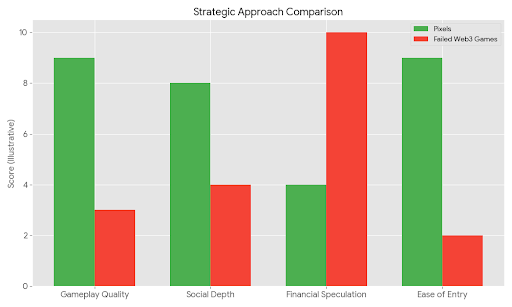
I’ve seen a lot of blockchain games fail because they were built backward. The token came first. The marketplace came second. Somewhere near the end, someone remembered there was supposed to be a game. Pixels feels different because the core experience is at least understandable before the crypto layer enters the conversation
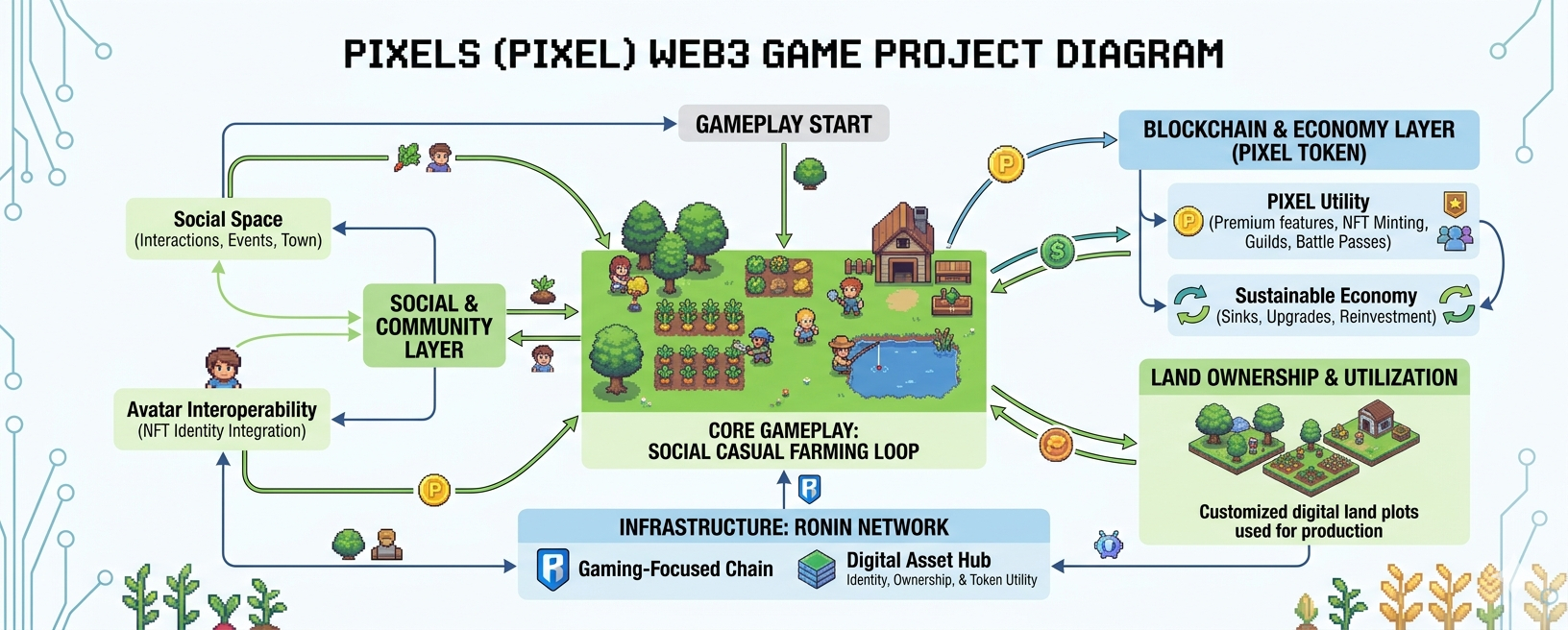
Pixels, or PIXEL in token terms, is a social casual Web3 game built on the Ronin Network. The basic idea is farming, exploration, creation, and social interaction inside an open-world environment. Players plant crops, collect resources, finish quests, manage progression, and take part in an economy that uses blockchain for ownership, identity, and token utility
That sounds clean when written in a project description. The reality is messier
Any game that introduces tokens has to deal with incentives. People do not behave the same way when a system offers financial rewards. Some players come to play. Some come to farm value. Some come with scripts, multiple accounts, and no attachment to the world at all. That is not a moral judgment. It is just what happens when game loops and financial loops overlap
Pixels is interesting because it seems to understand that problem better than many earlier play-to-earn projects did
The farming loop is familiar. Plant something. Wait. Harvest it. Use it, sell it, or turn it into something better. Repeat. Casual games have relied on this structure for years because it gives players a steady sense of progress without demanding constant intensity. It is low pressure, but it still creates attachment. Your farm improves. Your resources grow. Your routine becomes part of the reason you return
That is a good foundation for a Web3 game because it gives the system something to stand on besides speculation
The blockchain layer in Pixels does not need to be the first thing a new player understands. That is the right instinct. Wallets, tokens, NFTs, land ownership, and governance can become useful later, but they are terrible onboarding material if they show up before the player has any reason to care. A good system hides complexity until it becomes relevant
Pixels mostly follows that pattern
The move to Ronin was a major infrastructure decision. Ronin already had a history in blockchain gaming through Axie Infinity, which is both an advantage and a warning sign. Axie proved that Web3 games could attract huge attention. It also proved that reward-heavy economies can become unstable when earning becomes more important than playing
I’ve seen this pattern in other systems too. A platform finds a growth mechanic that works, scales it aggressively, and then discovers that the mechanic was not the same thing as retention. Rewards can bring people in. They do not automatically make people stay
For Pixels, Ronin gives the project access to a gaming-focused chain, an existing Web3 audience, and infrastructure designed around digital assets. That is useful. It also raises the bar. Once a game becomes visible inside a major blockchain gaming ecosystem, it is no longer judged only as a game. It becomes evidence in a larger argument about whether Web3 gaming has matured
That is a heavy burden for a farming game
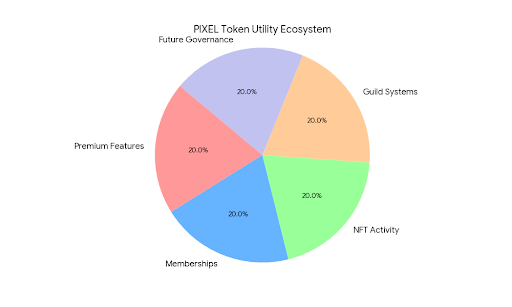
The PIXEL token sits at the center of the ecosystem’s economic design. It is meant to support premium features, NFT minting, memberships, battle passes, guild systems, and other in-game utility. Over time, it may also play a role in governance
Fine. That is the standard structure
The hard part is not creating token utility on paper. The hard part is creating reasons for players to spend, hold, and reinvest without making the game feel like a spreadsheet with animations. If everyone only wants to earn PIXEL and sell it, the economy leaks. If the game pushes too hard on spending, casual players leave. If rewards are too generous, inflation shows up. If rewards are too tight, the incentive layer loses energy
It is a mess
This is where Pixels has to be judged carefully. The project has talked about improving economic loops, adding better sinks, and building more meaningful progression. That is the right direction. A live economy needs places where value can go besides the exit door. Upgrades, land improvements, crafting systems, social status, access, convenience, and long-term progression can all help absorb value if they are designed well
But none of that works automatically
Actoken economy is not sustainable because a whitepaper says it is. It becomes sustainable only when players repeatedly choose to put value back into the system because doing so improves their experience. That is a much higher standard
Land is one of Pixels’ more practical ownership systems. In weaker NFT games, land is often just a speculative object with a map coordinate attached. People buy it because they hope someone else will want it later. That model can work during hype cycles, but it does not create a durable world by itself
Pixels tries to make land part of the game. Player-owned land can be customized, used for production, and connected to activity from other players. That is closer to useful infrastructure. A digital asset becomes more convincing when it has a job
Ownership needs function. Otherwise it is ecoration
The same applies to avatar integrations. Pixels allows players from other NFT communities to bring recognizable digital identities into the game. I do not think interoperability needs to be magical to be useful. Most of the time, it just needs to be practical. Let people carry an identity from one environment into another. Let it show up somewhere social. Let it create recognition
That is enough
The social layer may be the most important part of Pixels. Not the token. Not the land. Not even the farming loop
People return to games for many reasons, but social presence is one of the strongest. A world feels different when other people are in it. You notice familiar names. You compare progress. You visit spaces built by others. You trade, talk, attend events, or simply exist in the same environment. That kind of presence is hard to fake
Many blockchain games are technically multiplayer but emotionally empty. Players interact with markets more than with each other. They move assets around, claim rewards, and optimize tasks, but the world itself feels dead. Pixels has a better shot because it starts from a town-like structure rather than a purely transactional one
That does not mean it is safe from the usual problems
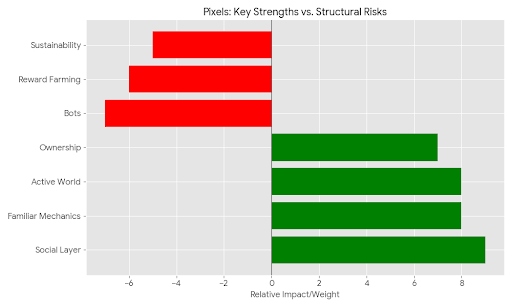
Bots are unavoidable in any rewarded system. The moment an action has financial value, someone will automate it. If an economy rewards repetitive activity, people will industrialize repetition. If a system distributes tokens based on engagement, people will manufacture engagement
I’ve seen this fail in gaming, advertising, loyalty programs, referral systems, and marketplaces. Different labels. Same failure mode
Pixels has to separate useful activity from extractive activity. That is not easy. Wallet counts can look impressive, but wallets are not the same as people. Activity can be real and still low quality. A system can grow quickly while quietly filling with participants who have no interest in the product itself
The better approach is to reward behavior that strengthens the world: long-term participation, useful creation, social interaction, reinvestment, cooperation, and progression that adds value for others. That requires measurement. It also requires restraint. Not every click deserves a reward
This is where Web3 gaming needs to grow up
The first wave of play-to-earn often confused payment with engagement. Players were treated like workers, and the game became a task board. That can produce numbers for a while. It does not produce a culture. Once the rewards weaken, the workers leave
Pixels seems to be moving toward something more balanced: play, own, create, socialize, and earn where earning makes sense. That is a healthier model. Still difficult. Still full of tradeoffs. But healthier
The game also has to keep its casual players in mind. Not everyone wants to think about token sinks, governance, emissions, or liquidity. Some people just want to farm, decorate, explore, and talk to other players. If the economic layer becomes too dominant, Pixels risks losing the warmth that makes it approachable
That is the tension
For Web3 users, the ownership systems are part of the appeal. For ordinary players, too much visible crypto machinery can feel like noise. Pixels has to serve both groups without letting either one ruin the experience for the other
That is not a branding problem. It is a systems problem
The game needs enough content to keep people engaged beyond the early loop. Farming is comforting, but repetition gets thin if the world does not expand. Players need new goals, new social moments, better events, more meaningful upgrades, and reasons to care about the spaces they build
A live game is never finished. The moment the content pipeline slows down, players start to feel the seams.l
Pixels’ broader ambition appears to go beyond one farming game. The project seems to be exploring a wider model around player identity, behavioral data, rewards, publishing, and Web3-native user acquisition. That is worth paying attention to, even if the language around it can drift into the usual industry fog
User acquisition in gaming is expensive. Retention is harder. Web3 incentives can reduce friction, but they can also attract the wrong users. If Pixels can use rewards more intelligently, not just more generously, it could become a useful model for other games
That is the optimistic infrastructure view
The skeptical view is that this is still a hard design space with a long history of failure. Tokenized economies are fragile. Social worlds are difficult to moderate and grow. Casual games need constant tuning. Crypto markets add volatility that game designers cannot control. A good product can still be dragged around by a bad market cycle
So Pixels deserves attention, but not blind faith
Its strongest advantage is that it begins with an actual game loop. A simple one, yes, but simple is not bad. Simple is often where durable systems start. Farming gives the game rhythm. Social spaces give it texture. Land gives ownership a purpose. The PIXEL token gives the economy a coordination layer. Ronin gives it infrastructure
The question is whether all of that can hold together under pressure
I am cautiously optimistic because Pixels is not trying to make blockchain the whole experience. It uses blockchain as part of the system. That is how this stuff should work. Infrastructure should support the product, not demand constant attention from the user
If Pixels succeeds, it will not be because it shouted louder than every other Web3 game. It will be because it made the crypto layer feel useful, kept the world accessible, and gave players reasons to return that were not purely financial
That is the real test
A game does not become durable because people can earn from it. It becomes durable when people care enough to come back even when earning is not the main story
