
I didn’t notice it at first, but something about Pixels feels different. Not louder, not more polished, not more revolutionary. Just different in a way that is harder to explain.
It looks like a simple farming game. Crops, routines, progression, a friendly world that feels easy to enter. But underneath that softness is a system asking a much bigger question. What happens when a game stops treating your time as entertainment and starts treating it as value
That question matters because most Web3 games before it struggled with the same problem.
For years, the formula was simple. Launch a token, reward early users, create excitement, attract traders, then hope the gameplay becomes strong enough later. Sometimes it worked for a moment. Usually it didn’t.
Rewards came too fast. Inflation built quietly in the background. Players joined to earn, not to belong. Once token prices dropped or rewards weakened, activity faded with them. The economy looked alive, but the world itself often felt empty.
That is where Pixels seems more self aware.
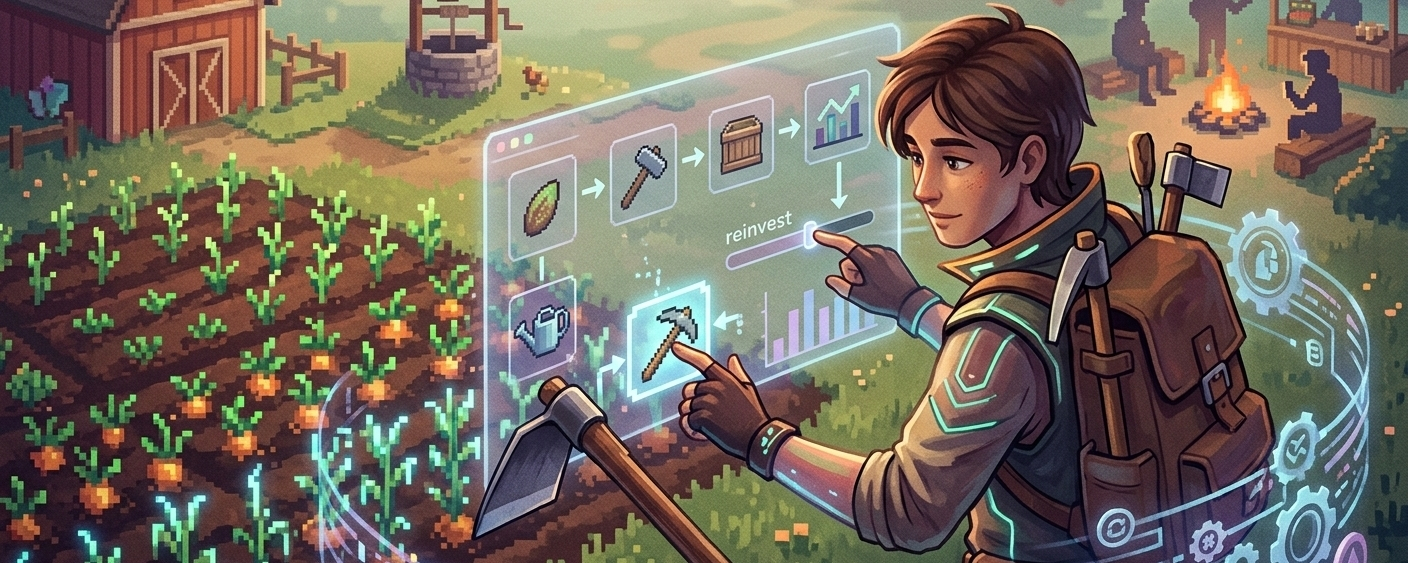
Instead of making the token the center of everything, it appears to place more weight on loops that create utility. Farming feeds crafting. Crafting supports upgrades. Upgrades improve efficiency. Land matters. Social spaces matter. Progression matters. The token still exists, but it feels more like part of the machine than the machine itself.
That shift sounds small, but behavior changes when incentives change.
When rewards are immediate and easy, people think like extractors. Log in, claim, leave. When rewards are tied to progression and reinvestment, people start thinking longer term. They begin planning instead of harvesting.
In Pixels, one player may be optimizing crop cycles and market timing. Another may simply enjoy building a daily routine. One sees numbers. Another sees comfort. Both are playing the same game, but they are living inside different meanings of it.
That is where the project becomes more interesting than it first appears.
Inflation control is not only about token supply. It is also about emotional pacing. If players receive too much too quickly, they consume motivation as fast as they consume rewards. Progress loses shape. Nothing feels valuable for long.
Pixels seems to understand that progress needs friction. Not painful friction, but enough resistance to make movement feel real. Upgrades cost something. Efficiency takes time. Better outcomes require planning. That tension creates attachment.
There is also a social truth many systems underestimate. People do not only stay for rewards. They stay for habits, identity, shared spaces, familiar names, and the feeling that their presence matters somewhere.
When a player leaves a solo game, they lose content. When they leave a living economy, they may also lose position, rhythm, relationships, and momentum. That difference is powerful.
But there is another layer beneath all of this.
Pixels may not just be rewarding players. It may be sorting them.
It quietly reveals who prefers patience over speed, who values routine over excitement, who optimizes every minute, who enjoys wandering without urgency, who cashes out early, who reinvests, who builds.
The game becomes less about farming and more about preference made visible.
That comes with trade offs.
Structure can create sustainability. Strong loops can create retention. Useful tokens are healthier than decorative ones. But efficiency can also drain wonder. Once players discover the best route, curiosity often gets replaced by repetition.
What begins as play can slowly become maintenance.
So the real question is bigger than Pixels.
Can a game contain an economy without becoming one
Can ownership deepen immersion instead of creating pressure
Can routine feel peaceful instead of transactional
I do not think Pixels has fully answered those questions yet.
But maybe that is why it matters.
It is not a finished success story or a failed experiment. It is a living attempt to balance fun with incentives, freedom with structure, comfort with optimization.
It is not perfect, and it is still changing.
The real question is not whether Pixels works today.
It is what kind of player it teaches people to become over time.
