
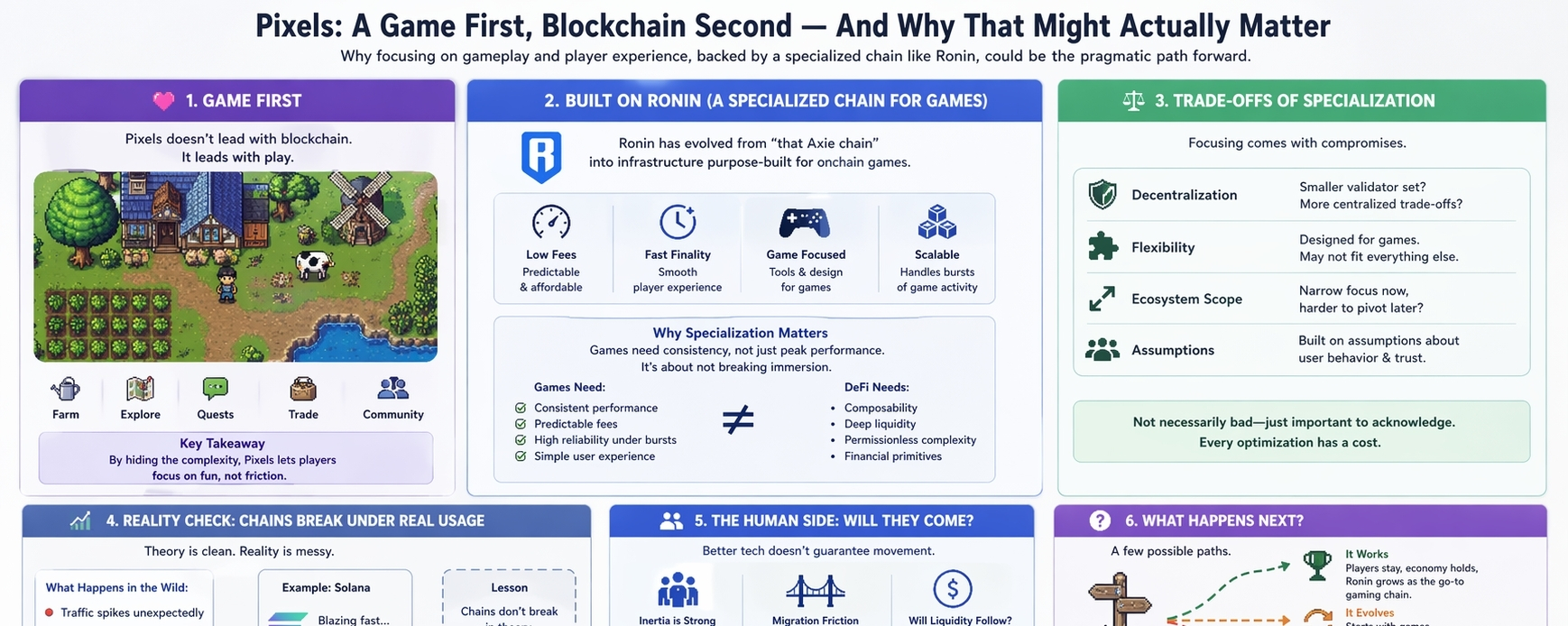
@Pixels The first time I came across Pixels, it didn’t feel like a blockchain thing at all. It felt like a game that just happened to have crypto somewhere in the background. That alone is already unusual. Most projects in this space lead with the chain, the token, the architecture diagrams. Here, the entry point is softer. You’re farming, wandering around, doing small repetitive things that don’t scream “financial primitive.” And it sits on Ronin Network, which itself has quietly shifted from being “that Axie chain” into something trying to support a broader idea of onchain gaming.
But then the old reflex kicks in. Every cycle, there’s another wave of “this is the chain that finally makes sense.” Faster, cheaper, more scalable, more user-friendly. It’s almost predictable at this point. You don’t even need to read the whitepaper anymore to guess the pitch. And after a while, you stop reacting to it. Not because none of it matters, but because most of it doesn’t survive contact with real usage.
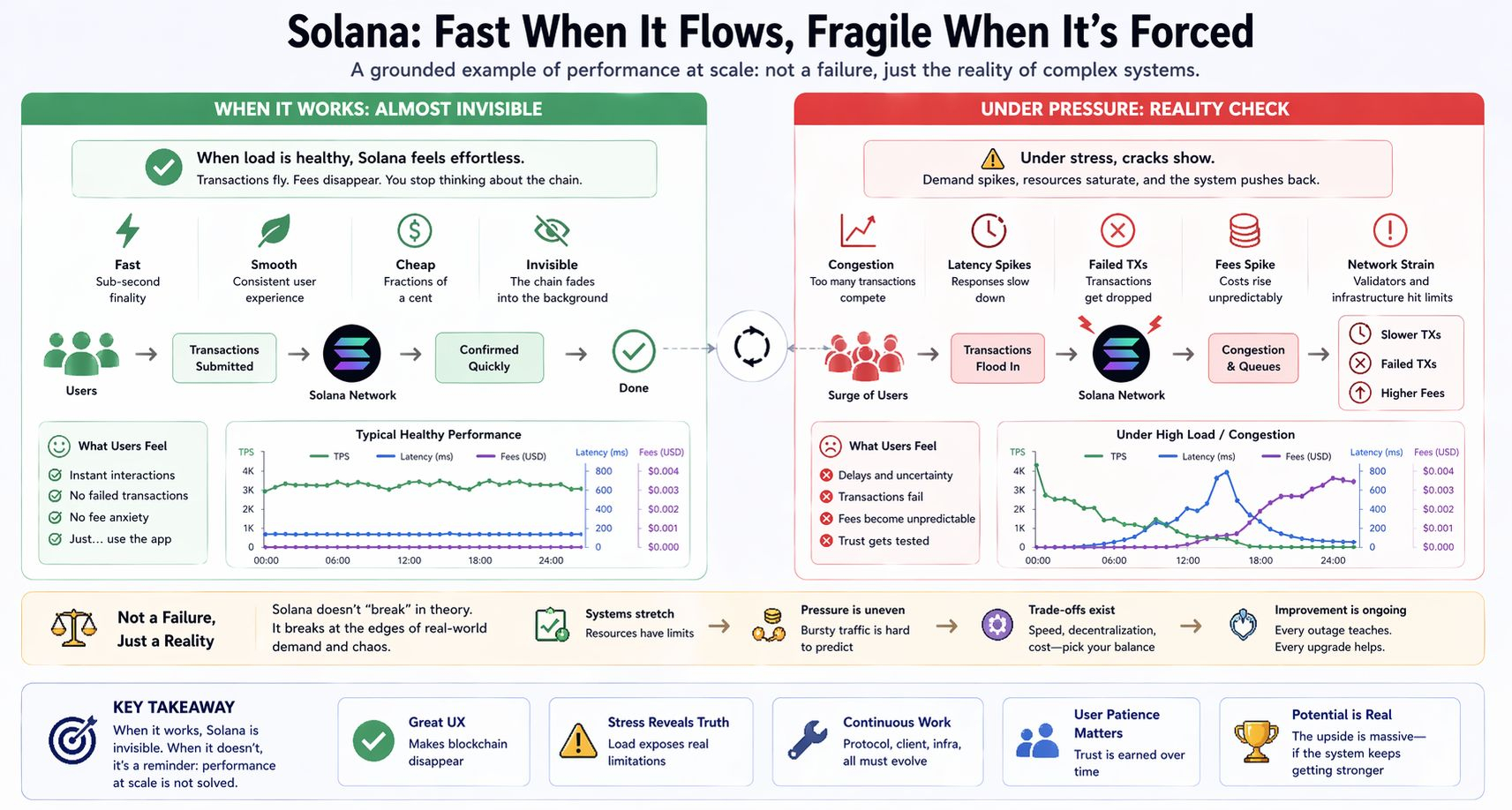
That’s the part people still underestimate. Chains don’t really break in theory. They break when people actually use them. When transactions pile up in uneven bursts. When bots show up. When one simple mechanic suddenly becomes popular and everything routes through the same narrow pathway. That’s when the cracks show. You can simulate load, sure, but real users behave in messy, irrational ways that no test environment captures.
You can look at Solana for a grounded example. When it works, it feels almost invisible. Fast, smooth, cheap enough that you stop thinking about fees entirely. And then every so often, under pressure, it reminds you that performance at scale is not a solved problem. Not a failure, just a reality. Systems stretch, and sometimes they don’t stretch gracefully.
So when something like Pixels leans on Ronin, it’s interesting not because it’s claiming to be the next dominant Layer 1, but because it’s almost avoiding that conversation altogether. Ronin isn’t trying to be everything. It’s narrowing its focus around games, which sounds obvious until you realize how rare that is. Most chains want to be general-purpose even when they’re clearly optimized for something specific.
And maybe that’s the quiet observation here. Games don’t need the same things DeFi does. They don’t need hyper-composable financial layers or endless token permutations. They need consistency. They need predictable fees. They need systems that don’t fall apart when a few thousand players decide to do the same action at once. It’s less about peak throughput and more about not breaking immersion.
But that comes with trade-offs, whether they’re explicitly stated or not. Specialization always does. If you optimize for games, you’re probably simplifying other things. Maybe you’re less decentralized than the purists would like. Maybe you’re relying on a smaller validator set, or making assumptions about user behavior that wouldn’t hold in a more adversarial environment. And maybe that’s fine. Or maybe it becomes a problem later, when the system is asked to do something it wasn’t designed for.
There’s also the uncomfortable question of movement. Not technical movement, but human movement. Will users actually migrate? Will liquidity follow? Or does everything just stay where it already is because inertia is stronger than any marginal improvement? People underestimate how sticky existing ecosystems are. It’s not just about better tech. It’s about habits, communities, and the quiet friction of starting over.
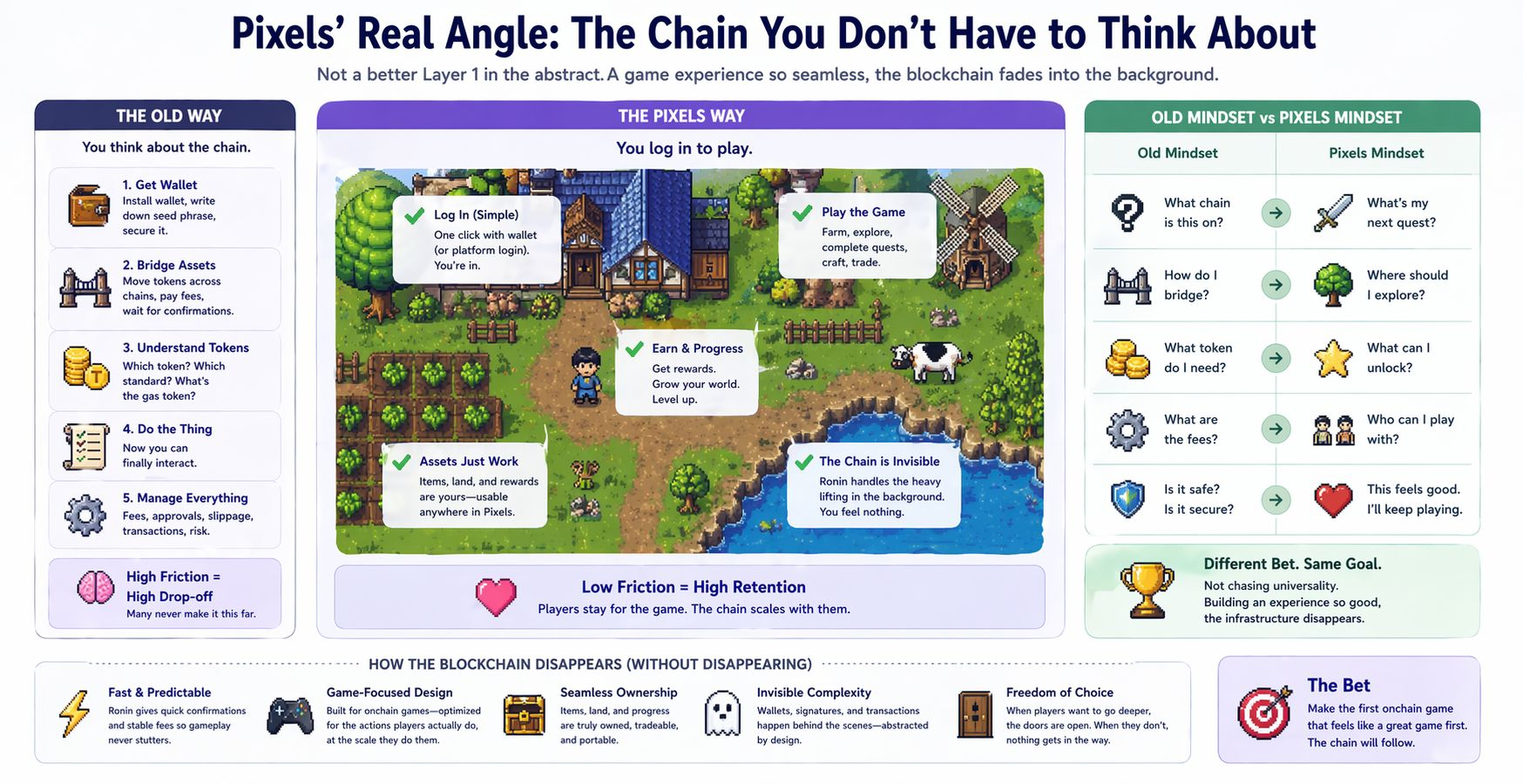
Pixels itself sort of sidesteps that by not asking users to think in those terms. You don’t log in thinking about bridges or token standards. You log in to play. And maybe that’s the real angle. Not building a better Layer 1 in the abstract, but embedding it so deeply into an experience that users don’t notice it anymore. It’s a different kind of bet.
Still, there’s a lot that could go wrong. Games are fragile in their own way. Player interest shifts quickly. Economies spiral if they’re not carefully balanced. And tying that to a blockchain layer adds another dimension of complexity. If the game fades, does the chain lose relevance? Or can it support something else just as naturally?
I don’t know. That’s the honest answer. There’s something sensible about focusing on a narrower use case and trying to actually make it work instead of chasing universality. But we’ve seen sensible ideas fail before, for reasons that had nothing to do with the original design.
It might work. Or nobody shows up.
