

I was just scrolling through a few Web3 games late at night. Nothing serious. Just passing time. Then I opened Pixels again. I had seen it before but never really thought much about it. This time I stayed longer.
Something felt different.
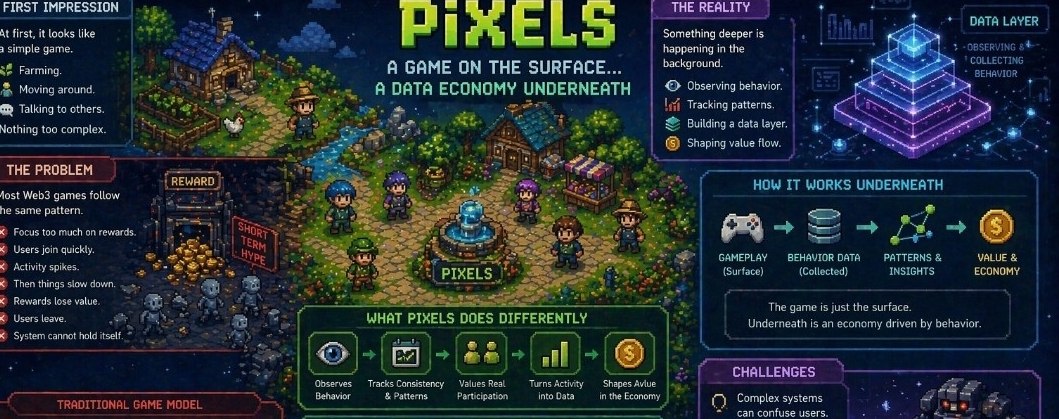
At first it still looked like a simple game. Farming. Moving around. Talking to other players. Nothing too complex. But the more I watched the more it felt like something else was happening in the background.
It did not feel like a normal game loop.
Over time I have seen many Web3 games follow the same pattern. They focus on rewards. People join quickly. Activity grows fast. Then things slow down. Rewards lose value. Users leave. The system cannot hold itself.
The problem always feels the same.
Too much focus on rewards. Not enough focus on what the system is actually tracking. What it is learning. What it keeps over time.
That is where Pixels started to stand out to me.
It feels like it is not just rewarding actions. It feels like it is observing behavior. How players move. How often they return. What they focus on. How they interact with others. All of this starts to look less like gameplay data and more like something deeper.
Something closer to a data layer.
The idea is simple when I think about it.
Instead of just giving rewards it collects patterns. It turns activity into something measurable over time. That data then starts to shape how value moves inside the system.
So the game becomes a surface.
Underneath it there is a structure that feels more like an economy driven by behavior.
That changes how I see it.
Because if value is connected to behavior then it becomes harder to fake. It becomes something that builds slowly. Something that reflects real participation instead of quick actions.
That is where it starts to feel less like a game and more like a data economy.
Of course this is not perfect.
Systems like this can become complex very quickly. If the data layer is not handled carefully it can create confusion. If users do not understand how value is shaped they may lose interest. There is always a risk when things move beyond simple design.
And pressure will test it.
Because when more users join everything changes. More activity. More patterns. More data. This can strengthen the system or break it.
If the structure is weak then all that data becomes noise. If it is strong then it becomes a foundation.
That is what I am watching.
Right now the market itself is still unstable. Some Web3 games grow fast. Then they lose momentum just as quickly. Activity comes in waves. Nothing feels steady for long.
Pixels is also moving through these phases. There are moments of growth. Then quieter periods. It is still finding its balance like everything else.
But what matters to me is not the short term movement.
It is whether this idea of turning gameplay into structured data actually holds up over time.
Because if it does then it changes how value is created.
Not from rewards alone.
But from behavior. From consistency. From how users exist inside the system.
That is a different direction.
I am not saying it will succeed.
I have seen too many systems look strong in the beginning and then slowly lose shape. So I stay careful. I do not take early signals too seriously anymore.
But I do pay attention when something feels different.
Right now Pixels feels like something in between.
Still a game on the surface.
But slowly moving toward something deeper underneath.
Maybe it becomes a strong system.
Maybe it faces the same limits as others.
It is still early.
For now I am just watching.
Still learning.
Still cautious.
