
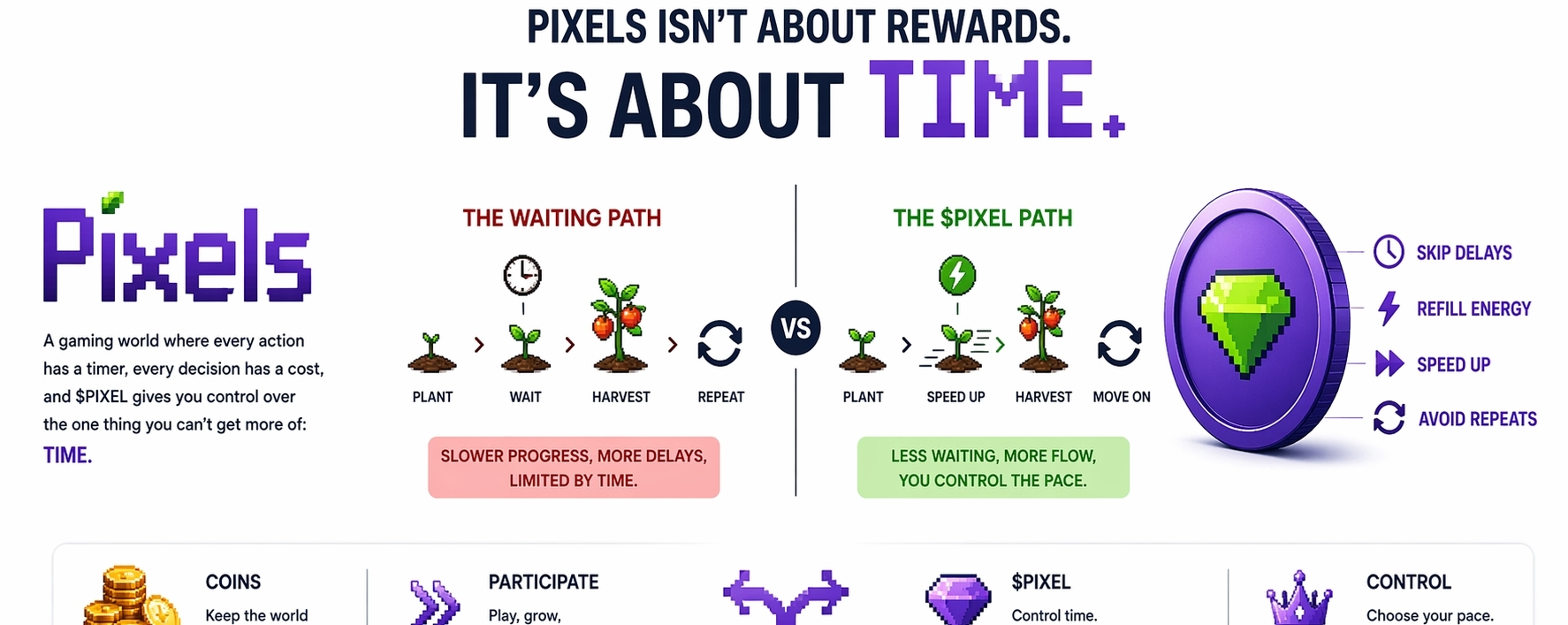
At first, Pixels doesn’t try to impress you. It slips in quietly, wearing a familiar shape. A farming loop tied to a token—something you’ve likely seen before, maybe even dozens of times. You plant crops, wait for them to grow, harvest them, and repeat. The rhythm is predictable, almost comforting, and because it feels so recognizable, you assume you already understand it. That assumption is where things begin to go wrong. Because Pixels isn’t really about what it shows you at the surface. It’s about what you start to feel underneath it—slowly, almost without noticing. Most GameFi systems are built around a simple promise: do more and get more. You upgrade tools to increase efficiency, optimize routes to reduce wasted time, stack bonuses to maximize output. Progress feels measurable, linear, rewarding. Pixels appears to follow that same script. Better tools exist, faster yields are possible, output can improve. But if you spend enough time inside the system, something begins to feel slightly off. You can play longer, play smarter, reduce mistakes, and yet the outcome doesn’t expand in the way you expect. Not because the system is broken—but because you’re focusing on the wrong variable. What actually shapes player behavior in Pixels isn’t the reward. It’s the waiting. Every game has pacing, but Pixels wraps every action in layers of subtle delay. You plant crops and wait, run out of energy and pause, complete a task and reset, move between actions with small interruptions. None of these delays are aggressive or unfair on their own, but together they accumulate and create an invisible weight on every loop. Not enough to frustrate instantly, but enough to slowly change how the game feels. Imagine two versions of the same system. In one, crops grow instantly, energy never runs out, tasks reset immediately. In the other, crops take a few minutes, energy drains and refills slowly, and tasks have cooldowns. The reward could be identical in both, but the experience would feel completely different. In the instant version, you focus on output. In the delayed version, you start asking a different question: is this wait worth it? That question changes everything. This is where $PIXEL begins to make sense. It doesn’t behave like a typical currency. It acts more like a switch that lets you override time. When players use it, they’re not just buying something—they’re choosing not to wait. Or choosing not to repeat something that’s already been done too many times. It’s a small decision, but it shows up again and again. What makes this powerful is how often that decision appears. Not once or twice, but dozens of times in a single session. Skip this timer, refill this energy, speed up this process, avoid repeating a loop. Each choice feels small, but together they form a pattern: a steady stream of moments where players trade patience for immediacy. Most players don’t even realize they’re doing it. And not everyone is chasing efficiency. One of the biggest misconceptions in GameFi is that players always want maximum output and perfect optimization. Pixels shows something different. Many players aren’t trying to win the system—they’re trying to make it feel better. They use $PIXEL not to dominate, but to smooth out friction. A casual player logging in after a long day may not want to deal with timers and interruptions—they just want a clean session, so they spend not to gain more, but to feel less resistance. That creates a different kind of demand—less visible, harder to measure, but consistently repeated. There’s also a subtle divide in how the system is structured. Coins handle basic gameplay, support routine activity, and keep the world alive. You can stay in that layer indefinitely without pressure. But the moment you want control over timing and flow, you start leaning toward $PIXEL. That transition feels natural, not forced, which is why it works. It’s similar to systems where the core experience is free, but control over that experience is not. Same environment, different level of agency depending on how much control you want over time. This shifts how adoption should be viewed. Most analysis focuses on user growth, token supply, unlock schedules, and expansion. Those metrics are easy to track, but they may not capture what really matters here. Pixels doesn’t rely purely on new players—it relies on existing players repeating a simple decision: is it worth waiting, or should I skip this? If that decision keeps happening, demand doesn’t need to explode. It just needs to persist quietly and consistently. But this model is fragile. If the system becomes too efficient and waiting disappears, there’s nothing left to skip and the token loses its purpose. If delays feel artificial, like they exist only to push spending, players notice and trust breaks. The system has to maintain a delicate balance where friction feels natural, almost invisible, like part of the environment rather than something imposed. That’s difficult to sustain, especially at scale. Another overlooked factor is that players always have an exit. When faced with friction, they can wait, pay, or leave. That third option matters. Sometimes instead of spending, players simply close the game. That choice exists in every system and shapes behavior more than most models account for. If you try to analyze $PIXEL through charts alone, you’ll miss its core function. It doesn’t live in supply curves or user numbers—it lives in behavior, in those quiet repeated decisions to skip, speed up, smooth out, and move on. Pixels doesn’t really sell progress. It sells control over time perception. It stretches time in some places, compresses it in others, and gives players the option to adjust that balance. $PIXEL sits exactly at that point of control. Whether this model works long term depends on subtlety. If the system remains quiet and almost invisible in how it shapes behavior, it can sustain demand through repetition. But if it becomes too obvious or too aggressive, the illusion breaks. And once players start noticing the system instead of simply feeling it, everything changes. That’s what makes Pixels interesting. Not because it’s loud or revolutionary, but because it operates in a space most systems ignore—the space between time, perception, and choice. And systems like that are easy to underestimate, right up until they aren’t.
