
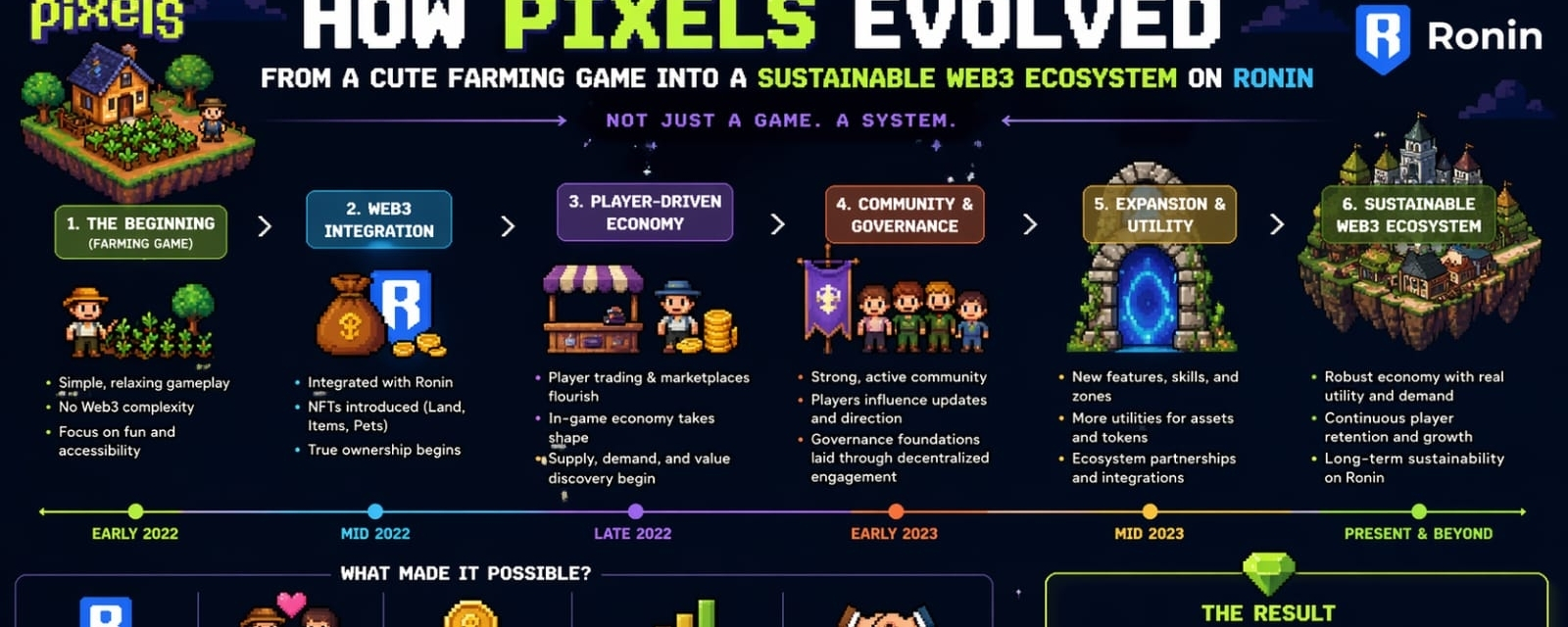
I’ve been watching Pixels long enough to know that what it looks like on the surface isn’t what’s actually happening underneath.
At first glance, it presents itself almost too simply. Farming. Exploration. A soft, inviting loop that feels intentionally harmless. But that’s exactly where I start paying closer attention—because in Web3, simplicity is rarely accidental. It’s usually a wrapper.
What I’m really observing isn’t just a game. It’s behavior being shaped in real time.
And the more I watch how players move through it, how they engage, how they stay… the more it stops looking like a game at all.
It starts to look like a system.
The shift didn’t happen loudly. There wasn’t a moment where Pixels suddenly “became” something bigger. It evolved quietly, almost passively, as if it was testing how far it could stretch without breaking its identity.
That’s what stands out to me.
Most projects force evolution. Pixels allowed it.
At some point, the farming loop stopped being about farming. Not explicitly—but functionally. Players weren’t just planting and harvesting. They were optimizing. Coordinating. Extracting value. The behavior changed before the narrative did.
And that gap—that delay between what people think they’re doing and what they’re actually doing—is where things get interesting.
Because once behavior shifts, the system follows.
I keep coming back to the infrastructure behind it: Sky Mavis and the Ronin Network.
Not because of what they claim to be building—but because of what they’re enabling without saying it directly.
Ronin isn’t just supporting gameplay. It’s removing friction at the exact points where user drop-off usually happens in Web3. Transactions feel lighter. Movement feels faster. The system doesn’t demand attention—it fades into the background.
And when infrastructure becomes invisible, behavior becomes natural.
That’s dangerous in a good way.
Because now, users aren’t “using blockchain.” They’re just… playing. But underneath that, they’re interacting with an economy, participating in ownership structures, contributing to liquidity flows—whether they consciously recognize it or not.
That’s not onboarding.
That’s absorption.
What I find more revealing is how people talk about Pixels versus how they act inside it.
Publicly, it’s still framed as casual. Relaxing. Even passive.
But the behavior says otherwise.
People are tracking efficiency. They’re managing resources with precision. They’re returning daily, not out of boredom, but because there’s a loop that rewards consistency in a way that feels almost invisible.
And I keep asking myself—are they aware of how structured their behavior has become?
Or does it feel organic enough that they don’t question it?
Because if it’s the second one, then Pixels has done something most Web3 projects fail to do.
It’s removed the psychological resistance.
There’s also something subtle happening with ownership.
Not in the loud, “you own your assets” narrative that gets repeated endlessly—but in how players treat what they have.
I notice hesitation before selling. I see attachment forming—not just to assets, but to progress. To position.
That’s not speculation behavior. That’s investment behavior—but without the language of investing.
And that shift matters.
Because once users start behaving like participants instead of visitors, the ecosystem stabilizes in ways that hype alone could never achieve.
But I’m not fully convinced this is entirely sustainable yet.
Something still feels… incomplete.
Not broken. Just unresolved.
There’s a tension between play and extraction that hasn’t fully settled. You can feel it in the way some users optimize too aggressively—like they’re trying to pull more out of the system than it naturally gives.
That usually doesn’t end well in Web3.
Every system eventually reveals whether it rewards balance or exploits imbalance.
And I’m still watching to see which direction this leans.
What I can’t ignore, though, is how quietly Pixels has shifted expectations.
It didn’t try to compete on complexity. It didn’t overwhelm users with token mechanics or governance narratives. It focused on something much more subtle—behavioral conditioning through simplicity.
And now, without making noise, it’s sitting in a position where users are already integrated into a functioning Web3 loop.
Not theoretically.
Practically.
I don’t think most people see it yet.
They’re still looking at Pixels as a game.
I’m looking at it as an environment.
A controlled space where user behavior, economic design, and infrastructure efficiency are all interacting at once—without drawing attention to themselves.
And that’s what makes it uncomfortable to analyze.
Because the more seamless it feels, the harder it is to separate intention from outcome.
So I keep watching.
Not for announcements. Not for roadmap updates.
But for behavior.
For the small shifts. The patterns that repeat. The moments where players act in ways that don’t match the story being told.
That’s where the truth usually sits.
Not in what Pixels says it is.
But in what people are actually doing inside it.
