


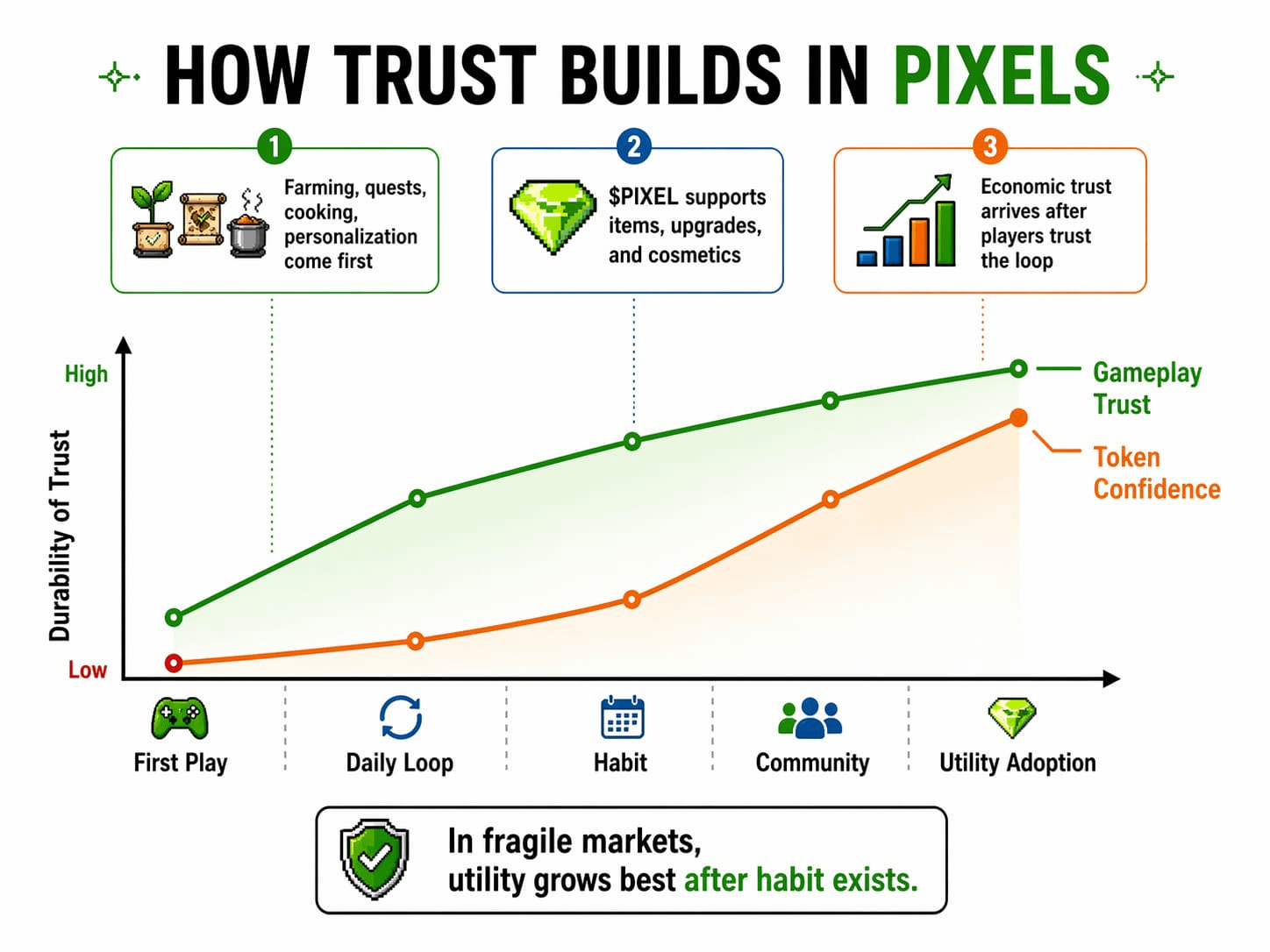
When I first looked at this, I assumed the lighter token emphasis was a weakness. In crypto, we are trained to treat loud token language as confidence. What changed my view was noticing that the litepaper does not sound shy about $PIXEL . It sounds protective of the game. My thesis is simple: the document makes gameplay the hero because economic trust in a live system usually arrives after players trust the loop, not before.
You can feel that choice in what gets foregrounded. The official litepaper describes Pixels first as a world of farming, exploration, relationships, story, and progression. The gameplay docs do the same thing more concretely, naming farming, quests, cooking, and personalization as primary mechanics that are available early and remain consistent through the experience. On the surface, that just reads like normal game framing. Underneath, it is doing economic work. It is telling players, and probably the designers too, that the repeat reason to come back should be activity before asset.
That is why the token language matters so much. The docs say $PIXEL is a premium in game currency for items, upgrades, and cosmetic enhancements outside the core gameplay loop, and that players do not need it to progress. A lot of people hear that and think the token is being diminished. I read it differently. Surface level, the token is present. Structurally, it is being kept from becoming a tax on basic play. In practice, that gives the game room to build habit without making every ordinary action feel priced. The tradeoff is obvious too. A token kept in a supporting role can look less exciting to speculators who want immediate centrality.
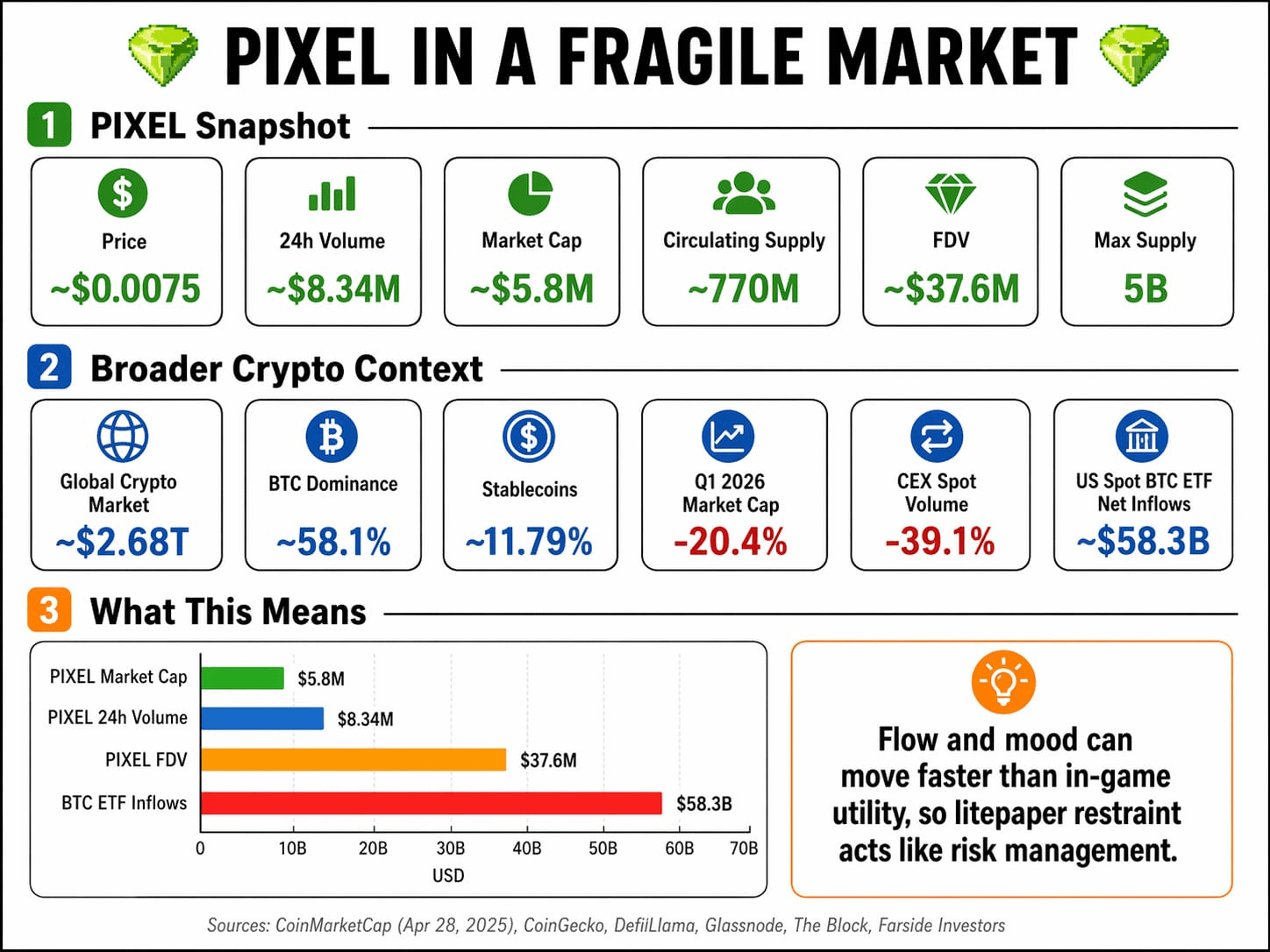
The market context makes that restraint look more intentional, not less. Today PIXEL trades around $0.0075, with roughly $8.34 million in 24 hour volume against a market cap of about $5.8 million. That means daily turnover is larger than the token’s equity like value, which is another way of saying flow and mood can dominate price faster than slow utility can stabilize it. Circulating supply sits around 770 million tokens, while the fully diluted valuation is about $37.6 million on a 5 billion max supply. So even before we talk design, we are looking at a small asset that can be pushed around by narrative, exchange activity, and unlock expectations more easily than by patient in game demand.
And the broader crypto tape is not especially forgiving. The global crypto market cap is about $2.68 trillion, but Bitcoin alone represents roughly 58.1% of it. Stablecoins account for about $316 billion, or 11.79% of the market, which tells me a large share of capital is still sitting in parking mode rather than enthusiastically rotating into risk at the edges. CoinGecko’s latest quarterly report says total crypto market cap fell 20.4% in Q1 2026 to $2.4 trillion, while spot trading volume on centralized exchanges dropped 39.1% to $2.7 trillion. Those numbers do not describe a market rewarding fragile token stories. They describe a market that is selective, cash aware, and quicker to punish weak reasons for demand.
That is also why the ETF comparison matters, even for a game token. U.S. spot Bitcoin ETFs have accumulated about $58.3 billion in net inflows, which shows where institutional comfort is gathering. Capital is not spreading evenly across crypto just because crypto exists. It is concentrating in assets with clearer wrappers, deeper liquidity, and fewer interpretive leaps. At the same time, policymakers are still arguing over how stablecoins should be coordinated globally, with the BIS warning that fragmented regulation could amplify stress and arbitrage. In that environment, a litepaper that tries to earn trust through consistency of play instead of theatrical token centrality looks less like modesty and more like risk management.
The same logic shows up in the infrastructure choices. The litepaper says complete decentralization is the end goal, but many mechanics are better kept off chain early, with ownership on chain and much of execution server side because that allows quicker development, faster response times, and better game experience. Surface level, that sounds less pure. Underneath, it is an admission that fairness and consistency in a game are operational problems before they are ideological ones. What it enables is fast balancing, fewer friction points, and tighter control when the system is still learning. The risk, of course, is centralization. But under pressure, I would rather see a team admit that tradeoff than hide it behind token theater.
So I do not think the litepaper leaves $P$PIXEL a supporting role because the token is unimportant. I think it does it because once the economy starts speaking louder than the world, players stop inhabiting a game and start managing a ledger. A supporting token can still matter a great deal. It just has to matter at the right distance. The sharpest thing this document understands is that a token can reinforce belief, but it cannot substitute for it.