
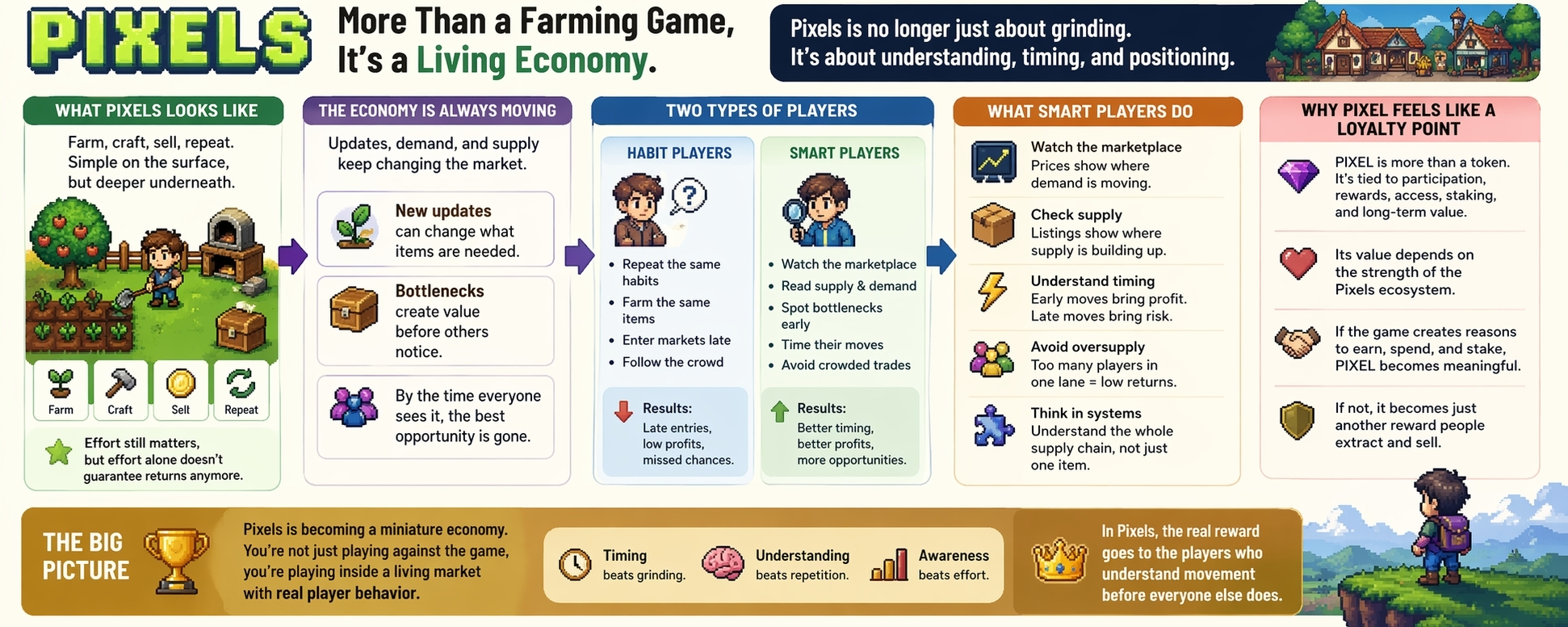

I’ve noticed Pixels keeps becoming more than the simple farming game people first understood it to be.
On the surface, it still looks easy.
You farm.
You craft.
You sell.
You repeat.
But the more I watch the project, the more I feel like Pixels is slowly training players to think differently. It is not only about who spends the most hours grinding anymore. It is about who understands what is happening inside the economy before everyone else catches on.
That is what makes the project interesting to me.
Pixels has built a world where small changes can quietly shift the whole market. A new update can make one resource more useful. A new crafting path can create demand for an item people were ignoring. A bottleneck can appear before the average player even notices it.
And by the time everyone starts talking about it, the best opportunity may already be gone.
This is where Pixels feels different from many Web3 games.
A lot of players still treat it like a routine. They do the same tasks, farm the same items, follow the same habits, and expect the same results. That worked better when the system was simpler.
But now, the project seems to reward attention more than repetition.
The players who do well are not always the ones grinding the hardest. They are the ones watching the marketplace, noticing price movement, checking supply, understanding what people need next, and spotting when too many players are about to rush into the same trade.
That is a real shift.
Because effort still matters, but effort alone does not guarantee returns.
You can work hard in Pixels and still be late. You can farm for hours and choose the wrong item. You can enter a market after the price has already moved. You can hold too long, sell too late, or miss the moment when demand starts fading.
That makes the project feel alive.
Not perfect.
Not easy.
But alive.
And this is why I sometimes think about PIXEL more like a loyalty point than a normal token. Its value is not just about a chart. It depends on the strength of the world around it. It depends on whether Pixels keeps giving players reasons to use it, earn it, spend it, stake it, and stay connected to the ecosystem.
That is a more grounded way to look at it.
PIXEL only becomes meaningful if the project keeps building real reasons for participation. If players only earn and sell, the loop becomes weak. But if Pixels keeps expanding the economy, creating new uses, adding pressure points, and making participation feel valuable, then PIXEL becomes tied to behavior, not just speculation.
That is the part I focus on.
Pixels is not only trying to keep players busy. It is trying to make their actions matter inside a moving system.
The marketplace is a good example. It is not just a place to sell items. It is almost like a live signal board. Prices show where demand is forming. Listings show where supply is building. Sudden spikes can show excitement, but they can also show that the opportunity is already becoming crowded.
That is where smart players separate from habit players.
Habit players repeat what used to work.
Smart players ask why something is working now.
That difference can change everything.
If everyone starts producing the same item, oversupply can form quickly. What looked profitable yesterday can become crowded tomorrow. A good trade can turn into a late trade. A strong price can weaken once too many players chase it.
Pixels makes this visible if you pay attention.
That is why I think the project is becoming more serious than it looks. It still has the soft farming surface, but underneath that surface is a small economy full of timing, dependency, and movement.
You are not just playing against the game.
You are playing inside everyone else’s decisions.
That can be exciting, but it can also be risky. Newer players may feel like they are doing everything right and still not getting the returns they expected. Casual players may not realize the economy has already moved. Even active players can miss opportunities if they only focus on effort and ignore structure.
And maybe that is the real story of Pixels right now.
The project is shifting value away from simple grinding and toward understanding.
Understanding supply chains.
Understanding bottlenecks.
Understanding delayed reactions.
Understanding when the crowd is early and when the crowd is already too late.
That is what makes Pixels worth watching for me. It is not just building another reward loop. It is building a system where player behavior, timing, and market awareness all start to matter.
So when I look at Pixels, I do not only see a farming game with a token attached.
I see a project slowly becoming a miniature economy.
And the bigger question is whether players are ready for that shift.
Because if Pixels keeps moving in this direction, the real winners may not be the ones who grind the most.
They may be the ones who understand the project before the rest of the market does.