
Most crypto projects try to stand out by being loud. They promise speed, profits, and big futures. But after some time, many of them feel empty because they don’t show how people will actually use them in real life.
Pixels feels different in a quiet way.
At first, it looks like a simple farming game. Nothing complex, nothing aggressive. But once you spend time understanding it, you start to see that it is not just a game. It is a system where actions, time, and ownership start to carry real meaning.
Pixels is a social Web3 game built on the Ronin Network. It is designed as an open world where players can farm, explore, craft, and interact with others. On the surface, it works like a normal game. You plant crops, collect resources, complete tasks, and slowly grow your progress. But the difference is not in what you do. The difference is in what happens to the results of what you do.
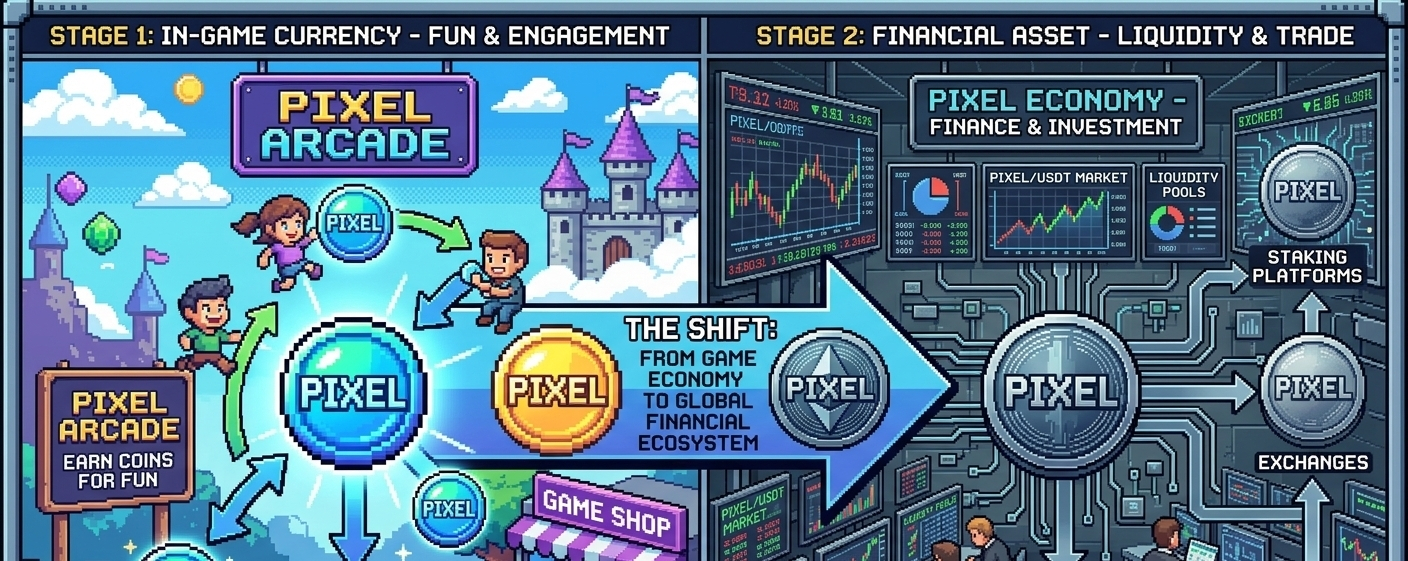
In most games, your progress stays inside the game. In Pixels, parts of your progress exist outside the game as digital assets. This means you can actually own items, trade them, and keep them beyond the game itself. That small shift changes the entire experience.
The real importance of Pixels is not about farming or gameplay mechanics. It is about ownership and coordination. Traditional games are closed systems. You invest time and sometimes money, but you do not truly own anything. If the game shuts down, everything disappears.
Pixels changes that structure. It creates a system where value is not only created by developers, but also by players. Your time, your strategy, and your activity contribute to something that can be recognized and exchanged. This connects gaming with real economic behavior, where players are no longer just users but participants.
The core loop of Pixels is simple. You enter the game, perform actions, earn resources, and use those resources to grow. You farm crops, craft items, complete quests, and interact with other players. But underneath this simple loop, there is a deeper layer that shapes everything.
The game uses blockchain technology to record ownership and transactions. This allows assets to be verifiable and transferable. You are not just collecting items. You are building a position inside a system. Because the game runs on Ronin, transactions are fast and low cost, which is important for a game where many small actions happen constantly. The system is designed so that value comes from activity, not just speculation.
The PIXEL token sits at the center of this system, but it is not used in a basic way. It is not there to replace simple in-game currency. Instead, it is used for deeper functions like premium access, memberships, minting assets, and participating in more advanced parts of the ecosystem. This creates a separation between casual gameplay and economic depth.
The supply of PIXEL is limited and released over time. There are also mechanisms that remove tokens from circulation when they are spent. This helps control inflation and keeps the system from becoming unstable too quickly. The design is not focused on fast growth, but on controlled development.
Pixels is also not meant to stay as one isolated game. It exists inside a wider ecosystem connected through the Ronin Network. This allows assets and tokens to move beyond the game into other applications. Over time, this can turn Pixels into part of a larger network where different experiences connect and share value.
This is where the idea becomes more interesting. When assets move across systems, the game stops being just a game. It becomes part of a broader digital economy. The value created inside one environment can flow into another, creating a connected structure instead of isolated spaces.
The direction of development shows a focus on stability. Instead of rushing new features just to attract attention, the system is being built slowly. Improvements in gameplay, better economic balance, and stronger community systems are all part of the process. The goal is to create something that can last, not something that peaks quickly and fades.
But there are real challenges. Game economies are fragile, and keeping them balanced is difficult. If rewards are too high, inflation can destroy value. If rewards are too low, players lose interest. Finding that balance is one of the hardest problems.
There is also the challenge of keeping players engaged. Initial growth is easier than long-term retention. If the experience becomes repetitive or loses meaning, players will leave, and the system weakens.
Token pressure is another risk. As more tokens enter circulation, there can be selling pressure that affects stability. This is a common issue in many Web3 systems.
Dependence on the underlying network is also important. Since Pixels runs on Ronin, any technical or security issue at the network level can affect the entire experience.
There is also a deeper tension between game design and economic design. If the system focuses too much on money, it may stop being enjoyable. And if it is not enjoyable, people will not stay. The balance between fun and value is critical.
What makes Pixels worth paying attention to is not its appearance, but its direction. It shows how a simple environment can evolve into something more complex, where value, ownership, and coordination exist together.
Inside this system, behavior starts to change. Players think differently when their actions have lasting meaning. Communities form differently when value is shared. Systems begin to stabilize when participation becomes real instead of temporary.
What stands out is the simplicity on the surface and the depth underneath. It does not try to overwhelm. It builds slowly and lets meaning emerge over time.
Pixels is not trying to be the loudest project. It is trying to become something stable, usable, and real. In a space where many things are short-lived, that approach feels rare.
