
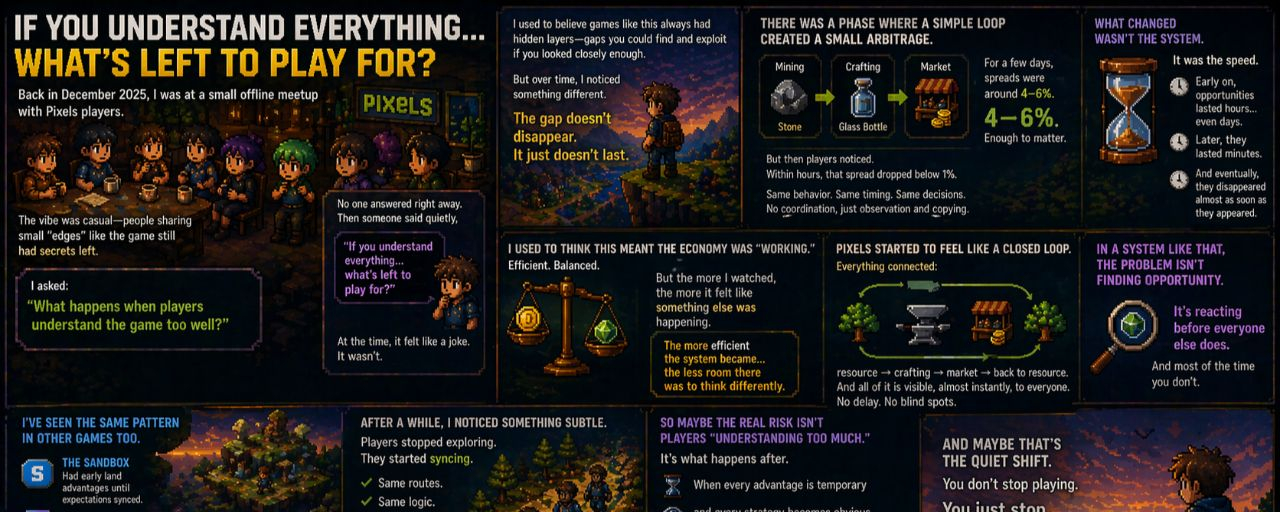
Back in December 2025, I was at a small offline meetup with Pixels players. The vibe was casual people sharing small “edges” like the game still had secrets left.
I asked: “What happens when players understand the game too well?”
No one answered right away. Then someone said quietly,
“If you understand everything… what’s left to play for?”
At the time, it felt like a joke.
It wasn’t.
I used to believe games like this always had hidden layers of gaps you could find and exploit if you looked closely enough.
But over time, I noticed something different.
The gap doesn’t disappear.
It just doesn’t last.
There was a phase where a simple loop mining Stone → crafting Glass Bottle created a small arbitrage.
For a few days, spreads were around 4–6%. Enough to matter.
But then players noticed.
Within hours, that spread dropped below 1%.
Same behavior. Same timing. Same decisions.
No coordination, just observation and copying.
What changed wasn’t the system.
It was the speed.
Early on, opportunities lasted hours… even days.
Later, they lasted minutes.
And eventually, they disappeared almost as soon as they appeared.
I used to think this meant the economy was “working.”
Efficient. Balanced.
But the more I watched, the more it felt like something else was happening.
The more efficient the system became…
the less room there was to think differently.
Pixels started to feel like a closed loop.
Everything connected: resource → crafting → market → back to resource.
And all of it is visible, almost instantly, to everyone.
No delay. No blind spots.
In a system like that, the problem isn’t finding opportunity.
It’s reacting before everyone else does.
And most of the time you don’t.
I’ve seen the same pattern in other games too.
The Sandbox had early land advantages until expectations synced.
Illuvium had early farming edges until metals spread.
Same cycle.
Opportunity → discovery → copying → collapse.
After a while, I noticed something subtle.
Players stopped exploring.
They started syncing.
Same routes. Same logic. Same decisions.
Not because they had to
but because it was the only thing left that worked.
So maybe the real risk isn’t players “understanding too much.”
It’s what happens after.
When every advantage is temporary
and every strategy becomes obvious
the game doesn’t break.
It just becomes predictable.
And maybe that’s the quiet shift.
You don’t stop playing.
You just stop discovering.
I’m not sure if that’s a problem.. or just how these systems naturally evolve.
But it does make me wonder
If everything can be understood
What exactly keeps us here?
@Pixels $PIXEL #pixel