
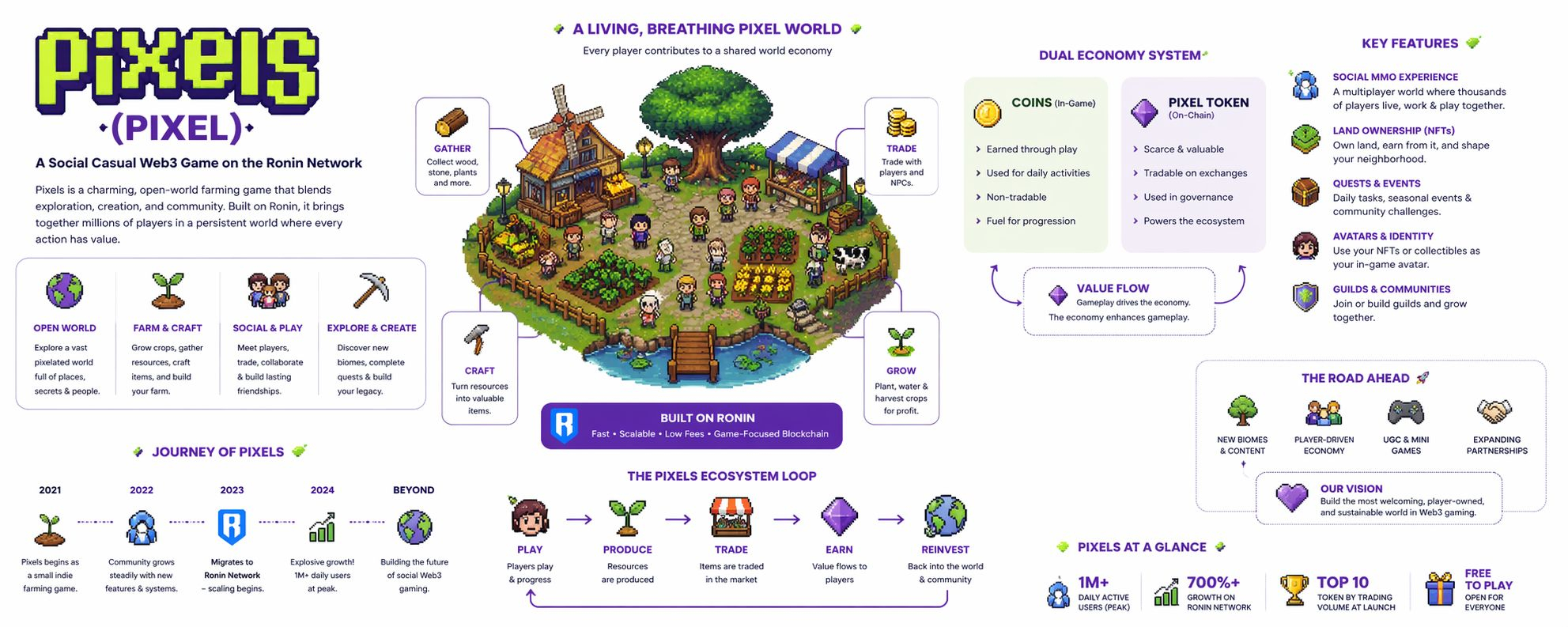
Pixels doesn’t arrive like a revolution. It doesn’t try to impress you with spectacle or overwhelm you with technical jargon. Instead, it feels disarmingly simple the first time you step into it—a pixelated world where you plant crops, gather resources, wander around, and occasionally bump into other players doing the exact same thing. It almost feels too ordinary. And that’s precisely the point.
What makes Pixels interesting is not what it shows you upfront, but what slowly reveals itself the longer you stay. Beneath that quiet farming loop is a carefully structured system where time, effort, and interaction start to take on real weight. You’re not just clicking to harvest carrots—you’re participating in a rhythm that connects you to a wider network of players, resources, and exchanges. The game doesn’t shout about this. It lets you feel it.
The origins of Pixels trace back to a much smaller, almost experimental phase. It wasn’t always positioned as a major player in Web3 gaming. But things changed when it moved onto the Ronin Network. That transition wasn’t just about better infrastructure or faster transactions. It gave Pixels an environment where its design philosophy could actually breathe. Ronin had already seen what happens when games become economies, but Pixels approached that idea with a softer touch. Instead of building everything around profit, it built around habit.
That difference is subtle but powerful. In many blockchain-based games, you can feel the pressure almost immediately—the sense that every action is tied to some financial outcome. Pixels resists that urgency. It creates space for routine. You log in, do a few tasks, maybe chat with someone, maybe optimize your farm a little, and then you leave. There’s no constant push to maximize, no aggressive reminder that you’re “earning.” And yet, over time, you realize that what you’re doing does feed into a broader system that has real economic implications.
Farming, in this context, becomes something more than a mechanic. It becomes a kind of anchor. It ties you to the world in a way that feels steady and predictable. There’s a reason farming works so well here. It mirrors something deeply human—the idea that effort accumulates, that patience leads somewhere, that small, repeated actions can build into something meaningful. Pixels leans into that instinct instead of trying to replace it with something flashier.
As you spend more time in the game, the layers begin to stack. Resources aren’t just things you collect; they become part of a network of production. Crafting isn’t just progression; it’s transformation—turning raw input into something with greater value. Even the limitations, like energy systems or time delays, start to feel less like restrictions and more like the boundaries that make the world coherent. Without them, everything would collapse into instant gratification, and the sense of effort would disappear.
Then there’s the economy itself, which sits quietly in the background until you start paying attention. Pixels uses a dual structure that separates everyday gameplay from its more valuable, tradable layer. That separation matters. It allows players to engage casually without immediately feeling like they’re stepping into a marketplace. At the same time, it creates a path for deeper involvement if someone chooses to pursue it.
What’s interesting is how this system shapes behavior without making it obvious. Tasks, rewards, and resource flows gently guide players toward actions that sustain the world. You’re not forced into participation, but you’re nudged in certain directions. Over time, those nudges add up. The game starts to feel less like a series of isolated actions and more like a living system that responds to collective effort.
The social dimension plays a huge role in making that system feel alive. Pixels isn’t built as a solitary experience. Even when you’re working on your own farm, there’s a sense that others are doing the same thing alongside you. You see them moving, trading, collaborating, or just existing in the same space. That shared presence changes the tone completely. It turns routine into something communal.
This is where Pixels quietly distances itself from many other Web3 projects. It doesn’t treat players purely as individual earners or isolated participants. It treats them as part of a network. Interaction becomes just as important as efficiency. In some cases, it becomes more important. The value of the world isn’t only in what you produce—it’s in how you connect.
Of course, the moment ownership enters the picture, things become more complicated. Land, in particular, introduces a layer that is both fascinating and uncomfortable. Owning land in Pixels isn’t just cosmetic. It comes with advantages, opportunities, and influence over how resources are generated and distributed. That can create a sense of progression and investment, but it also raises questions about fairness.
Digital ownership often carries the promise of empowerment, but it can also recreate familiar patterns of imbalance. Some players gain more control, more access, more leverage. Others participate from a different position, contributing effort without the same level of return. Pixels doesn’t hide from this dynamic. It exists as part of the system, shaping how players interact with each other and with the world.
What softens that edge is the game’s accessibility. You don’t need to own anything to start playing. You don’t need to commit financially to feel involved. That openness keeps the door wide enough for new players to enter and find their place. But the tension remains, and it’s part of what makes the game worth thinking about beyond its surface.
Visually, Pixels takes a path that might seem counterintuitive in today’s gaming landscape. It doesn’t chase realism or complexity. It embraces simplicity. The pixel art isn’t just an aesthetic choice—it’s a functional one. It keeps the game lightweight, easy to access, and instantly readable. You don’t need powerful hardware or long downloads. You can just step in.
There’s something quietly effective about that decision. It removes friction. It also shifts the focus away from visual spectacle and toward interaction. The world doesn’t try to impress you with detail; it invites you to participate. Over time, that participation becomes more engaging than any high-resolution texture ever could.
The relationship between Pixels and the Ronin Network adds another layer to the story. Ronin needed activity, a reason for people to return, a world that could sustain attention beyond short bursts of hype. Pixels provided that. In return, Ronin offered the infrastructure that allowed Pixels to scale without breaking its core experience. It’s a rare case where the platform and the application genuinely support each other.
Looking ahead, what Pixels represents is still evolving. It’s not a finished idea. It feels more like an ongoing experiment—one that is testing how far a game can stretch into something broader without losing its identity. There are hints that it could expand into a platform-like space, where multiple experiences exist within the same ecosystem. There’s also the possibility that it remains focused, refining what it already does well instead of chasing expansion.
Either way, its significance doesn’t come from being perfect. It comes from how it reframes the relationship between players and the world they inhabit. It suggests that games don’t have to choose between being fun and being meaningful. They can be both, if the systems are designed with enough care.
At its core, Pixels is less about farming and more about presence. It’s about showing up, doing something small, and knowing that it contributes to something larger. It’s about a world that doesn’t demand constant attention but rewards consistency. And it’s about the idea that even in a digital space, shaped by code and tokens, there’s still room for something that feels surprisingly human.
