
I keep coming back to one uncomfortable thought with Pixels: maybe the token is not the most valuable thing being built here.That sounds strange at first, because most crypto gaming conversations start with the token. What is the supply? What is the utility? Who earns it? Who sells it? Those questions matter. But they may not be the full story.#pixel @Pixels
The harder question is this: what does Pixels learn every time a player touches the economy?Because every quest, purchase, trade, withdrawal, stake, and reward claim is not just an action. It is also a signal. And if the system is designed well, those signals can slowly turn into an operating advantage.
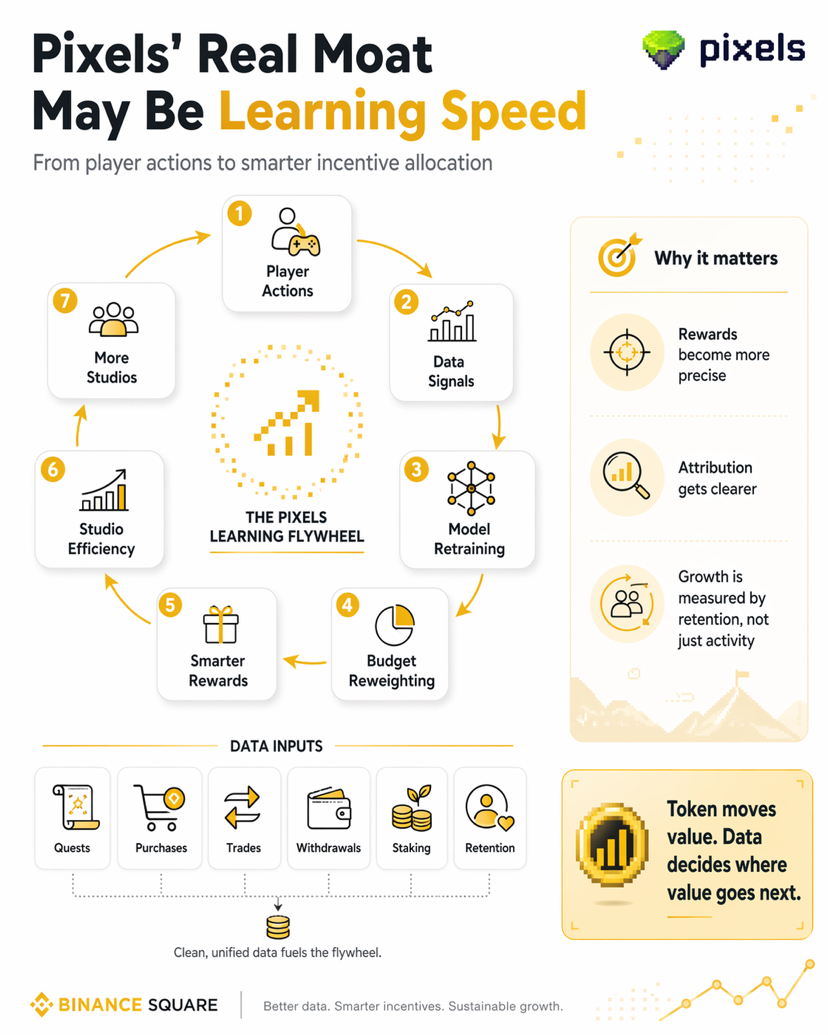
My thesis is simple: Pixels may become more interesting as a data engine than as a pure token story. The token moves value, but the data may decide where value should move next.
That is the part I think many people may be underpricing.In a normal game economy, rewards are often distributed through broad rules. Play more, earn more. Complete tasks, receive incentives. Join events, collect rewards. It is simple, but also blunt. The system can attract users, but it does not always know which users are actually valuable.
Some players stay. Some spend. Some bring social activity. Some help liquidity. Some only extract. Some look active but add very little long-term value.
Pixels seems to be dealing with that uncomfortable reality more directly. The ecosystem is not only asking, “How do we reward activity?” It is also asking, “Which activity deserves more budget next time?”
That distinction matters.The mechanism is where this gets more interesting.A player completes quests. That creates engagement data.
A player buys something. That creates monetization data.A player trades assets. That creates marketplace data.A player withdraws value. That creates extraction data.A player returns tomorrow, or disappears. That creates retention data.
Individually, these actions look small. But together, they form a behavioral map of the economy.If Pixels can read that map properly, then rewards stop being blind emissions. They become adjustable spending. Budgets can be reweighted toward players, games, events, or behaviors that produce better results.
This is where the ad-tech comparison becomes useful.A serious advertising platform does not only ask how many people clicked. It asks what happened after the click. Did the user stay? Did they convert? Did they spend? Did they return? Was the acquisition cost worth it?
Pixels may be moving toward a similar logic, but inside a crypto gaming economy.Quests become something like acquisition campaigns.
Rewards become something like user acquisition spend.Player behavior becomes attribution data.
Retention curves show whether incentives brought real users or temporary farmers.
Withdrawal patterns show whether value stayed inside the ecosystem or left immediately.
That is not a small shift. It changes the way we should look at the token.Instead of seeing $PIXEL only as a reward asset, it may be more accurate to see it as budget flowing through a measurement system. The important question becomes: how efficiently is that budget being allocated?
A basic example makes this easier.Imagine two partner games inside the Pixels ecosystem.
Game A receives incentive support. It brings in a lot of players quickly, but many of them claim rewards and leave. Marketplace activity is weak.After a few days, many players stop coming back. Withdrawals rise fast.
Game B receives the same amount of incentive support. It brings fewer users, but those users stay longer, buy more items, trade more assets, and return for future events.
A simple reward system might treat both outcomes as “growth.” A smarter data loop should not.It should notice that Game B produces healthier economic behavior. Then, over time, budgets can shift. More incentives can move toward the game, user segment, or quest design that creates better retention and stronger value circulation.
That is the learning loop.Data comes in.Models retrain.Budgets adjust.Rewards become more precise.Studios see better efficiency.
More studios become interested.
If that loop works, Pixels becomes more than a game. It becomes infrastructure for studios that want crypto-native distribution without spending blindly.
That is why the studio angle matters so much.A studio does not only care about token hype. A serious studio cares about acquisition cost, retention quality, fraud, monetization feedback, and whether incentives are producing real players or just mercenary traffic.
If Pixels can offer better targeting, cleaner attribution, and clearer efficiency measurement, then it starts to look less like a single-game ecosystem and more like a distribution layer.
That is a different category.And categories matter because markets often misprice projects when they use the wrong mental model. If people price Pixels only as a game token, they may miss the value of the data layer. But if the data layer fails, then the token design alone may not be enough.
This is also where I have some hesitation.A better data loop can improve rewards, but it can also concentrate power. If models decide which players are “valuable,” which studios deserve more budget, and which behaviors get rewarded, then the rules become harder for normal users to inspect.
That creates a real tradeoff.More precision can reduce waste. But too much invisible optimization can make the economy feel less fair. Players may start asking why one action gets rewarded more than another. Studios may question whether allocation is neutral. Token holders may want to know who controls the model logic.
So the moat is not just data. It is trusted data use.Pixels has to prove that better targeting does not turn into a black box economy where incentives are technically efficient but socially confusing.That is what I’m watching next.Not only whether $PIXEL has utility.Not only whether rewards increase.
Not only whether more games join.
I want to see whether the system keeps learning faster without becoming harder to trust.Because the strongest version of Pixels is not just “players earn tokens.” That story is too simple now.The stronger version is this: every economic action teaches the network how to allocate the next incentive better than the last one.If that becomes true, the real moat may not be token design by itself. It may be learning speed.
And that leaves the bigger question open: is the market pricing Pixels as a game token, or as a data-driven distribution engine for crypto gaming?#pixel @Pixels $PIXEL