
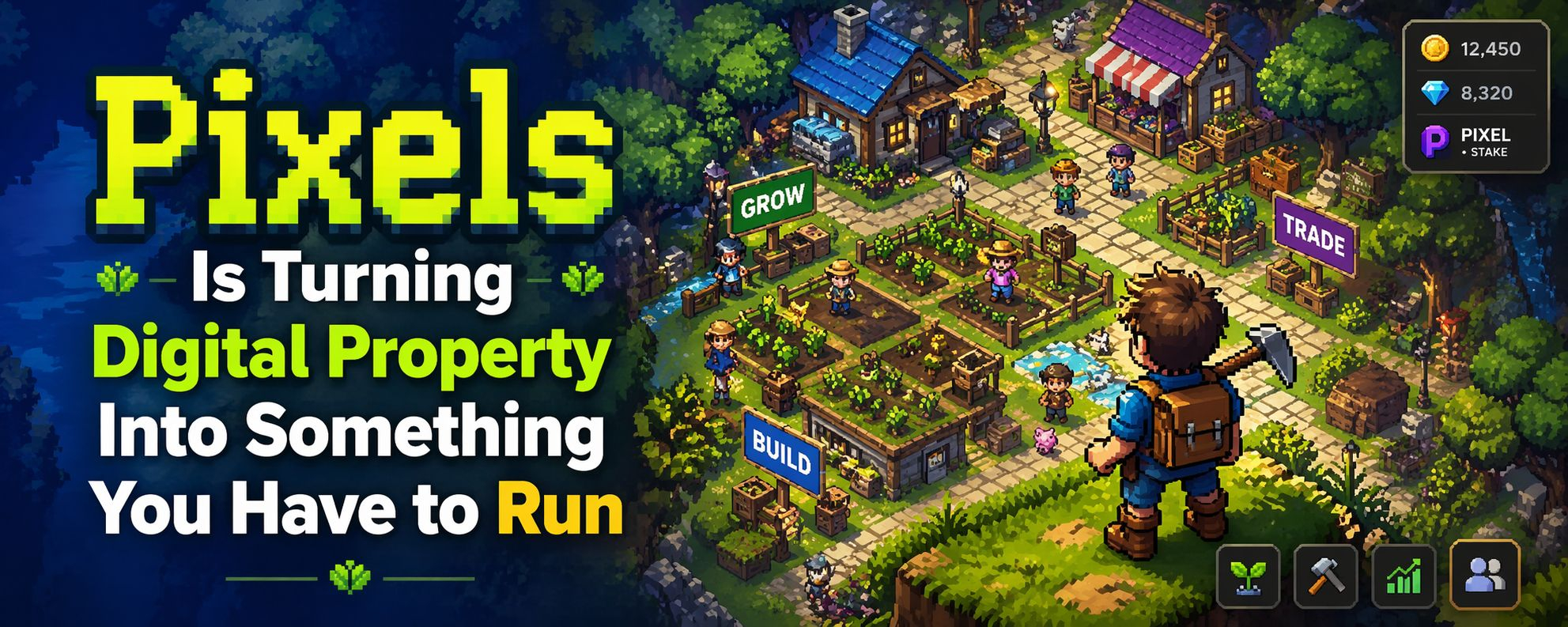

The more time I spend watching how people actually play Pixels, the less it feels like a typical Web3 game built around ownership. It feels more like a place where ownership quietly turns into responsibility.
A land plot here does not just sit in your wallet waiting for a price change. It asks something from you. You have to think about what to grow, when to harvest, how to route resources, and sometimes who to coordinate with. It starts to feel less like owning an asset and more like managing a small corner of a living world.
That shift changes how you behave. In most crypto games, the question in the back of your mind is always about exit. When should I sell, who will buy, did I get in early enough. In Pixels, that question slowly fades into something more practical. What can I actually do with this today. How do I make it work better tomorrow.
You can see this direction in how the game keeps layering systems. Task boards push players into structured activity. Land is useful only if it is actively used. Staking is not just passive yield but tied to how distribution flows. And with features like Unions, even social coordination becomes part of how value is created. None of it works well if you are just sitting still.
What makes this interesting is not that Pixels removed speculation. It did not. But it made speculation less comfortable. You cannot fully benefit from ownership unless you engage with it. That friction is intentional, and it changes the type of player who thrives.
Of course, there is a delicate balance here. If everything becomes too optimized, the experience risks feeling mechanical. But right now, Pixels is doing something subtle and important. It is making digital property feel alive by making it depend on you.
The takeaway is simple. Ownership in Pixels works best when it stops feeling like something you hold and starts feeling like something you run.