
I didn’t expect Pixels to make me rethink what “freedom” in a game actually means—but it did.
When I first stepped into Pixels, it felt refreshingly open. No rigid path, no immediate pressure—just a world where I could farm, explore, craft, and interact at my own pace. It gave me that rare sense of control, the kind most games promise but quietly restrict.
But the longer I stayed, the more I noticed something underneath that freedom.
It wasn’t limiting me directly—it was guiding me. Subtly, consistently, and almost invisibly.
And that’s where the contradiction begins.
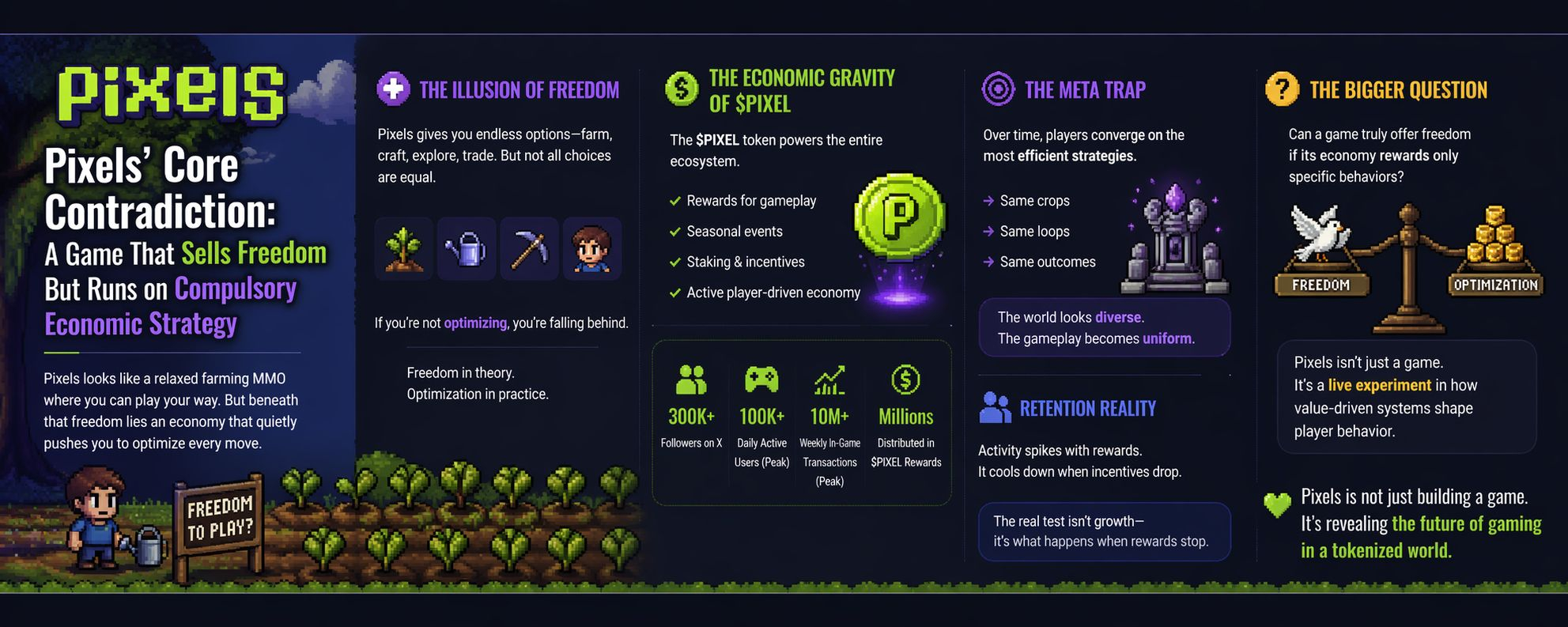
Pixels operates as a Web3 farming MMO, built around an active in-game economy powered by the PIXEL token. On paper, this enhances gameplay. It rewards time, effort, and participation. At its peak, the game has attracted hundreds of thousands of daily active users, driven millions of weekly transactions, and built a following of over 300K users on X.
That level of traction is impressive—and rare in Web3 gaming.
But scale introduces pressure.
Because the moment rewards are tied to actions, those actions stop being neutral. Every crop I plant, every resource I gather, every minute I spend in the game starts to carry measurable value. And once value is introduced, behavior changes.
I catch myself thinking differently.
Instead of asking, “What do I feel like doing?”
I start asking, “What’s the most efficient move right now?”
That shift is small—but it rewires the entire experience.
Pixels gives me choices, but not all choices are equal. If I ignore high-yield crops, I earn less. If I don’t optimize my energy usage, I fall behind. If I skip events or reward loops, I miss out on opportunities that others are actively capturing.
So while the game never forces me into a specific path, it creates a system where deviation comes with a cost.
That’s not restriction in the traditional sense—it’s economic gravity.
And it’s powerful.
At the center of this system is the PIXEL token, which fuels everything from rewards to progression. During peak activity phases, Pixels has distributed significant value through gameplay loops, seasonal campaigns, and staking mechanisms. This has led to bursts of engagement, where player activity surges in response to incentive structures.
But that also reveals something deeper.
Engagement in Pixels isn’t just driven by fun—it’s heavily influenced by rewards.
I’ve seen how quickly behavior shifts when incentives change. When rewards increase, activity spikes. When they slow down, participation becomes more selective. That pattern suggests a core tension: how much of the player base is here for the experience, and how much is here for the returns?
The answer isn’t binary—but it matters.
Because over time, optimization starts to dominate.
Like most systems with measurable outcomes, Pixels develops a “meta”—a set of strategies that maximize efficiency. And once that meta becomes clear, players naturally converge toward it. Certain crops become standard. Certain gameplay loops become dominant. Certain paths become “correct.”
The result is interesting.
A game that appears open-ended on the surface begins to feel increasingly structured in practice.
Not because the design restricts creativity—but because the economy rewards consistency.
And when players are incentivized to perform, they optimize.
I’ve noticed this shift not just in myself, but across the community. Conversations revolve around yield, efficiency, and strategy. Players share optimization techniques, track changes in profitability, and adjust behavior based on token dynamics.
At some point, it stops feeling like casual gameplay and starts resembling economic participation.
That doesn’t make it worse—it just makes it different.
Another layer that complicates this is the social experience. Pixels does a great job creating a sense of community. There are shared spaces, interactions, collaborations—elements that should, in theory, encourage creativity and expression.
But even here, the economic layer remains present.
Every action has an opportunity cost. Time spent exploring is time not spent optimizing. Social engagement competes with productive loops. And in a system where rewards are quantifiable, players naturally lean toward activities that generate value.
So the tension becomes clear.
The game encourages freedom—but the system rewards discipline.
And when those two collide, discipline usually wins.
To be clear, Pixels is not failing. In many ways, it’s doing exactly what it set out to do. It has built one of the most active ecosystems in Web3 gaming, onboarded a massive audience, and maintained consistent development and engagement.
It works.
But that’s exactly why its underlying dynamics deserve attention.
Because what Pixels is really showing us is how player behavior evolves in a value-driven environment.
When gameplay is tied to real economic outcomes, players don’t just play—they strategize. They calculate. They optimize. Freedom doesn’t disappear, but it becomes filtered through efficiency.
And that changes the meaning of choice.
So the real question I keep coming back to is this:
Can a game truly offer freedom if its economy quietly pushes players toward specific behaviors?
Pixels hasn’t fully answered that yet.
But it’s one of the first projects forcing us to confront it.
And maybe that’s its most important contribution—not just building a game, but revealing how games change when value becomes part of the equation.