
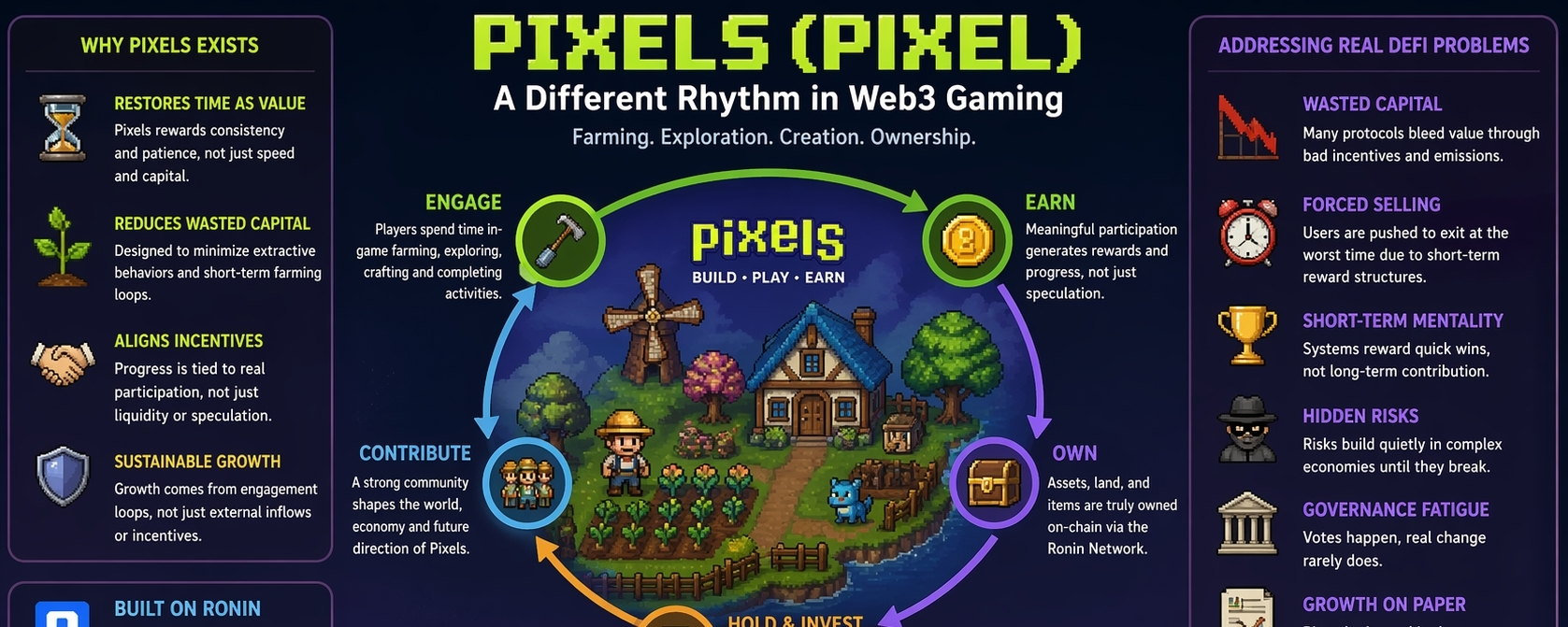
Pixels (PIXEL) does not rush to impress you. It moves in a way that can feel almost uncomfortable if you’ve spent enough time inside systems that reward speed over thought. I’ve watched enough cycles to recognize when a project is not trying to win attention, but trying to change behavior. Pixels sits in that rare category where the design feels less like a product and more like a quiet argument against the way most on-chain systems currently operate.
The deeper reason this project exists starts to reveal itself when you stop looking at it as a game and begin to see it as a response. Not to gaming trends, but to capital patterns. Most DeFi environments train participants to act quickly, often forcing decisions under pressure. Liquidity moves fast, incentives decay even faster, and what looks sustainable in a dashboard slowly collapses under the weight of its own assumptions. Pixels doesn’t try to compete with that speed. It questions it.
There’s a persistent inefficiency in crypto that rarely gets discussed in honest terms. Capital is not just volatile, it is often wasted. Incentives are designed in ways that attract attention but fail to hold conviction. Users are pushed into cycles where they must either chase yield or exit entirely. The system quietly punishes patience. In that context, Pixels feels like an attempt to reintroduce time as a meaningful variable.
I’ve noticed that when systems slow down, they expose truths that fast environments tend to hide. In Pixels, progression is not purely financial. It is tied to participation in a way that cannot be easily gamed by capital alone. This matters because one of the biggest structural flaws in DeFi is that money often replaces effort. Whoever brings liquidity gets rewarded, regardless of whether they contribute to the long-term health of the system. Pixels shifts that balance slightly. Not completely, but enough to create friction for purely extractive behavior.
That friction is important. It’s the kind that makes short-term strategies less effective without explicitly banning them. In most protocols, if you stay long enough, you start to feel the pressure to exit at the wrong time. Rewards decrease, token emissions dilute value, and narratives shift before fundamentals have time to mature. Pixels approaches this differently. It builds an environment where stepping away too early means leaving unfinished progress behind, not just unrealized gains.
This subtle shift changes how users interact with the system. It reduces the constant need to optimize for immediate outcomes. And when that pressure is reduced, something else emerges. People start to engage in ways that are not purely transactional. That might sound idealistic, but it’s actually rooted in practical design. When the system doesn’t reward speed alone, it naturally filters out a certain type of behavior.
There’s also a quieter risk that Pixels seems aware of, even if it doesn’t explicitly address it. Governance in most decentralized systems has become performative. Votes happen, proposals pass, but the underlying direction rarely changes in meaningful ways. Power concentrates, even when it’s distributed on paper. Pixels, by focusing less on governance theatrics and more on user-driven activity, sidesteps some of that fatigue. It doesn’t solve governance, but it reduces its immediate importance.
Another point that often gets overlooked is how growth is framed. Many projects present expansion plans that look convincing in isolation. New features, partnerships, ecosystem incentives. But when market conditions tighten, those plans reveal their dependence on continuous inflows of capital. Pixels takes a more grounded approach. Growth happens through engagement loops that are not entirely dependent on external liquidity. That doesn’t make it immune to downturns, but it does make it less fragile.
I’ve learned that systems which rely too heavily on optimism tend to struggle when reality sets in. Pixels doesn’t lean on optimism as much as it leans on structure. The structure is simple on the surface, but it carries a deeper intention. It tries to align user behavior with the kind of activity that can sustain itself over longer periods. That alignment is not perfect, but it’s deliberate.
There is also an interesting tension in how value is perceived within the ecosystem. In most financialized environments, value is immediately translated into price. Everything is measured, compared, and acted upon in real time. Pixels introduces layers where value is experienced before it is realized. This creates a gap between action and reward, and that gap changes decision-making. It forces users to think beyond immediate returns, even if only slightly.
Of course, this approach is not without its own risks. Slower systems can lose attention in a market that constantly looks for the next opportunity. There is always the possibility that users revert to familiar patterns, treating the environment as just another place to extract value. No design can fully prevent that. But what Pixels does is make that path less efficient, which is often enough to influence behavior at scale.
What stands out to me is not what the project promises, but what it avoids promising. There is no aggressive narrative about transforming finance or redefining ownership. Instead, there is a quieter focus on building something that can exist without constant reinforcement. That restraint is rare. It suggests an awareness of how easily systems can collapse under the weight of their own expectations.
Over time, I’ve come to see that the most durable projects are not the ones that grow the fastest, but the ones that understand their own limitations. Pixels seems to operate within those boundaries. It doesn’t try to solve every problem in DeFi. It focuses on a specific set of behaviors and tries to reshape them in a controlled environment.
That might not sound revolutionary, and it isn’t meant to be. The value here is not in disruption, but in correction. A small shift in how users interact with time, incentives, and participation. These are not changes that create immediate impact, but they accumulate quietly.
In the long run, what matters is whether a system can hold its structure when external conditions change. Pixels has not been tested across every possible scenario, but its design choices suggest a level of caution that is often missing elsewhere. It does not rely entirely on growth to justify itself. It builds an internal logic that can function even when growth slows.
That alone makes it worth paying attention to. Not because it will outperform in the next cycle, but because it approaches familiar problems from a different angle. It asks whether users can be guided toward more sustainable behavior without forcing them.
The answer is still unfolding. But the attempt itself carries weight.
And sometimes, in a space driven by noise, a quiet attempt is the most honest signal you can find
