
Most GameFi projects end up feeling like variations of the same idea loud launches, heavy incentives, and a kind of surface-level excitement that fades once the rewards start thinning out. You see the cycle repeat: attract users with emissions, watch activity spike, then slowly lose them when the system has nothing deeper to hold onto. It’s not that these projects lack effort, it’s that they’re built on a fairly rigid assumption that attention can be bought and retention will somehow follow.
That’s why Pixels stands out, but not in an obvious way. It’s not something you immediately notice from price charts or social media noise. In fact, if anything, it looks quieter than most. The difference shows up in behavior. People don’t just arrive and leave they stay. They keep logging in, adjusting how they play, finding their place in the system. And in GameFi, that’s usually the first thing to disappear when incentives cool off. Here, it doesn’t.
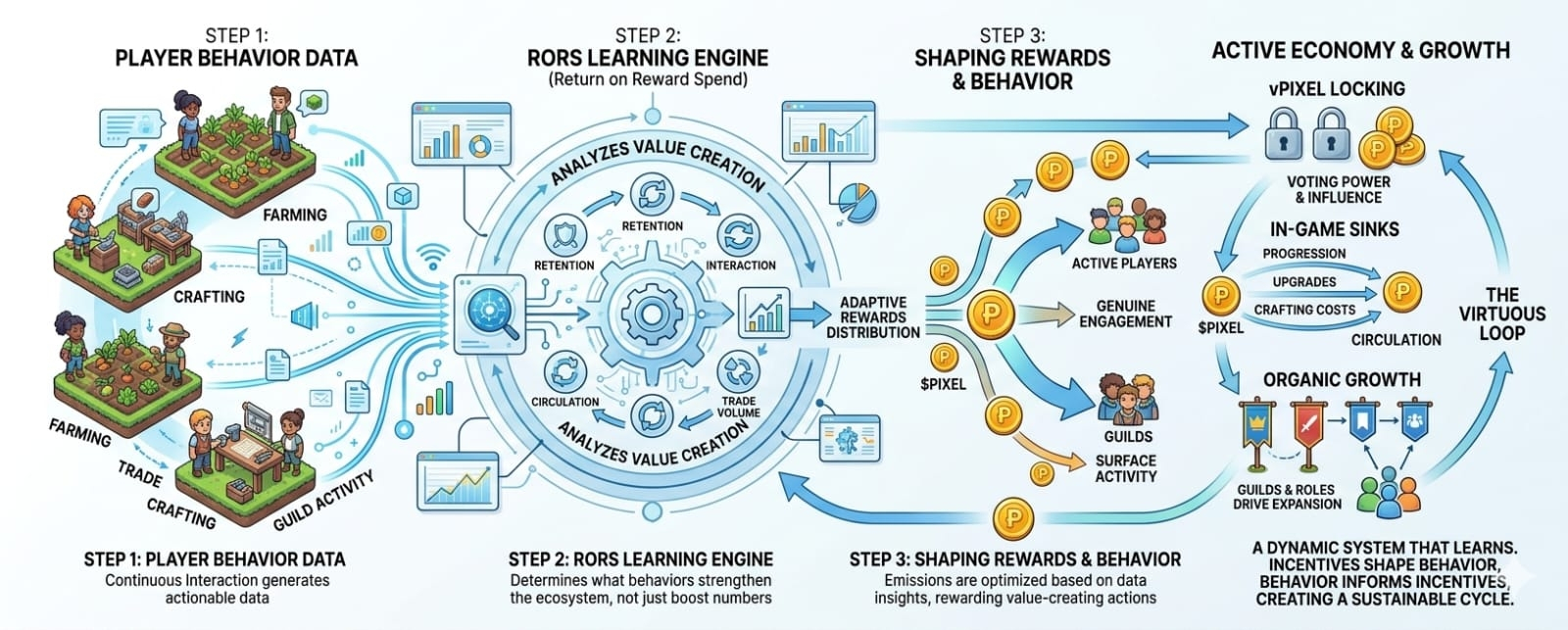
What starts to become noticeable over time is that the system doesn’t feel static. It feels like it’s paying attention. Not in a literal sense, but in the way rewards seem to subtly shift depending on what players actually do. Most games distribute rewards based on fixed structures you complete a task, you get a payout. Pixels leans into something more fluid. It treats rewards less like a constant output and more like something that can be reshaped depending on what actually creates value inside the game.
That’s where the idea of Return on Reward Spend, or RORS, quietly becomes important. Instead of emissions being treated as a necessary expense, they’re treated more like capital. The system is, in a way, trying to figure out whether the rewards it gives are actually producing something meaningful in return. Not just activity for the sake of numbers, but activity that strengthens the ecosystem—things like retention, trade, interaction, and continuity.
On the surface, the gameplay still feels familiar. You farm, craft, trade, upgrade land, and participate in guilds. None of that is particularly new. But underneath those actions, something else is happening. Every interaction feeds into a broader layer of understanding. The system isn’t just tracking what players do it’s gradually learning which behaviors matter more than others. Some actions become more rewarding over time, others quietly lose relevance. It’s not abrupt or obvious, but it’s there.
That’s when a kind of loop starts to form. Rewards shape how players behave, that behavior generates data, and that data feeds back into how rewards are distributed. Over time, the system starts to refine itself. Emissions stop feeling random and start to feel more intentional, like they’re being directed toward parts of the game that actually hold things together rather than just inflate activity.
Of course, none of this exists outside the usual realities. PIXEL still deals with supply increases, unlocks, and all the pressures that come with a token economy. On the surface, it can still look like any other cycle. But there’s a subtle shift underneath that. It’s not just about how much supply is out there it’s about who ends up holding it and what they’re doing with it. If rewards increasingly go to players who are genuinely involved in the system, the way that supply behaves starts to change. It doesn’t eliminate sell pressure, but it can reshape it.
The introduction of $vPIXEL adds another layer to that. Locking tokens into a vote-escrowed system turns holding into something more active. You’re not just sitting on tokens you’re influencing where rewards go and how the system evolves. That creates a different kind of relationship between players and the economy. It’s less about extracting value and more about participating in how value moves.
At the same time, the presence of in-game sinkscrafting, upgrades, progression costs keeps the system from simply leaking outward. Tokens don’t just leave the ecosystem; they circulate back into it. That circulation is what allows optimization to actually matter. Without it, even the smartest reward system would eventually break under its own weight.
There’s also a quieter shift happening in how the game grows. Instead of relying purely on external marketing, the ecosystem starts to expand through its own players. Guilds form, roles emerge, people specialize, and over time, players themselves become the reason others join. Growth becomes less about pulling people in and more about building something that people don’t want to leave.
When you step back, it becomes harder to think of Pixels as just a game or just a token. It starts to feel more like a system that learns. Incentives shape behavior, behavior produces insight, and that insight reshapes incentives again. It’s a continuous loop, and if it works, it becomes more efficient over time.
That doesn’t mean it’s risk-free. If the system misreads what actually creates value, it can end up reinforcing the wrong behaviors. If emissions grow faster than the system can adapt, the balance breaks. And like any system built on participation, it depends heavily on trust.
But if it keeps improving if it continues to understand player behavior faster than it distributes rewards then something interesting happens. The token stops being the thing that drives the system, and instead becomes something that reflects it.
And that’s a very different dynamic from what most GameFi projects are trying to do.
