
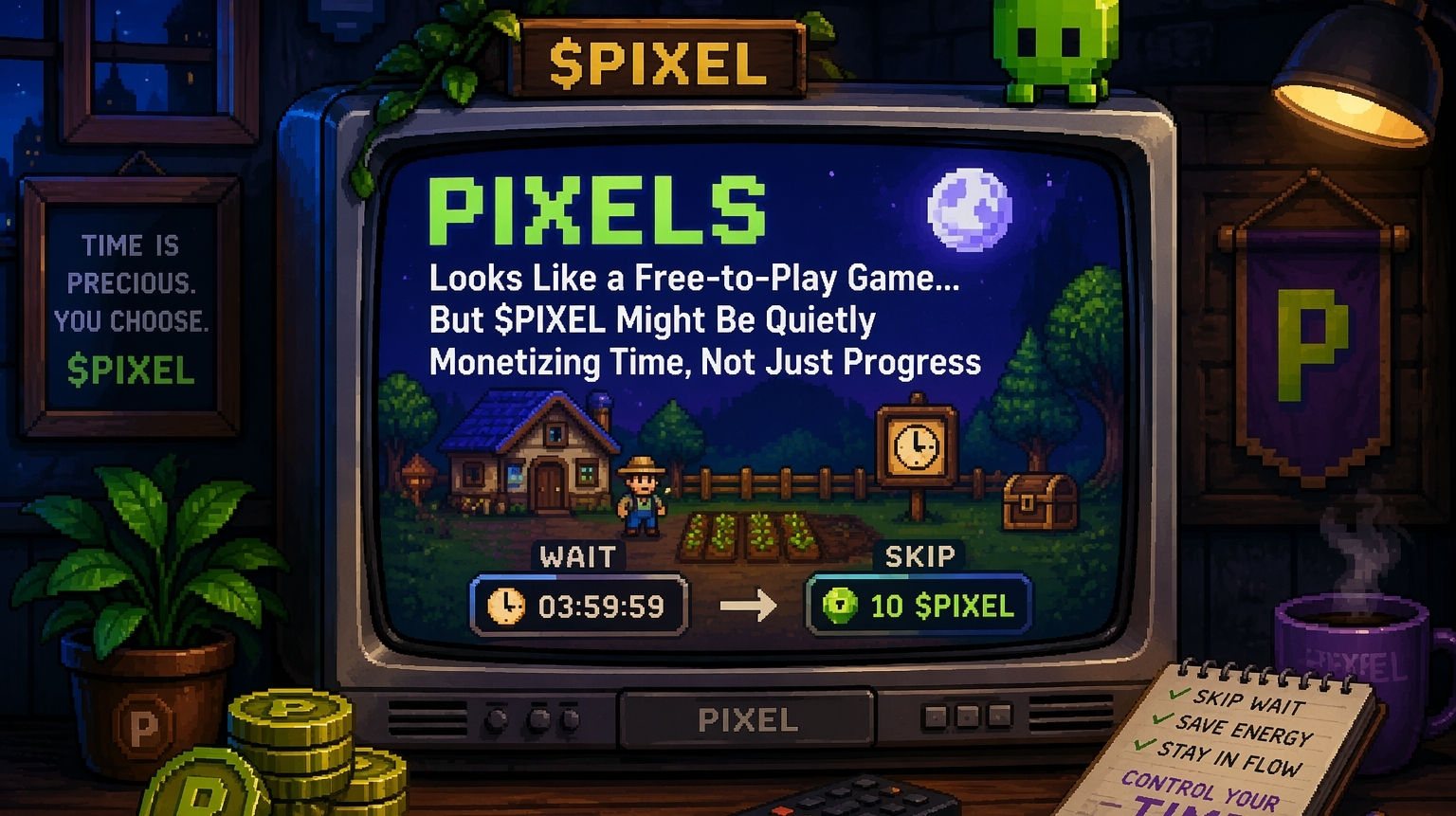
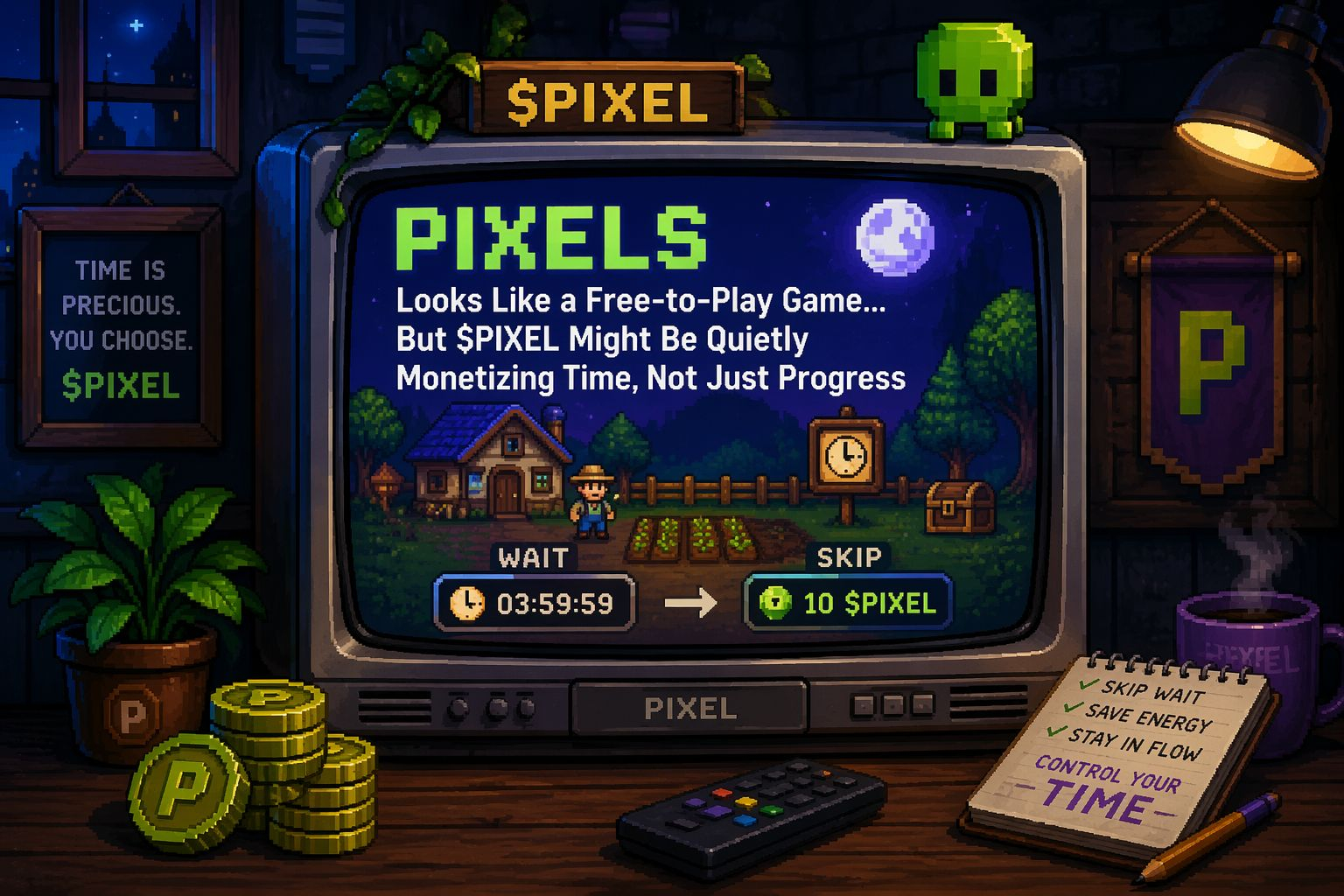
 At first glance, looked like just another GameFi token to me—a premium in-game currency attached to a farming simulator. Plant, wait, harvest, repeat. I’ve seen that formula plenty of times before. But the more I watched how people actually interacted with Pixels, the more I realized it wasn’t really operating like a traditional “progress token.”
What Pixels seems to monetize isn’t progress itself. It monetizes time.
That distinction matters.
Most GameFi economies are built around selling acceleration in obvious ways: stronger tools, better yields, higher output. Pixels offers those benefits too, but its real economic engine feels much more subtle. The pressure point isn’t the reward. It’s the delay surrounding the reward.
Growth timers. Energy caps. Cooldowns. Repetitive loops. Individually, each mechanic feels harmless—even familiar. Together, they create a persistent layer of friction that shapes the player experience far more than the rewards themselves.
And that’s exactly where becomes important.
Rather than functioning purely as a transactional currency, increasingly looks like a premium layer for time management. When I see players spend it, they often aren’t buying a better item or a stronger advantage. They’re making a simpler calculation: is waiting still worth it?
In many cases, the answer is no.
That creates a very different kind of demand. It isn’t always driven by competition or optimization. Often, it’s driven by convenience. Players may not care about maximizing efficiency, but they do care about reducing interruptions, smoothing repetitive actions, and maintaining momentum. In that sense, serves less as a tool for advancement and more as a mechanism for friction removal.
This is important because convenience-driven demand behaves differently from speculative demand. It tends to be quieter, less visible, and much harder to model. Yet it can also be surprisingly persistent.
Pixels also seems to maintain a deliberate divide between participation and control. Standard in-game coins support routine activity and keep the ecosystem functioning. A player can remain in that economy indefinitely. But the moment I want greater agency over how my time is spent—faster cycles, smoother progression, fewer interruptions—I naturally drift toward
That boundary feels intentional.
It reminds me of how many successful free-to-play games structure monetization: free access for participation, premium access for control. Everyone can play, but not everyone experiences time in the same way.
This also changes how I think about adoption. Most market analysis focuses on user growth, supply schedules, and token unlocks. Those metrics matter, but they may not fully capture what drives utility here.
The more relevant variable might be behavioral repetition.
If players repeatedly encounter moments where compressing time feels worthwhile, then demand for can persist even without explosive user growth. It doesn’t require constant expansion. It requires recurring decisions.
Skip this wait.
Speed up that process.
Avoid repeating that loop.
These are small choices, often made almost unconsciously. But collectively, they form the foundation of the token’s utility.
That said, this model is delicate.
If the game becomes too efficient, the need for $PIXEL diminishes. Without meaningful friction, there’s nothing left to compress. On the other hand, if delays start feeling overly engineered—less like gameplay and more like monetization—players will notice immediately.
And players are rarely forgiving when friction feels artificial.
That leaves Pixels balancing on a narrow edge. The friction must remain meaningful enough to create demand, but natural enough to avoid resentment. It has to feel like part of the game’s rhythm, not an obstacle inserted solely for extraction.
That’s much harder than it sounds.
Ultimately, I think the market may still be evaluating through the wrong lens. Supply mechanics and user growth are easier to quantify, but they overlook the token’s most important function: its role in shaping the player’s relationship with time.
doesn’t simply accelerate progress.
It changes how waiting feels.
And in digital economies, the ability to compress time—subtly, repeatedly, and voluntarily—can become one of the most powerful monetization models of all.