
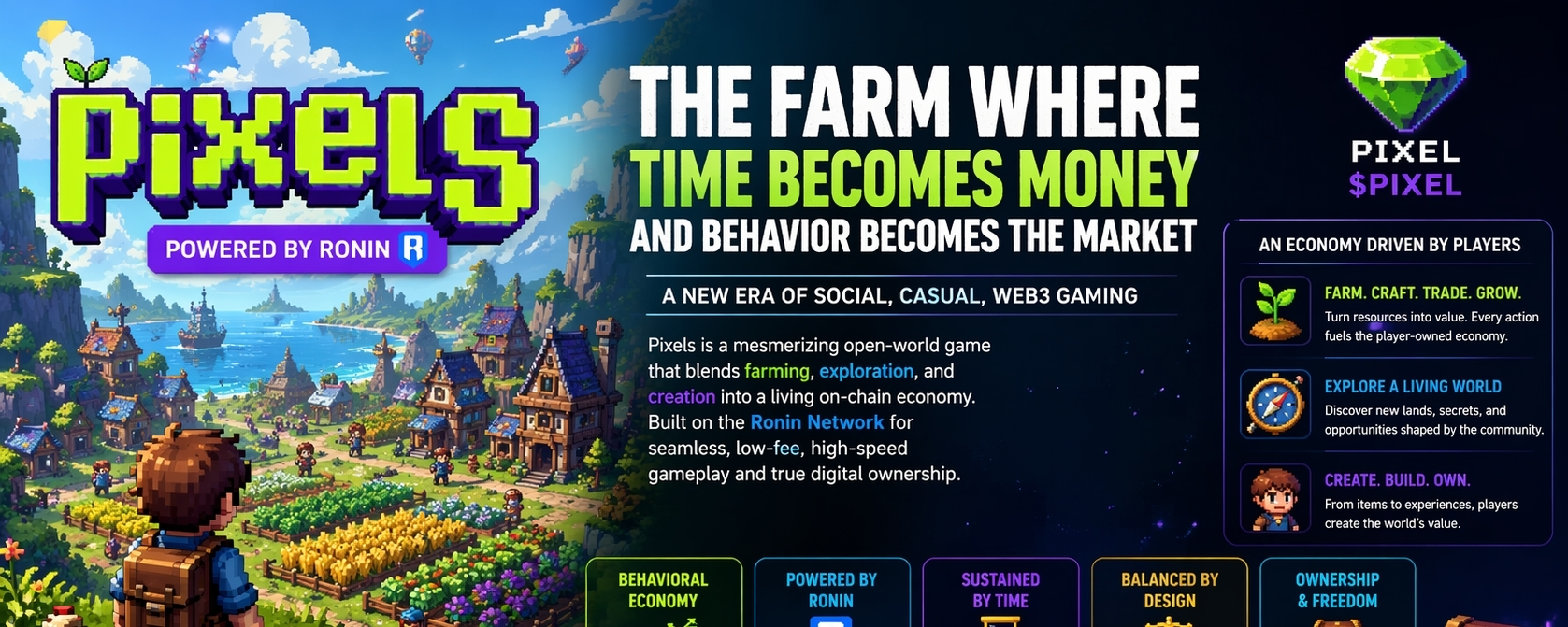
Pixels (PIXEL) doesn’t behave like a game in the way most people still try to frame it. i don’t see crops, land, or avatars first — i see a live economic surface where attention, time, and coordination are constantly being priced. what looks like casual farming is actually a low-friction labor market embedded inside a blockchain environment, where every click quietly feeds into a system that resembles a soft version of on-chain productivity.
what most people miss is that Pixels is not trying to maximize fun — it’s optimizing for repeatable economic behavior. the farming loop is deliberately simple, almost boring on the surface, because complexity would break consistency. the real design choice here is predictability. when actions are predictable, they become measurable. when they become measurable, they become optimizable. and when players start optimizing, they unknowingly transition from gamers into economic agents.
this is where the Ronin infrastructure matters more than the gameplay itself. low fees and fast confirmations don’t just improve user experience — they compress the time between action and reward. that compression changes behavior. in traditional games, effort and reward are separated by long feedback loops. here, they’re almost immediate. that immediacy trains users into high-frequency participation patterns, which is exactly what any functioning economy needs: velocity.
if you track wallet activity instead of player count, the pattern becomes clearer. you don’t see “users playing a game,” you see cycles of resource extraction, conversion, and reinvestment. players farm, craft, trade, and re-enter the loop not because it’s entertaining in isolation, but because the system creates a subtle expectation of return. this is where Pixels quietly overlaps with DeFi mechanics — not through yield farming in the traditional sense, but through behavioral yield.
the token, PIXEL, sits in an uncomfortable but fascinating position. it’s not purely a reward token, and it’s not purely a governance asset. it acts more like a balancing valve between effort and perceived value. if too much value leaks out relative to effort, inflation pressure builds. if rewards feel too low, participation drops. the system is constantly walking a tightrope, adjusting emissions and sinks in a way that feels closer to central bank policy than game design.
and yet, unlike DeFi protocols where liquidity can vanish overnight, Pixels anchors its economy in time investment. that’s a stronger glue than capital alone. people who spend hours building farms, optimizing routes, and learning mechanics don’t exit as easily as liquidity providers chasing APY. this introduces a different kind of stickiness — not financial lock-in, but psychological and behavioral inertia.
there’s also a deeper layer forming around coordination. guilds, informal groups, and even quiet partnerships are starting to emerge, not because the game forces them, but because efficiency demands it. solo optimization hits a ceiling. beyond that, cooperation becomes the edge. this is where Pixels starts to resemble early-stage economic clustering — small networks forming to extract more value from shared knowledge and synchronized actions.
if you overlay this with on-chain data, you’d likely see concentration patterns over time. a small percentage of wallets gradually capturing a disproportionate share of resources, not through speculation, but through superior process design. this is not a flaw — it’s a natural outcome of any open economic system. but it does raise a question: how long can a game sustain engagement when efficiency gaps become too visible?
another overlooked tension sits in the oracle layer, even if it’s abstracted away from users. any system that bridges in-game value with tokenized assets implicitly relies on price references, whether direct or indirect. if external market conditions shift — especially token price volatility — the entire in-game economy feels it. a sharp drop in PIXEL value doesn’t just affect traders, it changes how farming feels. effort suddenly seems less worthwhile, even if mechanics stay the same.
this is where most GameFi projects historically break — not at the gameplay level, but at the perception layer. when players start benchmarking in-game effort against external markets, the illusion of a “game” collapses into a financial activity. Pixels is walking directly into this tension, not avoiding it. the difference is that it leans into behavioral design to cushion the impact rather than relying purely on tokenomics.
from a structural perspective, Pixels benefits from being on an ecosystem that already understands gaming economies. Ronin isn’t experimenting from zero — it carries the memory of previous cycles, including what happens when reward systems spiral out of control. that historical context matters. it increases the chances that adjustments will come earlier, before imbalances become irreversible.
capital flow right now is subtle but telling. it’s not rushing in aggressively like early GameFi phases. instead, it’s probing. smaller allocations, more cautious participation, and a clear preference for observing retention metrics over hype. this is a healthier signal. it suggests that the market is no longer buying the narrative blindly — it’s waiting for proof of sustainable loops.
the real metric to watch isn’t token price, it’s behavioral consistency. how often do players return? how stable are activity patterns across different wallet sizes? does engagement hold when external market conditions turn unfavorable? these are the signals that will define whether Pixels is a temporary cycle or an evolving system.
what i find most interesting is how Pixels quietly reframes what “play-to-earn” actually means. it’s no longer about extracting value quickly. it’s about embedding yourself into a system where value emerges over time through participation. slower, less explosive, but potentially more durable. the market hasn’t fully priced this shift yet.
if Pixels succeeds, it won’t be because it became the most fun game. it will be because it became a place where people unconsciously choose to spend time in a way that feels productive, even when returns fluctuate. that’s a much harder problem than building gameplay — it’s about shaping behavior at scale.
and if it fails, it won’t be due to lack of users or liquidity. it will be because the balance between effort, reward, and perception slipped just enough for users to notice. in systems like this, collapse doesn’t happen loudly — it happens when people quietly stop caring.
right now, Pixels is still in the phase where belief and behavior are aligned. the question is how long that alignment can hold once the market starts testing it harder.
