
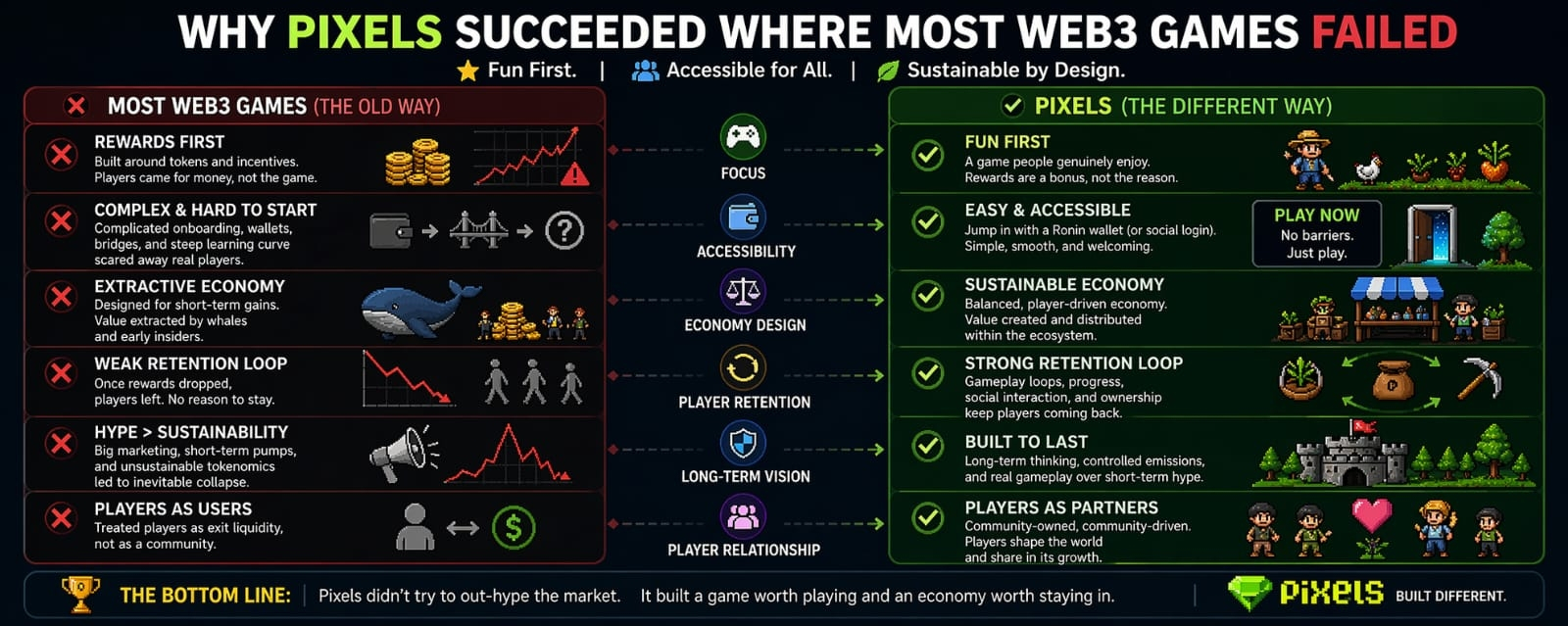
It didn’t hit me immediately. It was more like a quiet irritation that kept showing up every time I opened another Web3 game. The dashboards looked impressive, numbers everywhere, rewards stacked, tokens moving… but something felt off. So I paused and asked myself something I hadn’t really asked before — if the rewards disappeared right now, would I still care about this?
That question stayed longer than I expected.
Because when I shifted my attention to Pixels, the feeling changed. Not dramatically. Not in a flashy, “this is the future” kind of way. Just… different enough to make me pay attention.
At first glance, this looks simple, but it’s not. A farming game. Pixel visuals. Calm pacing. It almost feels too basic for a space that constantly tries to over-engineer everything. And maybe that’s why I underestimated it at first.
I used to think Web3 games failed because they weren’t polished enough. Bad UI, weak gameplay loops, poor retention strategies — all surface-level issues. Easy to point out. Easy to blame. But over time, I started noticing a pattern that didn’t fit that narrative.
Even the “good” ones couldn’t hold people.
They spiked. Then they faded.
And not slowly… fast.
That’s when it started getting uncomfortable, because it forced me to look beyond execution and into intent. What were these games actually built for?
This is the part most people completely miss.
Most of them weren’t designed as games first. They were designed as economic systems. The gameplay was just the entry point. The real focus was on attracting liquidity, creating hype cycles, and sustaining token demand. Fun was… optional.
And when fun is optional, people leave the moment incentives weaken.
Pixels doesn’t follow that path. At least not in the same way.
The game exists first. Then the economy is layered on top.
It sounds simple. But it changes behavior.
I started watching how players interact inside it. Not just what they earn, but what they do. They farm, optimize, trade, explore, chat, return. There’s a rhythm there. A kind of natural engagement that doesn’t feel forced.
That’s hard to fake.
Because when people are only there for rewards, their behavior is predictable. They extract and move on. There’s no attachment. No curiosity. No patience.
And honestly, that’s what most Web3 systems have been rewarding.
I used to think this was just “how the space works.” High incentives bring users. Users create volume. Volume drives growth. But now I see the flaw in that thinking.
You don’t build communities that way. You build temporary traffic.
Now I approach this differently. I don’t get impressed by reward structures anymore. I look for friction, for depth, for signs that someone would stay even when it’s quiet. If that’s missing, I already know how it ends.
Pixels feels like it’s built with that awareness.
The economy isn’t aggressively pushing rewards. It’s slower. More controlled. Almost like it’s intentionally avoiding the usual hype cycle. At first, I thought that was a weakness.
Now I see it as discipline.
Because fast growth in Web3 often comes at the cost of stability. And most people don’t question it because the early phase feels exciting. But excitement isn’t sustainability.
Accessibility is another thing I didn’t value enough before.
Pixels removes friction quietly. You can jump in without overthinking wallets or technical barriers. It doesn’t overwhelm you upfront. And that changes who enters the system.
This matters more than it seems.
Because complex systems with high rewards attract a certain type of user — short-term, profit-focused, always looking for the next opportunity. Simple, engaging systems attract people who are actually willing to stay.
Two completely different behaviors.
And once I saw that clearly, it became hard to ignore it anywhere else.
Not just in games, but in markets, projects, even personal habits. Am I building something sustainable, or am I chasing quick outcomes? Am I creating value, or just positioning myself to extract it?
Those questions don’t feel comfortable. But they’re necessary.
Pixels isn’t perfect. I’m not pretending it is. There are still risks. Scaling challenges. Economic pressures that will test the system over time. But it feels like one of the few projects that understands what most others ignored.
You can’t force long-term engagement with short-term incentives.
At some point, the structure reveals itself.
And where I’ve landed now is simple, but it took time to accept — if people wouldn’t stay without rewards, then the rewards were never the strength. They were just the disguise.
