
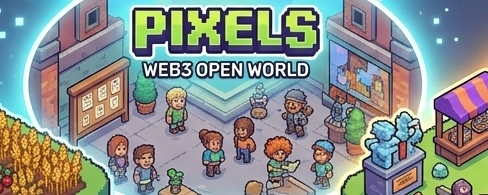
The first time I read the short description of Pixels as a social casual Web3 open-world game built around farming, exploration, and creation, one detail immediately stood out to me. Farming and exploration are normal anchors for an open world like this. But seeing creation placed beside them as a core activity suggested something different. It implied the Pixels world isn’t only meant to be used by players. It’s meant to depend on what players add to it.
That small detail changes how the structure of the game reads from the start.
Pixels is described around three loops: farming, exploration, and creation. Farming gives players repeatable activity inside the world. Exploration spreads players across the shared map. Creation does something the other two cannot do on their own. It introduces persistence through player contribution. It suggests the world is expected to reflect what players leave inside it, not just where they move through it.
That makes creation a structural layer, not a side feature.
If Pixels were built only around farming and exploration, the open world could still function as a casual environment supported mostly by developer-prepared structure. Players would gather resources and move across the map, but the shape of the environment itself would remain largely unchanged between sessions. The moment creation appears beside those loops in the description, the expectation shifts. The world is no longer framed as something that simply waits for players. It becomes something that responds to them.
Creation quietly turns participation into influence.
This creates a visible tension inside the Pixels structure. Farming supports routine activity. Exploration supports movement across the open world. Creation supports change that carries forward beyond a single visit to the map. When these three loops are placed together, the description is pointing toward a world that becomes more recognizable through player presence over time, not only through what already exists inside it.
That difference affects how the open world behaves.
If players mostly farm and explore but rarely engage with the creation layer, then one of the three pillars described in Pixels stops contributing to how the environment develops. The world would still be playable. Movement would still happen. Resources would still be gathered. But the environment would behave more like a prepared space than a socially shaped one. Exploration would mainly reveal what is already there instead of what players are gradually defining together.
This is why creation matters in the structure more than it first appears.
Farming starts activity. Exploration distributes it across the map. Creation is what allows activity to leave traces that remain part of the shared space. When those traces exist, the open world begins to reflect player behavior instead of only developer layout. That is the point where a social open world starts feeling shaped rather than simply visited.
Pixels being described as a social casual open-world game makes that expectation clearer. Social environments gain meaning when players influence what other players encounter later. Farming alone does not do that. Exploration alone does not do that either. Creation is the loop that allows individual sessions to connect into a shared environment that can evolve through use.
This is also where the responsibility placed on players quietly changes.
Casual participation usually means players can enter and leave without needing to affect the structure around them. Farming fits that pattern. Exploration fits it as well. Creation introduces a different role. It suggests the world becomes stronger when players contribute to it instead of only moving across it. That shifts Pixels away from being only a space for activity and closer to being a space shaped by activity.
If the creation layer stays active, the environment reflects player presence over time. If it stays underused, the world still runs, but it starts behaving more like a background for farming movement rather than a shared space shaped through interaction. The three-loop structure described in Pixels only fully works when creation carries weight alongside the other two.
So the important question inside the Pixels design isn’t just what players can do inside the world. It is whether players treat creation as part of the environment itself or as something optional beside it.
Once creation appears as one of the three pillars in the description, the open world is no longer positioned as something players only enter. It becomes something that gradually takes shape through what players decide to leave inside it. That changes what participation means in Pixels and explains why creation is placed exactly where it is in the structure of the game.
An open world supported only by farming and exploration can stay active. But an open world supported by farming, exploration, and creation is clearly asking players to help define what that world becomes over time.
