
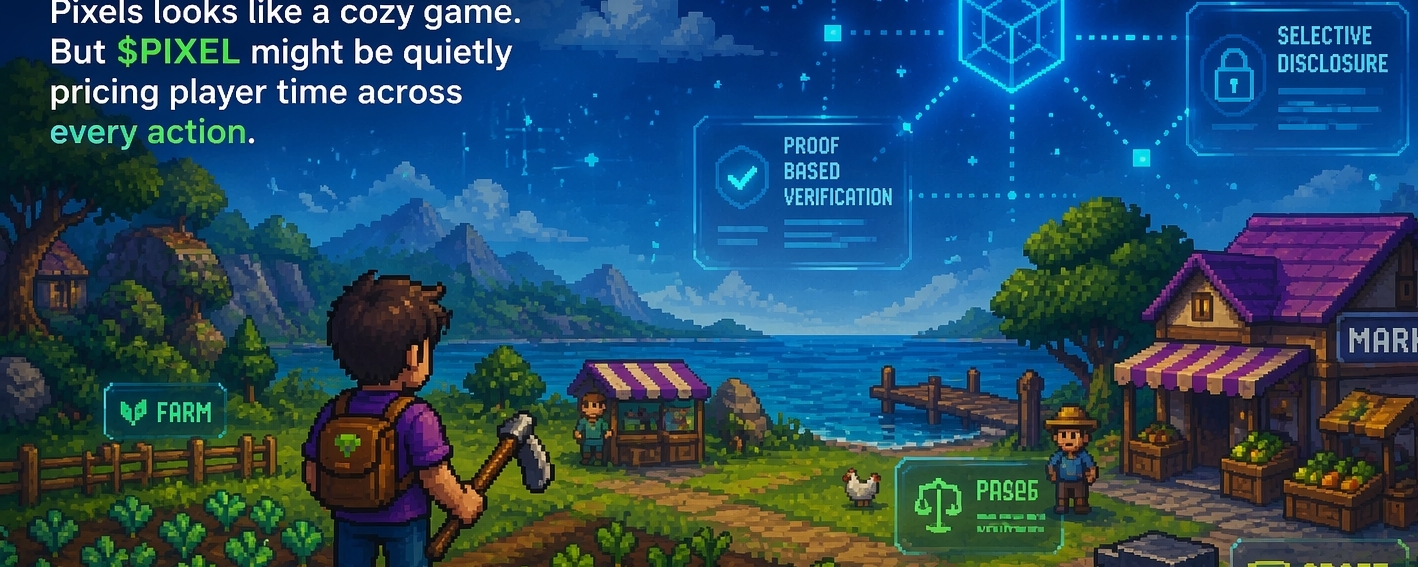
The way I see it, Pixels is not really competing with other Web3 games.
It is competing with a bad habit.
That bad habit is the GameFi instinct to measure everything through the token first. The moment a player enters a game and immediately starts calculating rewards, exits, claims, unlocks, and token value, the game has already lost some of its magic.
Pixels is interesting to me because it sits right on that dangerous line.
On one side, it is a cozy farming world with land, crops, quests, crafting, pets, social spaces, and slow progression. On the other side, it has PIXEL, staking, rewards, NFTs, land value, and all the economic layers that can easily pull attention away from the game itself.
That tension is what makes the project worth watching.
Not because Pixels has completely solved GameFi.
It has not.
But because it appears to understand the problem better than many games that came before it.
I do not think players hate tokens. They hate feeling used by them.
There is a big difference between a token that adds value and a token that turns the game into work.
A healthy token feels like a tool. It lets players access better items, personalize their experience, speed up certain actions, join deeper parts of the economy, or express status inside the game.
An unhealthy token becomes the reason for every action.
That is where many GameFi projects went wrong. They trained players to see the game as a workplace. Every mission became a wage. Every asset became inventory. Every click became a calculation.
At that point, the player is not thinking, “This is fun.”
They are thinking, “Is this efficient?”
That is a dangerous mindset for a game.
Pixels has to avoid that by making sure PIXEL feels useful without becoming the center of the emotional experience. The token should support the world, not swallow it.
To me, the best version of PIXEL is not “the thing people chase.”
It is the thing that makes committed players feel more connected to the world they already enjoy.
Pixels feels strongest when it behaves like a small town
I do not see Pixels as just a farming game.
I see it more like a small digital town.
That sounds simple, but it changes how you judge the project.
A casino needs constant excitement.
A trading app needs constant movement.
A town needs routine.
Pixels’ biggest strength is not that farming is new or complex. It is that farming creates rhythm. You plant, return, collect, craft, upgrade, and repeat. Over time, that rhythm can become familiar. Familiarity is underrated in Web3, where everyone is always chasing the next launch.
Most crypto projects want attention.
Pixels needs attachment.
Attention is loud and temporary. Attachment is quieter, but much more valuable.
If a player logs in only because there is a reward campaign, that relationship is weak. But if they log in because they want to check their land, finish a task, help their group, see what others are doing, or slowly improve their space, then Pixels has something more durable.
That is where the project can separate itself from token-driven GameFi.
The farming loop is not the point. The feeling of return is the point.
A lot of people underestimate casual games because they look simple.
But simple games are often the ones that survive longest. They do not demand too much from the player. They become part of a routine.
Pixels has that kind of structure. It does not need to overwhelm players with cinematic battles or complicated mechanics. Its advantage is smaller and more human: it gives people a reason to come back.
That reason cannot only be PIXEL.
If the main reason to return is the token, then the player’s loyalty belongs to the market, not the game.
But if the reason to return is progress, habit, social connection, land development, crafting goals, seasonal competition, or community identity, then the game becomes stronger.
This is why I think Pixels should protect its slower side.
The small tasks matter.
The land matters.
The social spaces matter.
The little upgrades matter.
The sense of “I have something here” matters.
In a market obsessed with speed, Pixels’ best weapon may actually be slowness.
Unions are a smart move because they make the game less lonely
For me, the most important direction in Pixels is not just token utility or staking.
It is social pressure.
The introduction of Unions matters because it gives players something larger than their own farm to care about. A solo farming loop can become repetitive. A group-based loop can become personal.
When players join a side, contribute, compete, sabotage, or work toward shared seasonal goals, the game starts creating stories.
And stories are much harder to replace than rewards.
A player might forget the exact value of a reward they earned last month. But they may remember the group they played with, the rival union they wanted to beat, the friend who helped them, or the moment their side climbed the rankings.
That is the kind of memory Web3 games need.
Too many GameFi projects create transactions but not stories.
Pixels has a chance to create both.
Ronin gives Pixels a better stage, but the performance still matters
Pixels being on Ronin is important, but I do not think it should be treated like a guarantee.
Ronin gives Pixels a strong gaming-native environment. It has users who already understand Web3 assets, wallets, marketplaces, and game economies. That helps Pixels reach the right audience faster than it could on a more general-purpose chain.
But infrastructure is only the stage.
The game still has to perform.
A chain can bring users to the door, but it cannot make them care. It can make transactions smoother, assets easier to trade, and onboarding more familiar, but it cannot create emotional loyalty by itself.
That part has to come from Pixels.
This is why I think the Ronin connection is valuable but not enough. Pixels still has to prove that players will stay when the token is quiet, when campaigns slow down, and when the only reason to log in is the game itself.
That is the real test.
Staking is useful, but it can quietly change the mood
I understand why staking exists. It gives PIXEL holders another reason to stay involved. It can connect the token to the wider ecosystem and create long-term alignment.
But I also think staking is one of the areas Pixels has to handle carefully.
Staking can support a game economy, but it can also pull attention away from the game. Once users start caring more about yield than gameplay, the emotional center shifts.
That does not mean staking is bad.
It means staking should feel like a supporting layer, not the main event.
Pixels has a cozy identity. It feels like farms, land, avatars, crafting, and community. If too much of the conversation becomes staking rewards and optimization, the project risks losing the very atmosphere that makes it different.
A farming world should not feel like a spreadsheet in costume.
That is the line Pixels needs to protect.
Bots are not just a technical problem. They are a design warning.
Every successful Web3 game attracts bots and reward farmers. That is almost unavoidable.
But bots reveal something important: if the most profitable actions are also the most repetitive, the game becomes easy to exploit and easy to misunderstand.
Pixels should not only ask, “How do we stop bots?”
It should also ask, “Why are bots able to imitate valuable play?”
The answer is usually that the game is rewarding shallow activity too much.
Real players do things bots struggle to copy well. They build identity. They form relationships. They make choices based on taste. They participate in groups. They care about reputation. They return for reasons that are not purely mechanical.
So the more Pixels rewards human behavior, the safer it becomes.
Creative land use, social contribution, meaningful group play, long-term achievements, and reputation-based systems can make the world feel less extractive. They also make it harder for the game to be reduced to simple farming scripts.
In my view, this is one of the most important paths forward.
Pixels should reward presence, not just activity.
My biggest concern: the economy could become too clever
Pixels has many ingredients: land, tokens, resources, quests, crafting, pets, staking, Unions, seasonal rewards, and ecosystem connections.
That richness can be good.
But there is a risk.
If too many systems are added too quickly, the game may start to feel less like a casual world and more like a complicated economic machine. That would be a mistake.
The charm of Pixels comes from approachability. It feels easy to understand. It does not scare people away with heavy mechanics at first glance.
Pixels should not lose that.
Depth is good, but only if it does not destroy warmth.
A good farming game should make players feel curious, not exhausted. It should invite them back, not make them feel like they need a strategy guide, a token dashboard, and a calculator open at the same time.
The economy should create interesting choices.
It should not create mental fatigue.
The question I would use to judge every Pixels update
If I were judging Pixels from the outside, I would ask one question after every major update:
Would this feature still matter if the PIXEL token stayed flat for six months?
If the answer is yes, that feature probably strengthens the game.
If the answer is no, it may only strengthen speculation.
This question is simple, but I think it cuts through most of the noise.
A strong game feature creates value even without price movement. It gives players something to do, something to care about, or something to remember.
A weak GameFi feature only feels exciting when rewards are high.
Pixels needs more of the first kind.
Final perspective
I do not think Pixels has fully escaped the classic GameFi trap yet.
No Web3 game with tokens, staking, rewards, and tradable assets can honestly say that risk is gone.
But I do think Pixels has a better chance than many projects because its core idea is not built around combat hype, impossible graphics, or financial promises. It is built around something more ordinary: routine.
And routine can be powerful
If Pixels becomes a place where people return because they enjoy the world, PIXEL becomes healthier as a result. But if Pixels becomes a place where people return only because they expect rewards, then it will face the same problem that damaged so many GameFi projects before it.
For me, the future of Pixels depends on whether it can keep the player’s first thought simple:
Not “How much can I earn?”
But “What do I want to do today?”
That is the difference between a game economy and an economy pretending to be a game.
