I completely underestimated this part
At first, Pixels felt like well, a farming game. You log in, plant something, harvest it later, maybe upgrade a few things. Pretty standard loop. Nothing about that screams economic system worth studying
But then I started looking at land.
And that’s when it clicked. This is property.
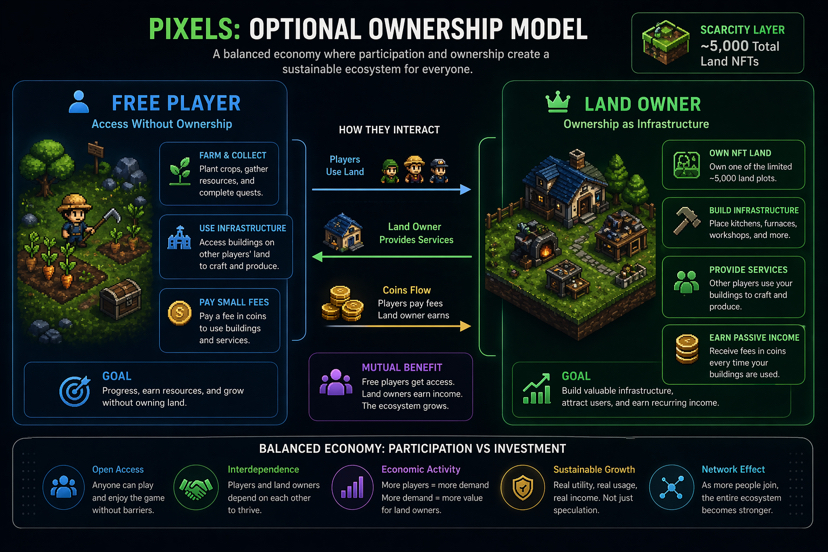
Here’s the thing. Land in Pixels is optional, which sounds like a small design choice, but it actually changes everything. You don’t need to own anything to play. You can show up, grind, progress, enjoy the game just fine. But at the same time, there’s this parallel layer running underneath one where ownership starts to matter in a very real way.
Only about 5,000 land plots exist. That number is doing a lot of heavy lifting. It quietly introduces scarcity without forcing it on the player. No one is screaming limited supply at you but once you notice it, you start thinking differently. You’re not just farming anymore. You’re looking at space
Position
Access
And then the mechanics start to stack
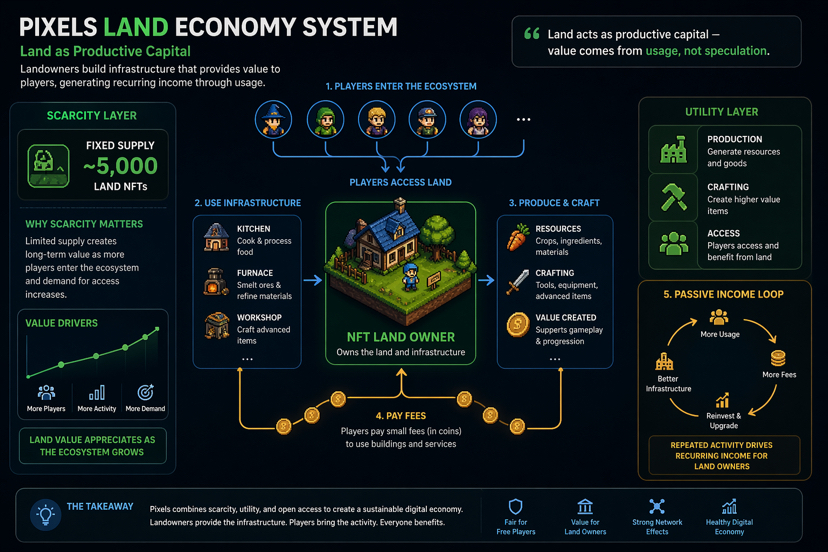
When you own land, you’re not just holding an NFT for the sake of it. You’re building on it. Kitchens, furnaces, workshops these aren’t decorative. They’re productive units. They create resources. They enable crafting. They turn your plot into something other players actually need.
That’s the shift your land becomes useful to others.
And this is where it gets interesting. Other players can walk onto your land and use your setup. But they don’t do it for free. They pay a fee in coins. Small amounts, sure, but it adds up. Suddenly, you’re not just playing you’re operating.
To be honest, it feels less like a game mechanic and more like running a tiny business in a busy town.
You provide the infrastructure. Others bring the activity.
And the reward? It’s not just hypothetical value. It’s flow. Ongoing, repeat usage. That’s a very different mindset from typical NFT ownership, where people are mostly hoping the price goes up. Here, the value comes from being used.
That’s a subtle but important distinction.
WHY NOT EVERYONE NEEDS LAND AND WHY THAT’S SMART
What I find fascinating is that Pixels doesn’t force you into ownership.
Most games that introduce NFTs almost push you into buying something just to participate properly. Pixels doesn’t do that. You can stay a free player forever if you want. You can farm, trade, progress, interact nothing is locked away from you.
At first glance, that might seem like it weakens the value of land.
But it actually does the opposite
Because now, the people who buy land aren’t doing it out of necessity they’re doing it because they believe in the system. That creates a different kind of participant. Less short-term speculation, more long-term thinking.
Free players and landowners end up forming this natural relationship. One group needs access to better infrastructure. The other provides it. No one is forced into either role, but both roles depend on each other
That balance is hard to get right. Most projects mess it up
Pixels surprisingly doesn’t.
THE IDENTITY LAYER THAT TIES IT ALL TOGETHER
There’s another angle here that I didn’t expect to matter as much as it does.
Personal identity
You can customize your land. Your house. Your farm layout. That’s normal for games. But then you notice something else players walking around with avatars from completely different NFT collections. Bored Ape Yacht Club, Azuki, Doodles.
But the more I watched it, the more it started to make sense.
This is what people mean when they talk about interoperability but here, it’s not theoretical. It’s visible. It’s social. You see it the moment you enter someone’s farm. Their land isn’t just a production space it’s an extension of who they are
And that matters more than most people think.
Because economies don’t run purely on logic. They run on identity, status, expression. The reason someone chooses your land over another might not just be efficiency it might be familiarity, reputation, or even aesthetic preference.
That’s how digital worlds start to feel real
WHEN LAND STARTS LOOKING LIKE CAPITAL
If I strip all the game elements away and just look at the structure, the closest real-world analogy is pretty obvious.
This is commercial real estate.
You own a location. You build useful things on it. People come because they need what you’ve built. And in return, you earn from that activity.
Simple but powerful
And because the supply is fixed, the moment more players enter the system, pressure builds. Not artificially organically. More users means more demand for infrastructure. More demand means more activity flowing through existing land
I’ve seen early players renting out their land to groups almost like digital guild hubs and earning consistently from it. That’s when it stops feeling like speculation and starts feeling like a functioning market
To be honest, that’s the part most people overlook. They see NFTs, they think “price.” But the real story here isn’t the price it’s the behavior
People are using these assets. Relying on them. Building around them
And once that happens the system starts sustaining itself.
That’s when things get interesting.