
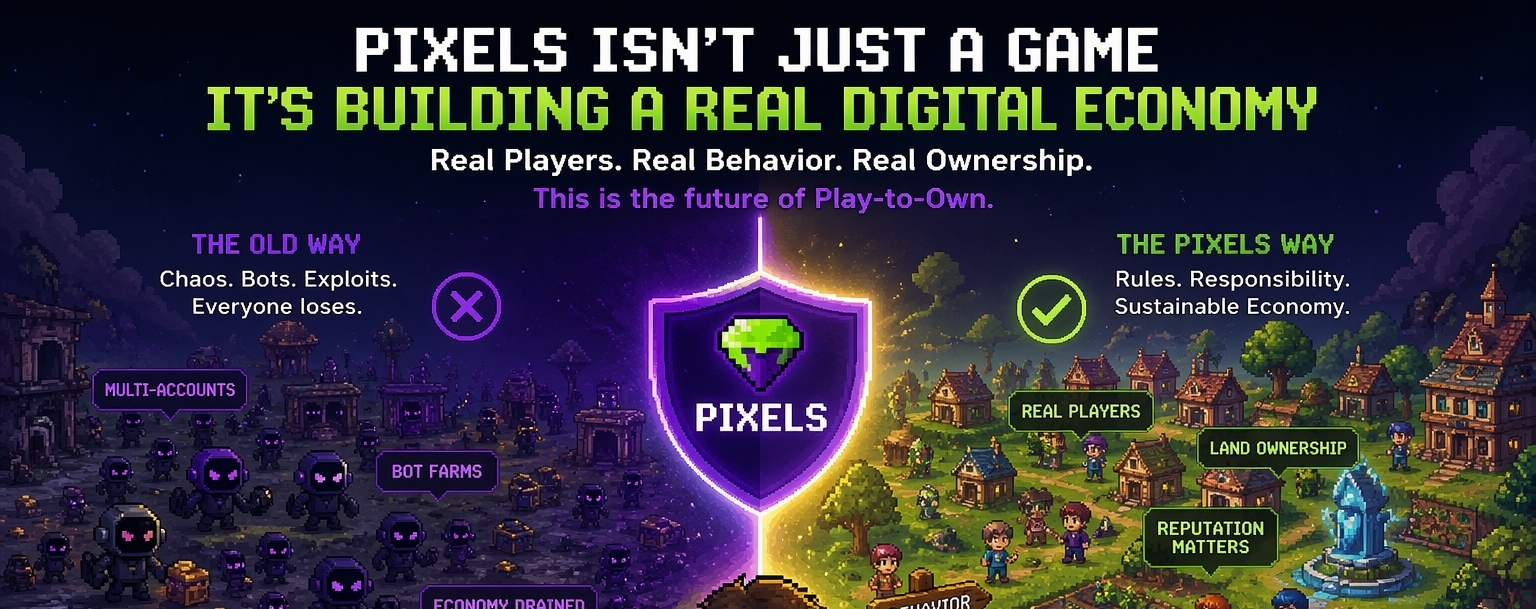
I didn’t like it at first… I’ll be honest.
Something about Pixels felt… too strict. Like, why would a game care this much? Games are supposed to be loose, right? You log in, you play, maybe you grind a little, maybe you don’t. No one’s watching that closely… or at least that’s what I thought.
But Pixels doesn’t feel like that anymore. And maybe it never really did.
At first, the rules just felt annoying. Limits here, restrictions there, warnings about behavior, systems tracking patterns. It almost made me uncomfortable. Like… why is this necessary? Why does a farming game need to feel like it has a security system behind it?
Then I started noticing something.
Most play-to-earn systems I’ve seen before… they eventually break. Not suddenly, but slowly. Bots creep in. Multi-accounts everywhere. Rewards get drained. Real players start feeling like they’re competing with scripts instead of people. And then the economy just… fades. It becomes noise. Numbers without meaning.
Pixels seems to be reacting to that. Not casually. Not softly. But directly.
The zero-tolerance approach to botting and multi-accounts felt harsh at first, but when you think about it… it’s kind of like a city trying to survive. If anyone can open fake shops, manipulate prices, or duplicate themselves endlessly, the whole system collapses. It stops being a market. It becomes chaos.
And Pixels is trying really hard not to become chaos.
Even the land system… I didn’t fully get it in the beginning. The idea that your land isn’t just yours to exploit, but something you’re responsible for. That 48-hour correction window — it almost feels like the system is saying, “we’ll give you a chance, but we’re watching how you behave.” It’s not just ownership… it’s accountability.
That’s a weird shift. And yeah, it feels uncomfortable.
Because now it’s not just about how much you grind.
It’s about how you act.
Reputation is quietly becoming part of the economy. Not in a loud, obvious way, but in the background. The way you play, the way you interact, even the patterns you follow… they matter. And not just inside the game either. There’s this strange blur now, where what happens on Discord, or how you engage socially, starts to feel connected.
It’s like Pixels is building something bigger than just a game loop.
And I keep coming back to this thought… maybe this isn’t about control at all.
Maybe it just looks like control because we’re used to broken systems.
If you filter out bots, fake activity, and exploitative behavior… what you’re left with is cleaner data. Real players. Real actions. And suddenly, the economy isn’t inflated by noise anymore. It starts to reflect actual human participation.
That’s rare.
Most systems don’t fix the root problem. They just adjust rewards, tweak numbers, delay the collapse. Pixels feels like it’s doing something else entirely… like it’s trying to fix behavior before it fixes outcomes.
And yeah… that requires rules. Strict ones.
I’m still not completely sure how I feel about it. Part of me still resists it a little. That instinct doesn’t just go away.
But another part of me… kind of respects it.
Because if this works — if real users actually start mattering more than fake activity — then this might not just be another play-to-earn experiment.
It might be something closer to a real digital economy.
And maybe that was the point all along.