
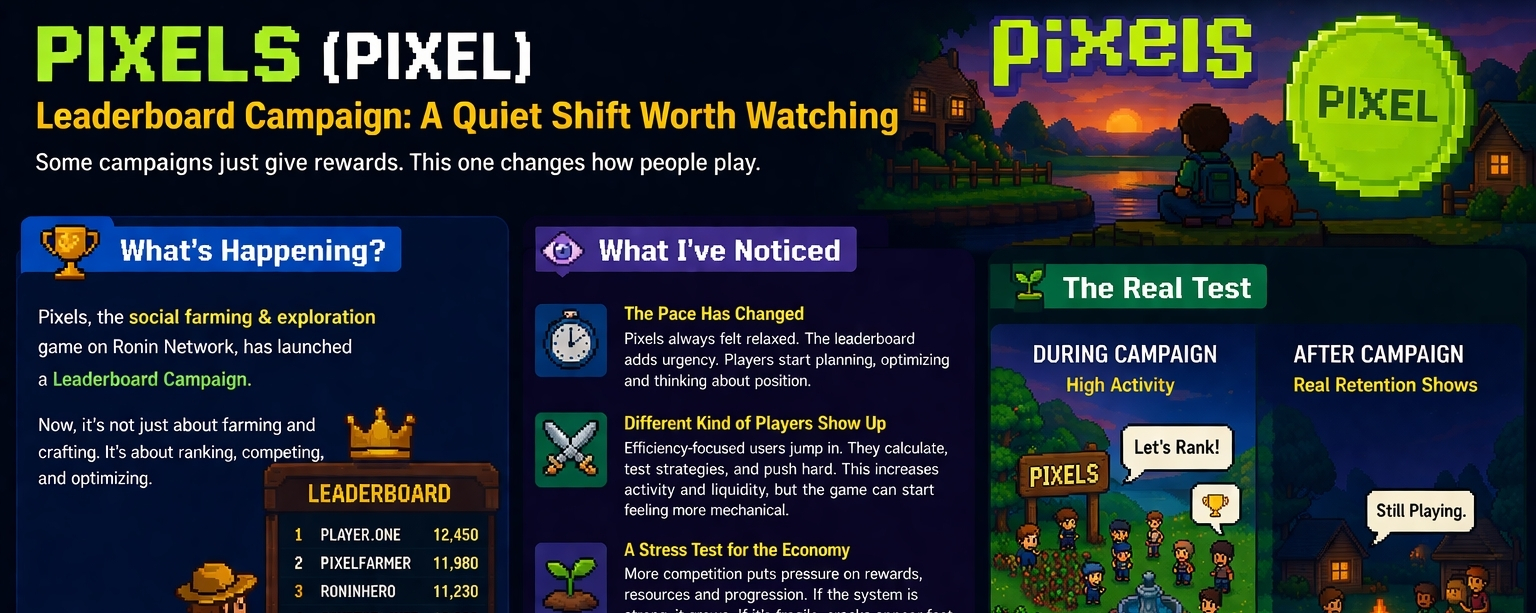
I’ve been spending some time looking at Pixels, and the first thing that really stood out to me wasn’t the token or the Web3 angle. It was the pace. Everything about it feels slower and more deliberate. You log in, walk around, plant something, collect resources, maybe craft an item, then just keep going. There’s no immediate push toward earning, no complicated system thrown at you in the first five minutes. It feels closer to the kind of casual farming games people used to play years ago, just placed inside a shared world. That alone made me pause, because most crypto games usually lead with rewards first and gameplay second. Pixels seems to be trying the opposite approach.
I noticed pretty quickly that the game relies heavily on routine. You return, tend your crops, gather materials, and gradually build progress. It’s simple, but that simplicity can be powerful if players develop habits. I’ve seen projects try to build this kind of loop before. When it works, users don’t log in for rewards, they log in because it becomes part of their daily rhythm. But when it doesn’t work, the repetition becomes obvious, and activity drops as soon as incentives slow down. That’s the line Pixels seems to be walking right now.
Another thing I kept thinking about is how social the world feels. Players aren’t isolated. Land is shared, resources move between users, and different players naturally fall into different roles. Some focus on farming, some craft tools, some trade items, and others invest in land. It creates a small economy that grows organically. I’ve seen similar systems in sandbox-style games where the value comes from interaction rather than just gameplay. That kind of structure usually lasts longer because the players themselves create demand. Still, it depends heavily on continued activity. If the world feels empty, the economy slows, and everything becomes less meaningful.
The move into the Ronin ecosystem also felt intentional rather than random. Ronin already has a reputation for supporting Web3 gaming, and projects there tend to attract actual players. When Pixels started gaining traction, it didn’t feel like pure speculation. It looked more like users were actually logging in and spending time inside the world. That distinction matters. I’ve seen tokens surge in price with almost no real gameplay, and those usually fade quickly. With Pixels, the attention seemed to come from activity first, then liquidity followed.
What also caught my attention is how the token sits in the background instead of dominating everything. PIXEL exists, but it doesn’t completely control the gameplay loop. Most of what you do revolves around resources, crafting, and progression. The token feels more like a layer on top rather than the foundation. I’ve seen this model used before to avoid heavy inflation early on. Sometimes it helps stabilize things. Other times, once emissions start, the pressure slowly builds anyway. It really depends on how carefully the economy is managed and whether players actually need the token long term.
Accessibility is another quiet strength. You don’t need to buy anything just to start. You can jump in, explore, and understand the game before deciding to commit more time. That removes a lot of friction. Earlier Web3 games often required players to purchase assets first, which limited adoption. Pixels feels more open. It invites casual players and lets them decide later if they want to go deeper. That kind of approach usually builds a wider base, but it also means the project relies heavily on keeping those users engaged.
I’ve also been thinking about longevity. Farming and crafting loops are comfortable, but they can become repetitive if nothing evolves. The team seems to be adding features slowly, expanding social mechanics, and building out the world. That’s usually a good sign. But I’ve seen many games reach this stage where things feel promising, then momentum slows when the novelty wears off. The difference always comes down to whether players find their own goals inside the world. If everything depends on developer-driven events, activity tends to come in waves instead of staying consistent.
Another familiar pattern is the early surge of users. When a Web3 game starts gaining attention, people join quickly, explore, and test the economy. Liquidity increases, trading picks up, and the project feels alive. Then the real phase begins — watching whether those users stay. Pixels feels like it’s entering that stage. The early curiosity has already done its job. Now it’s more about whether the gameplay can hold attention without constant incentives.
What makes Pixels slightly different, at least from my perspective, is that it doesn’t try to feel urgent. There’s no rush. The world is calm, the mechanics are simple, and progression is gradual. That tone might actually help retention. I’ve seen fast-paced reward-driven games burn out quickly, while slower ones quietly build loyal communities. It’s hard to know which direction this goes, but the design seems built for patience rather than hype.
Right now, I don’t see it as something clearly bullish or bearish. It feels more like a long experiment in whether casual gameplay combined with light Web3 elements can hold real users. The pieces are there — shared world, player-driven economy, accessible entry, and gradual progression. But the outcome still depends on behavior over time. If players keep logging in even when rewards normalize, that’s usually when a project proves itself.
So I’m mostly just watching. I’m paying attention to activity inside the world, how the economy moves, and whether players continue interacting naturally. It doesn’t feel like something that needs immediate judgment. It’s one of those projects that needs time to settle, and the real signal will come later, when the excitement fades and only consistent participation remains.