I keep coming back to a simple moment one that most players don’t talk about, but almost everyone has felt.
You log into a game. The world looks full. There’s movement everywhere. Numbers are ticking, tasks are lined up, systems are working exactly the way they were designed to. On paper, everything is alive. But after a while, something starts to feel off. You’re playing, but not really experiencing. You’re progressing, but not really connecting.
And if you’re honest with yourself, you realize something uncomfortable: if the rewards disappeared tomorrow, you probably wouldn’t come back.
That’s the quiet problem most digital worlds carry.
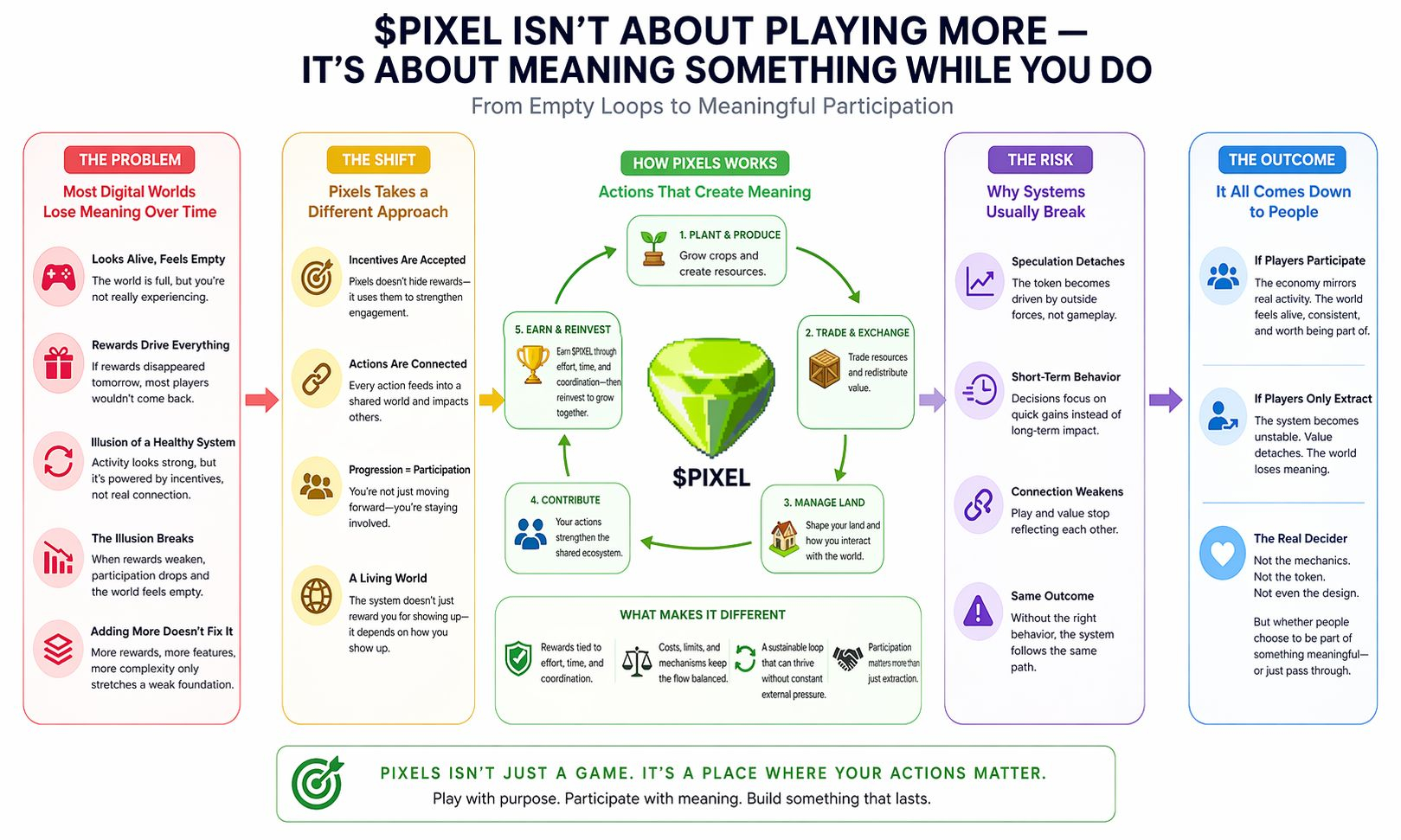
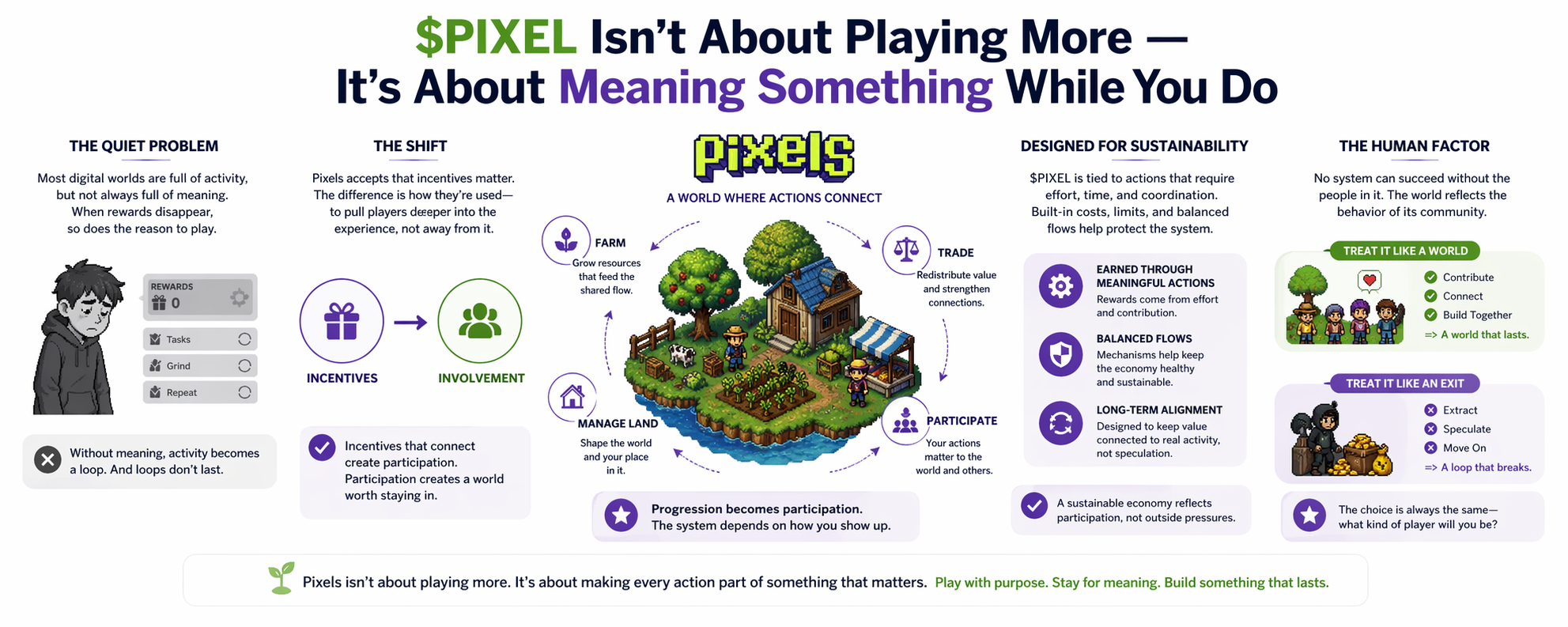
It’s not that they lack activity. It’s that the activity often doesn’t hold any meaning once you strip away what it pays. The moment rewards become the only reason to act, everything else becomes replaceable. The world stops being a place and starts feeling like a loop.
I’ve seen this pattern repeat more times than I can count.
At the beginning, everything feels strong. There’s momentum. Players show up, systems circulate, actions lead to rewards, and rewards feed back into more action. It creates the impression of a healthy ecosystem one where everything is moving in the right direction.
But that impression doesn’t last.
Because over time, something becomes clear. People aren’t really there because they want to be. They’re there because the system is giving them a reason to stay. And the moment that reason weakens even slightly the illusion starts to break. Participation drops. Energy fades. The world that once felt full starts to feel empty almost overnight.
Not because the mechanics failed, but because nothing underneath them was strong enough to hold people in place.
That’s where most systems get it wrong.
They treat the problem like it’s about content, or features, or complexity. So they add more. More rewards. More mechanics. More layers. But that doesn’t fix the foundation it just stretches it thinner. The system becomes heavier, more dependent on constant input to keep moving.
And eventually, it reaches a point where it’s not sustaining itself anymore. It’s being sustained.
That’s why what’s happening with Pixels feels different not because it’s trying to escape this reality, but because it’s willing to work within it.
Pixels doesn’t pretend incentives don’t matter. It doesn’t try to hide them behind layers of design. Instead, it accepts a simple truth: incentives will always shape behavior. The real question is whether they push players away from the experience, or deeper into it.
That shift changes everything.
On the surface, nothing about Pixels feels unfamiliar. You’re still farming, crafting, managing land, trading resources. These are loops players already understand. There’s no attempt to reinvent what people do moment-to-moment.
But the difference isn’t in the actions themselves. It’s in how those actions connect.
Because here, actions don’t exist in isolation. They feed into something larger.
When you plant crops, you’re not just completing a task you’re producing something that enters a shared flow. When you trade, you’re not just extracting value you’re redistributing it. When you manage land, you’re not just holding an asset you’re shaping how you interact with the world and with other players inside it.
Over time, that changes how the experience feels.
Progression stops being a straight path of accumulation and starts to feel like participation. You’re not just moving forward you’re staying involved. The system doesn’t just reward you for showing up; it depends on how you show up.
And that’s where PIXEL becomes more than just a token.
But it’s also where things become fragile.
Because tokens in systems like this tend to follow a very predictable arc. They begin as tools to incentivize behavior. Then they attract attention. Then speculation. And slowly, almost quietly, they start to detach from the very activity they were meant to support.
When that happens, everything shifts.
The economy stops reflecting what players are doing and starts reacting to forces outside the system. Prices move independently of participation. Decisions become driven by short term gain instead of long term involvement. And the connection between play and value begins to weaken.
Pixels seems designed with that risk in mind.
The token isn’t simply distributed for the sake of keeping people engaged. It’s tied to actions that require effort, time, and often coordination. There are costs involved. There are limits. There are mechanisms meant to keep the flow balanced rather than one-sided.
It’s not about flooding the system with rewards. It’s about shaping how those rewards move.
And that’s an important distinction.
Because a system doesn’t become stable just by rewarding people. It becomes stable when the way people earn, spend, and interact creates a loop that can sustain itself without constant external pressure.
That’s what Pixels is trying to build.
Not a system where people show up just to take but one where staying involved actually matters.
Still, no matter how carefully something is designed, there’s one part that can’t be engineered.
People.
Because in the end, every system reflects the behavior inside it.
If players treat Pixels like a world something to participate in, something to contribute to then the design has a real chance to hold. The economy can start to mirror real activity. The experience can start to feel consistent, grounded, alive in a way that isn’t dependent on constant stimulation.
But if players approach it the same way they’ve approached every other system as a place to extract value as quickly as possible then the outcome won’t be any different.
The structure might look better. The loops might feel smoother. But the result will follow the same path.
That’s why Pixels doesn’t feel like a reinvention.
It feels more honest than that.
Like a system that understands where things usually go wrong and is trying, quietly, to correct that course. Not by forcing new behavior, but by making better behavior the one that actually works.
And that’s a harder thing to build than it sounds.
Because it doesn’t rely on novelty. It relies on alignment.
Between what players do… and why they choose to keep doing it.
And in the end, that’s what will decide everything.
Not the mechanics. Not the token. Not even the design itself.
But whether people inside the system choose to treat it like something worth being part of or just something to pass through on the way to something else.