

i have been following crypto gaming economies long enough to have watched the same collapse happen in slow motion more times than i can count and honestly the first time i saw Pixels publish their RORS number openly at 0.8 i had to read it twice because no project in this spAce does that 😂
every other protocol i have tracked either buries the relevant economic health metric inside a governance forum post that nobody reads, presents vanity metrics that look impressive until you understand what they are not measuring, or simply never discloses anything that would let an outside observer evaluate whether the economy is actually sustainable. Pixels published tHe number that exposes the model before it defends it. that posture is unusual enough to be worth examining seriously.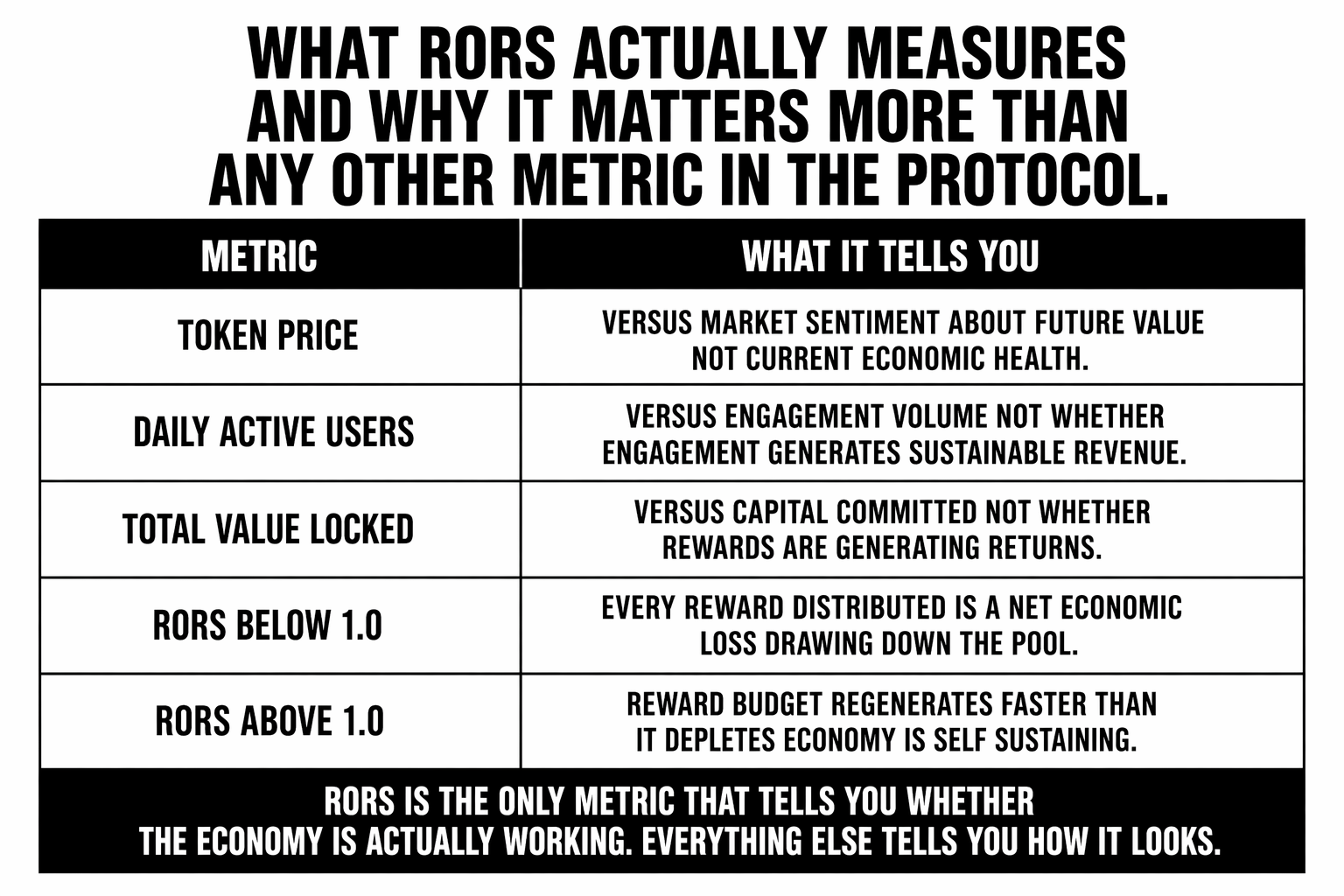
here is what RORS actually measures and why it matters more than token price, DAU counts, or total value locked. Return on on Reward Spend is the ratio of protocol revenue generated back in fees to the total value of rewards distributed to players. at 1.0 the protocol breaks even. every reward token spent generates exactly one unit of fee revenue in return. above 1.0 the economy is self sustaining. the reward budget regenerates faster than it depletes. below 1.0 every reward distributed is a net economic loss that draws down the ecosystem reward pool over time. at 0.8 the current position means for every one hundred units distributed the protocol recovers eighty. the twenty unit gap is being covered by the existing ecosystem reward pool which holds thirty four percent of a five billion capped supply. the math on how long that pool sustains the gap at current emission rates is calculAble and $PIXEL holders should be running it. and the path to closing that gap is precisely what the entire Stacked infrastructure is designed to accelerate....
what bugs me: most coverage of Pixels focuses on token price, staking yields, and game mechanics. almost none of it focuses on the single number that determines whether all of those things remain viable. RORS at 0.8 is not a crisis. it is a stated position on a known trajectory toward a defined target. the team describes surpassing 1.0 as the clear and ambitious goal that solidifies economic sustainability and positions the protocol as the leader in efficient player rewards. but the distance between 0.8 and 1.0 is not trivial. it requires the reward targeting to improve precisEly enough that a meaningfully higher proportion of rewards land on players who generate fee revenue rather than players who extract value and leave. that improvement comes from the AI game economist processing better cross game data and routing rewards with increasing precision. the question is not whether the direction is right. it is whether the improvement rate is fast enough relative to the emission timeline.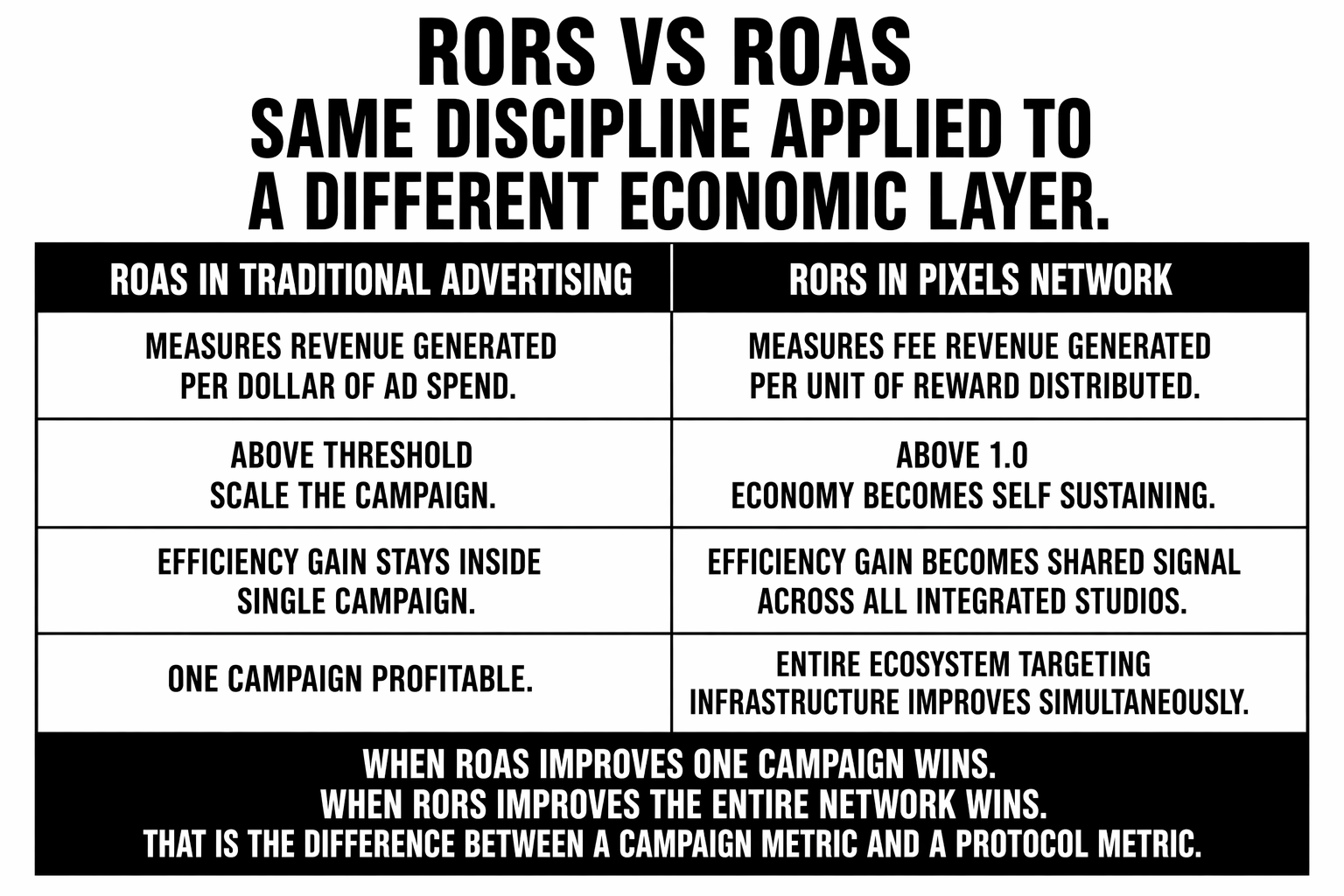
the tokenomics angle nobody discusses: RORS is analogous to ROAS in traditional advertising and the analogy goes deeper than most people take it. Return on Ad Spend measures how much revenue a campaign generates per dollar spent on acquisition. studios running ROAS positive campaigns scale them. studios running ROAS negative campaigns cut them. the entire discipline of performance marketing is built around finding the threshold where spend generates more than it costs and then deploying capital aggressively above that threshold. Pixels is applying exactly that discipline to reward spend inside a live game economy. the difErence is that when ROAS improves in a traditional campaign the efficiency gain stays inside that campaign. when RORS improves inside the Pixels network the efficiency gain becomes shared signal across every integrated studio simultaneously. one protocol crossing 1.0 does not just make one campaign profitable. it improves the targeting infrastructure that every studio in the ecosystem uses. that collective efficiency improvement is what the whitepaper calls the compounding flywheel and RORS is the single number that tells you whether the flywheel is spinning in the right direction.
My concern though:
RORS improvement depends on two variables moving together and neither one is fully in the team's control. the first variable is data quality. better behavioral signal from more games with more genuinely engaged players produces more precise targeting which pushes RORS upward. the second variable is studio quality. games that attract players who spend and retain generate fee revenue. games that attract extractors generate reward costs without corresponding revenue. if the studio pipeline brings in titles that look promising but perform poorly the RORS improvement stalIs or reverses regardless of How sophisticated the targeting infrastructure becomes. the team controls the infrastructure. the community controls the studio selection through staking votes once phase two dynamic pools go live. and right now phase two has not launched. the quality filter the RORS metricss depends on is still being assembled while the metric is already being tracked. that sequencing gap is the most importAnt undisclosed variable in the entire economic model.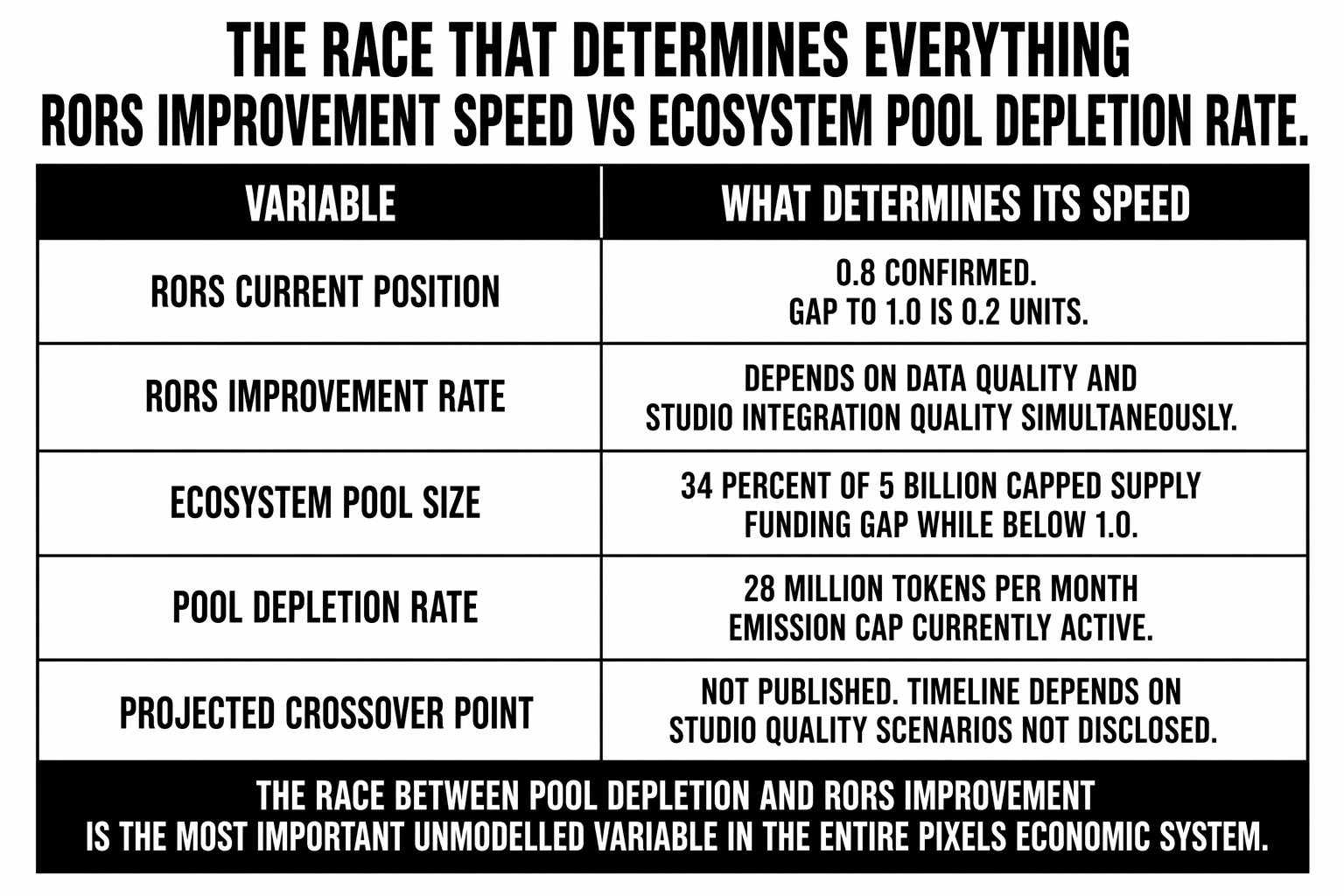
what they get right: publishing RORS openly at a level below breakeven is the kind of transparency that builds durable credibility and almost no protocol does it. the instinct in this space is to release metrics only after they look good. the decision to publish 0.8 while still actively working toward 1.0 signals that the team believes the trajectory is more convincing than the current position. that confidence in the direction rather than the snapshot is a different posture than projects which manage perception by controlling which numbers become visible. for anyone evaluating the long term viability of the ecosystem the published number is more useful than a claim of sustainability that offers no supporting data.
what worries me: the ecosystem reward pool is finite. thirty four percent of five billion tokens is the engine that funds reward distribution while RORS is below 1.0. the rate at which that pool depletes at current emission levels relative to the rate at which RORS is improving toward 1.0 is the race that determines everything. the whitepaper describes the emission schedule and the pool allocation clearly. it do not publish a projected timeline for RORS reaching 1.0 or a sensitivity analysis showing how much the timeline changes under different studio integration quality scenarios. that projection gap means holders are evaluating the race without knowing the current lap times of either competitor.
the three numbers worth tracking alongside RORS are the monthly emission rate from the ecosystem pool, the number of external studios actively contributing fee generating revenue back to the protocol, and any published data on how RORS has moved quarter over quarterr since the 2025 restructuring. those three datapoints together would let an outside observer model the race between pool depletion and RORS improvement with meaningful precision.
honestly dont know if RORS crosses 1.0 before the emission pool faces meaningful pressure or whether the studio quality dependencies and targeting improvement timeline mean the gap stays open longer than the current model assumes.
what's your take take the metric that finally gives P2E economics an honest scoreboard, or a number that is bracingly transparent about the gap without fully disclosing the timeline for closing it??
🤔